China Extends Rare-Earth Export Pause to January
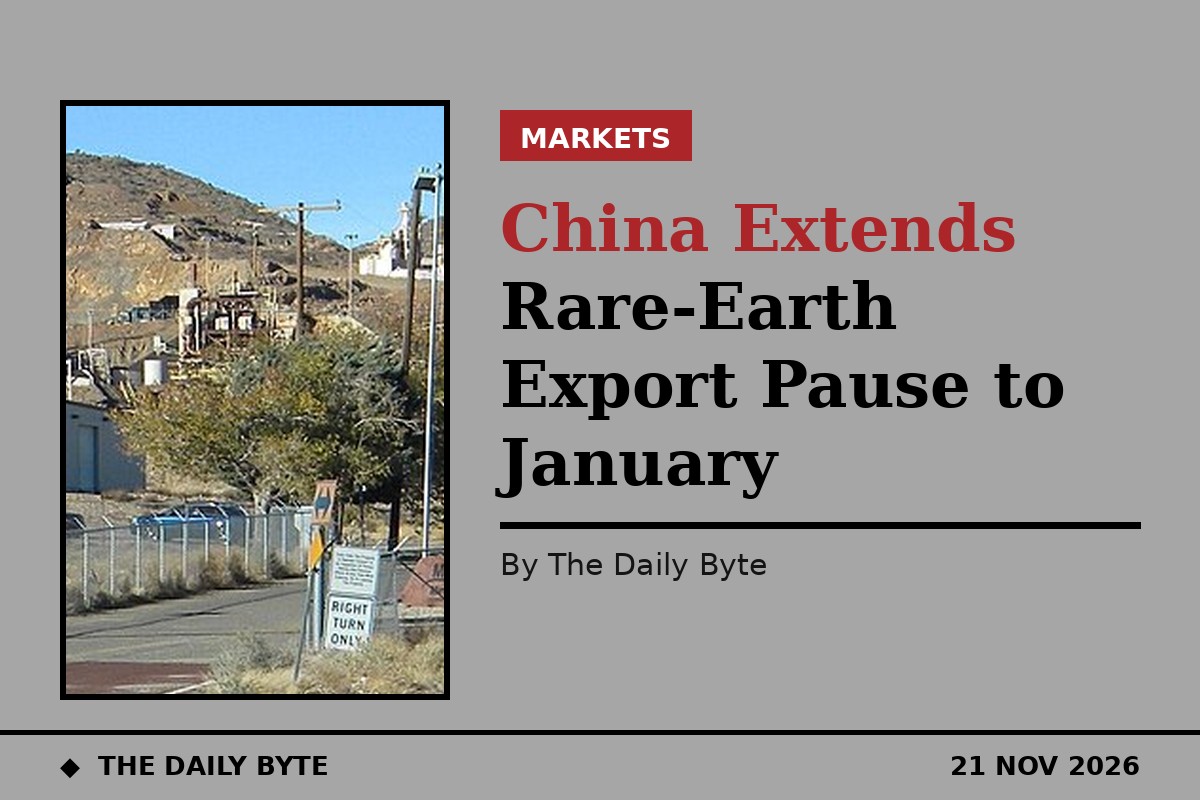
China has extended its pause on expanded rare-earth export controls until 10 January 2027, prolonging a reprieve for makers of magnets, lasers and electric-vehicle parts that had been due to lapse this month.
The extension, set out in a joint announcement from China's Ministry of Commerce and the General Administration of Customs, keeps a lid on the trade dispute that has shadowed global supply chains since Beijing first tightened controls on the critical minerals. It also buys negotiators in Beijing and Washington more time: the pause now runs to the same date as the wider US-China trade truce.
What the extension covers
Under Announcement 2026/58, Beijing is prolonging the suspension of two earlier measures — Announcements 2025/61 and 2025/62 — from 11 November 2026 through 10 January 2027. The suspended controls cover five medium and heavy rare earths: holmium, erbium, thulium, europium and ytterbium, according to Benchmark Mineral Intelligence.
The pause also covers technical restrictions on rare-earth separation, smelting and advanced processing equipment, as well as secondary constraints on high-energy lithium batteries and synthetic graphite anode materials. A 0.1 per cent de minimis rule — which would have caught foreign-made products containing even small amounts of Chinese-origin rare earths — is suspended too.
For manufacturers, the practical effect is continuity. Magnet makers, laser producers and battery supply chains that feared a fresh round of licensing paperwork in November can keep shipping under the existing rules for another two months.
What stays controlled
The extension is a pause, not a rollback. Licensing requirements imposed in April 2025 remain in force on seven other medium and heavy rare earths, including dysprosium, terbium, yttrium, samarium, gadolinium, lutetium and scandium, according to the law firm Pillsbury.
That matters because of the scale of China's grip on the sector. China accounts for more than 70 per cent of global rare-earth extraction and more than 90 per cent of downstream magnet refining, according to EU Today. Even with the pause in place, China's rare-earth exports to the United States are running about 75 per cent below normal levels, according to the Center for Strategic and International Studies — a sign that the licensing regime already in force continues to bite.
A truce with a deadline
The extension forms part of a wider two-month trade détente negotiated by Presidents Donald Trump and Xi Jinping in September. On 9 November, the two sides moved to implement it: China delayed its rare-earth export controls, while the United States extended tariff exclusions on 178 Chinese products and postponed port fees on Chinese vessels, according to the law firm Thompson Hine, citing a US Trade Representative notice in the Federal Register. The year-long truce had been due to expire on 9 November.
Rare-earth flows topped the agenda when Trump and Xi met in Shenzhen on 18–19 November, according to MiningSee. The truce agreed in Busan in October 2025 had cut tariffs from peaks of 145 per cent on Chinese goods and 125 per cent on US goods; it has now been extended beyond its original 10 November expiry and is due to lapse on 10 January 2027.
The calendar from here is tight. Customs authorities implement the extension through November, bilateral consultations are scheduled for December, and the pause expires on 10 January. In the first quarter of 2027, EU and US defence procurement rules are set to prohibit Chinese-origin rare-earth magnets in new military and aerospace hardware — a deadline that gives Western buyers a clear incentive to use the breathing space to diversify supply while it lasts.