China Factory Output Slows to Weakest in Over a Year
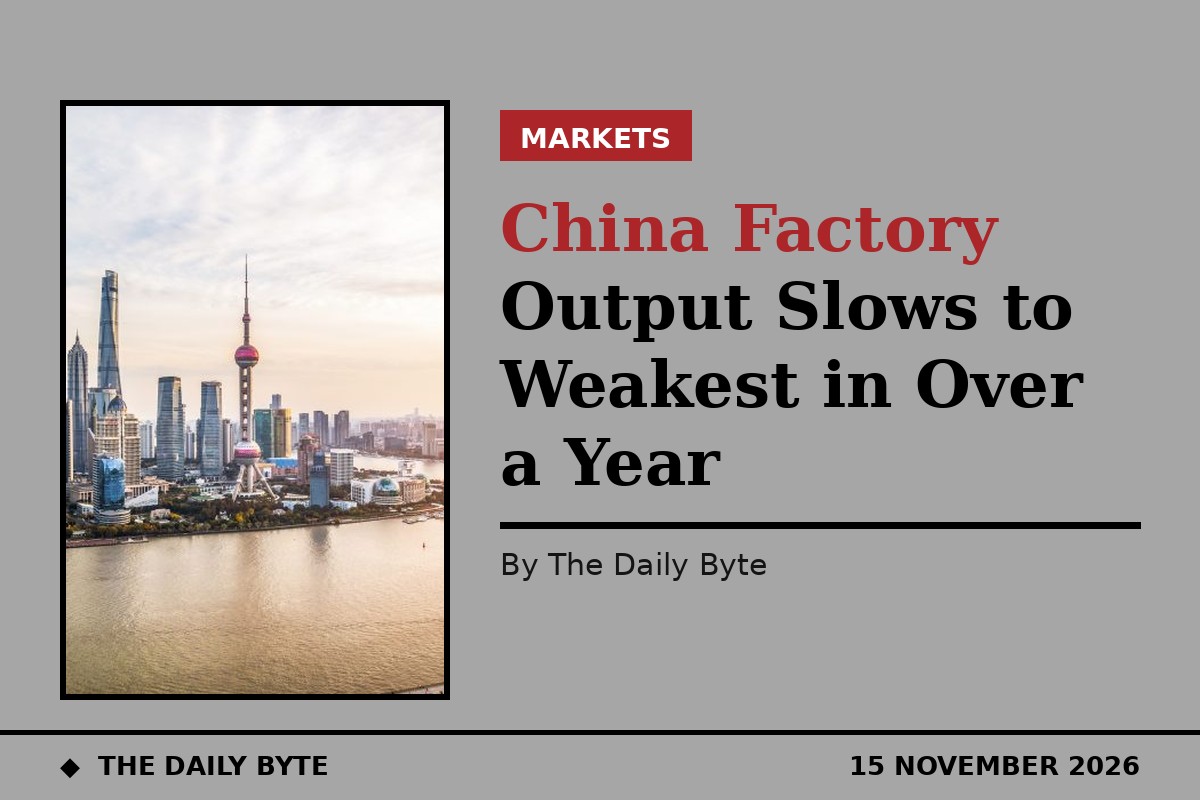
China's factory output and retail sales both grew at their slowest pace in more than a year in October, official data showed on Friday 13 November 2026, as a broad slowdown deepened across the economy and investment fell by the most since 2020.
Industrial production rose 4.9% from a year earlier, easing from a 6.5% increase in September and falling well short of the 5.5% gain expected by economists, the National Bureau of Statistics said. It was the lowest rate of growth since August 2024. Manufacturing activity growth fell to 4.9% from 7.3%, while mining output rose 4.5% after growing 6.4%, with the Golden Week national holiday thought to have weighed on activity during the month.
Retail sales totalled 4.629 trillion yuan in October, up 2.9% over last year. Fixed asset investment over the first ten months of the year totalled 40.891 trillion yuan, down 1.7% from a year earlier, after a 0.5% decline over the first nine months.
Investment slump deepens
The investment figures were the weakest part of the release. A 1.7% fall over the first ten months of the year is the biggest drop in year-to-date terms since 2020, and the deterioration from the 0.5% fall recorded over the first nine months shows the drag intensifying rather than easing. Weak investment by businesses and local governments has become the central concern for economists watching China, because it points to falling confidence about future demand.
Factory output told a similar story. The slowdown was broad, hitting manufacturing and mining alike, and it came despite Beijing's efforts to support industry. The Golden Week holiday, which fell in October, explains part of the softness, but not the scale of the miss against forecasts.
Consumers stay cautious
The car market, long a bellwether for Chinese household spending, underlined the caution. Nationwide passenger car retail sales fell 25% year on year in October to 1.693 million units, according to the China Passenger Car Association. New-energy vehicle retail sales fell 10% to 1.148 million units, although their share of the market hit a record 67.8% as persistently high oil prices pushed buyers away from petrol cars.
Exports told the opposite story. Passenger car exports jumped 68.5% year on year to 928,000 units, with exports of electric and plug-in hybrid cars more than doubling. Carmakers are increasingly relying on overseas buyers to offset weak demand at home, a pattern visible across much of Chinese manufacturing.
Tesla's experience captured the split. Its Shanghai factory wholesaled 67,829 vehicles in October, up 10.3% year on year, but 59,012 of those were exports, leaving only 8,817 cars for Chinese buyers, down 66% from a year earlier and the weakest domestic month since 2022.
Surveys split on the outlook
Business surveys offer a mixed picture. The official manufacturing purchasing managers' index fell below 50 in October, to 49.3, signalling contraction. The private RatingDog survey, compiled by S&P Global, eased only slightly to 52.0, with output growing at its fastest pace since April and new orders rising for a 17th consecutive month. The gap between the two reflects their different samples: the official survey covers 3,200 manufacturers, while RatingDog polls around 650, weighted towards smaller private firms.
The data piles pressure on Beijing. Third-quarter GDP grew 4.5% year on year, and consumer prices rose 0.7% in October, so the economy is not in freefall. But with factory output at its slowest in over two years, retail sales barely growing and investment falling, the case for further stimulus is strengthening. Markets will now watch for the policy response, and for November's data, to judge whether October was a holiday-affected dip or the start of a deeper slowdown.
Sources: QNC News and Lloyds Bank, reporting Sharecast, both citing China's National Bureau of Statistics, 13 November 2026.