China Factory Prices Jump 5.7% as Consumer Inflation Eases
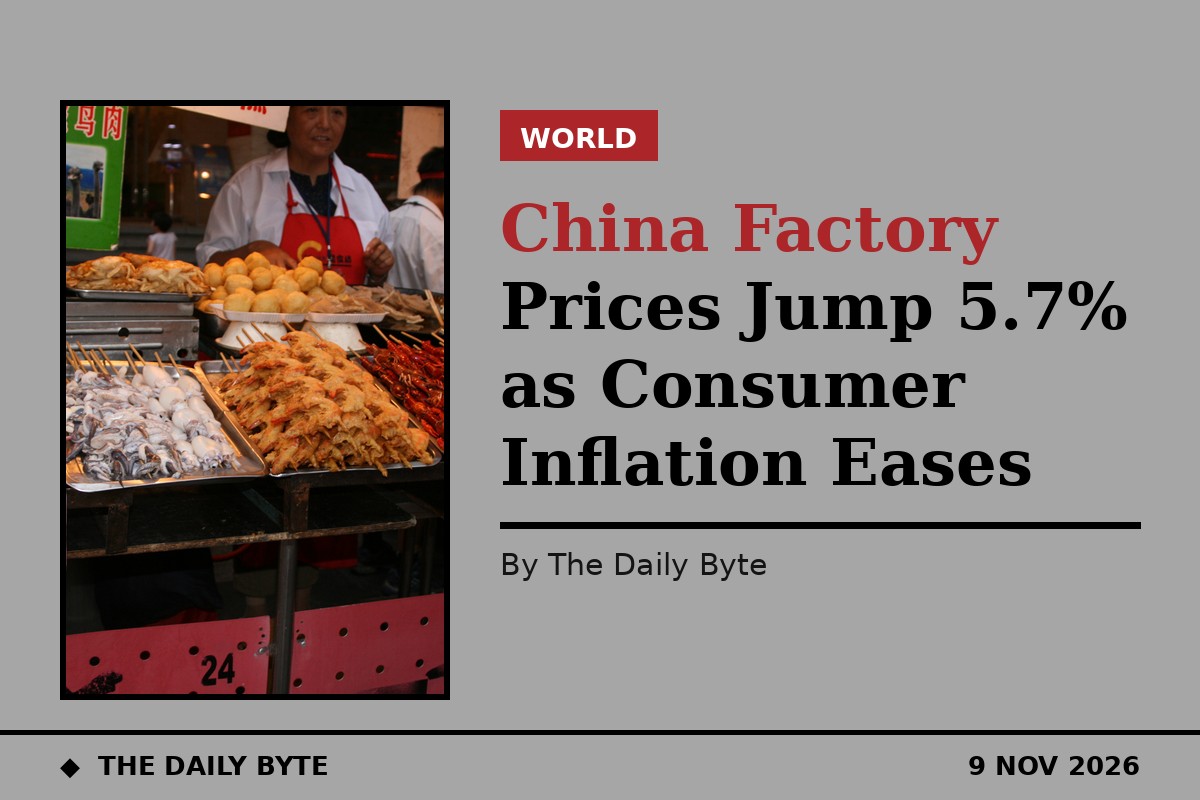
China's factory-gate inflation rose to its fastest pace in more than four years in October, while consumer price growth slowed, official data showed on Monday, 9 November.
The producer price index rose 5.7% from a year earlier, the National Bureau of Statistics said, up from 5.0% in September and above the 5.3% rise economists had expected in a Reuters poll. It was the sharpest increase since June 2022, and the fastest pace in nearly four and a half years.
Consumer prices rose 0.7% year on year, down from 0.9% in September and just below the 0.8% forecast. Prices were unchanged from September, after a 0.2% monthly rise the month before. In the first ten months of 2026, consumer prices rose 0.9% from a year earlier, the bureau said.
Food prices pull consumer inflation lower
Food prices fell 2.9% from a year earlier, a steeper drop than in September, and were the main force holding consumer inflation down. Fresh vegetable prices fell 16.9% and pork prices fell 8.6%. The bureau's chief statistician for urban surveys, Dong Lijuan, said food prices pulled the year-on-year consumer rate down by about 0.49 percentage points.
Non-food prices rose 1.5%, and petrol prices rose 22.4% from a year earlier, adding about 0.63 percentage points to consumer inflation. Core consumer prices, which exclude food and energy, rose 0.8%, down from 1.0% in September, offering a gauge of underlying price pressures in the economy.
The consumer price index is the main gauge of inflation for households, tracking the prices of goods and services bought by consumers. The producer price index tracks the prices factories receive for their goods, and is watched as an early sign of cost pressures working through the economy.
Energy costs drive factory prices higher
The bureau linked the factory-price rise to higher energy costs, with prices for coal, oil and gas climbing. Producer prices rose 0.7% from September, a slower monthly increase than the month before, but the year-on-year rate still widened by 0.7 percentage points from September.
The gap between producer and consumer inflation has now widened to around five percentage points, underlining the difference between cost pressures on factories and weak demand from households. Higher oil prices have pushed up costs for producers, while soft domestic demand has kept consumer prices subdued.
What happens next
Attention now turns to October trade figures, due on Tuesday, which will show whether export strength can continue to offset soft domestic demand. Credit and money-supply figures are due later in the week, and will give a further reading on the state of the world's second-largest economy.