China MQ-25-Like Drone Spotted at Test Site
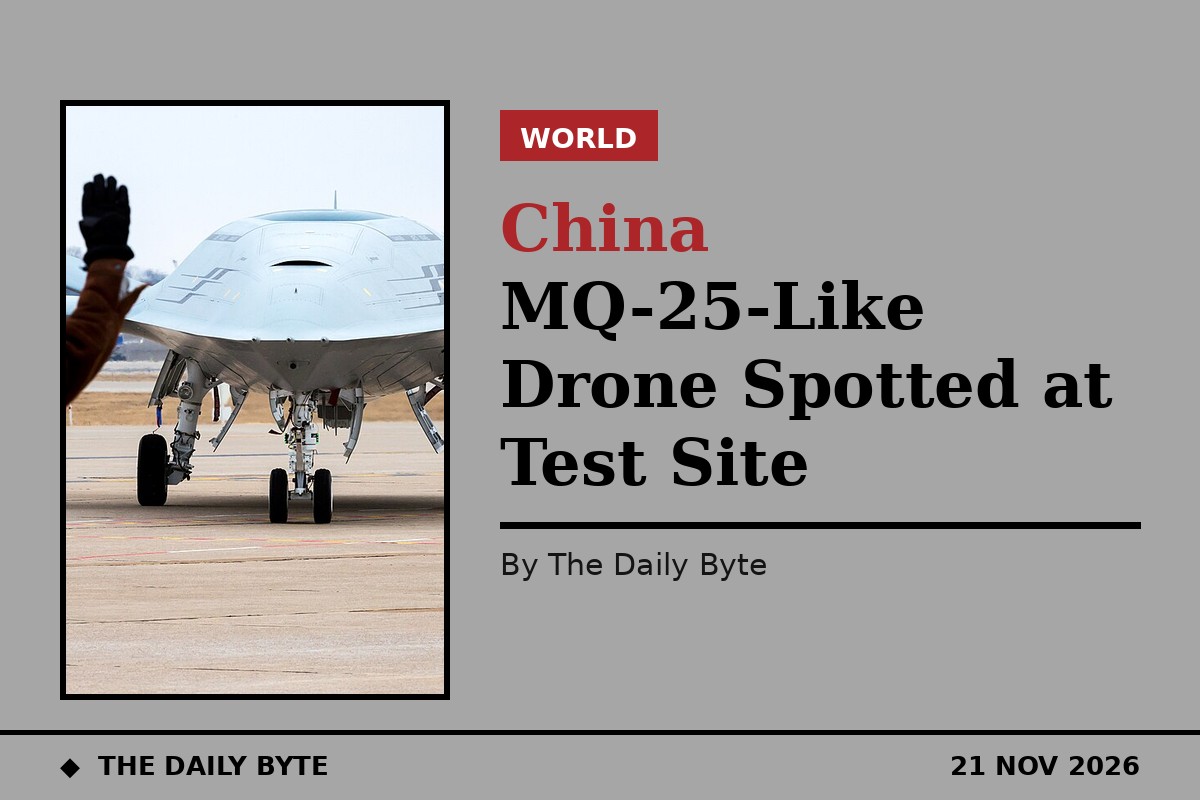
Satellite images have revealed an unidentified uncrewed aircraft at a flight test site in north-west China, in a design that closely resembles the United States Navy’s MQ-25 Stingray carrier-based drone.
The aircraft was photographed at Pucheng Neifu Airport in Shaanxi province. The images, obtained by the defence publication The War Zone from satellite provider Vantor, are dated 23 April 2026, but were only published on 20 November, after the aircraft was first noticed in publicly available mapping imagery.
Vantor measured the aircraft at about 66 feet across the wings and 49 feet long, roughly a fifth smaller than the MQ-25, which measures about 75 feet by 51 feet. It is finished in yellow primer, with coloured markings along the trailing edges of its wings and tail.
What the images show, and what they do not
The most obvious comparison is with the MQ-25, the US Navy’s carrier-based uncrewed tanker. But analysts who have studied the images stress the differences as much as the similarities. The Chinese aircraft has a more tapered nose, possibly housing a radar, where the MQ-25 has a flattened, shovel-like front end. Its engine intake sits on top of the fuselage and appears serrated, possibly splitting into two channels, rather than the MQ-25’s flush inlet. The tail is a laterally flared V-shape, as on the Stingray.
What the aircraft is for remains unknown. No aerial refuelling pod is visible under its wings, which would have been a strong sign of a tanker role, and the images alone cannot settle whether it is meant to refuel other aircraft, gather intelligence, carry weapons, or fly alongside crewed jets. Andreas Rupprecht, a long-standing observer of Chinese military aviation, told The War Zone that China could be following a similar path to Boeing, developing a tanker that can also take on surveillance work, but he cautioned that the manufacturer has not been identified.
One possible clue points to Shenyang Aircraft Corporation, which unveiled a smaller propeller-driven demonstrator with a similar layout in 2025. Whether the two aircraft are linked is unconfirmed, and the Pucheng aircraft could equally be a general test platform with no direct connection to that programme.
A growing test hub for Chinese drones
The same April imagery shows two other Chinese drones at Pucheng: the CH-7 stealthy flying-wing drone and the heavyweight jet-powered Jiutian mothership drone. The site was little known to outside observers until the past year or two, but several manufacturers now appear to be testing there, and Rupprecht has suggested it could be a dedicated uncrewed-aircraft branch of China’s Flight Test Establishment at Xi’an.
The sighting fits a wider push to put uncrewed aircraft aboard China’s warships. In October 2026 Chinese state media reported that the GJ-21 naval combat drone had completed its first takeoff and landing aboard the large-deck vessel Sichuan. China’s new catapult-equipped carrier Fujian has also begun operating the J-35 stealth fighter, the J-15T carrier fighter and the KJ-600 early warning aircraft.
For now, the Pucheng images offer only a glimpse of a possibly significant new programme. The photographs are seven months old, the aircraft has not been seen flying, and Beijing has said nothing about it. Its purpose, and whether it will ever operate from a carrier, remain open questions.


