China renews Arunachal claim as border stays stable
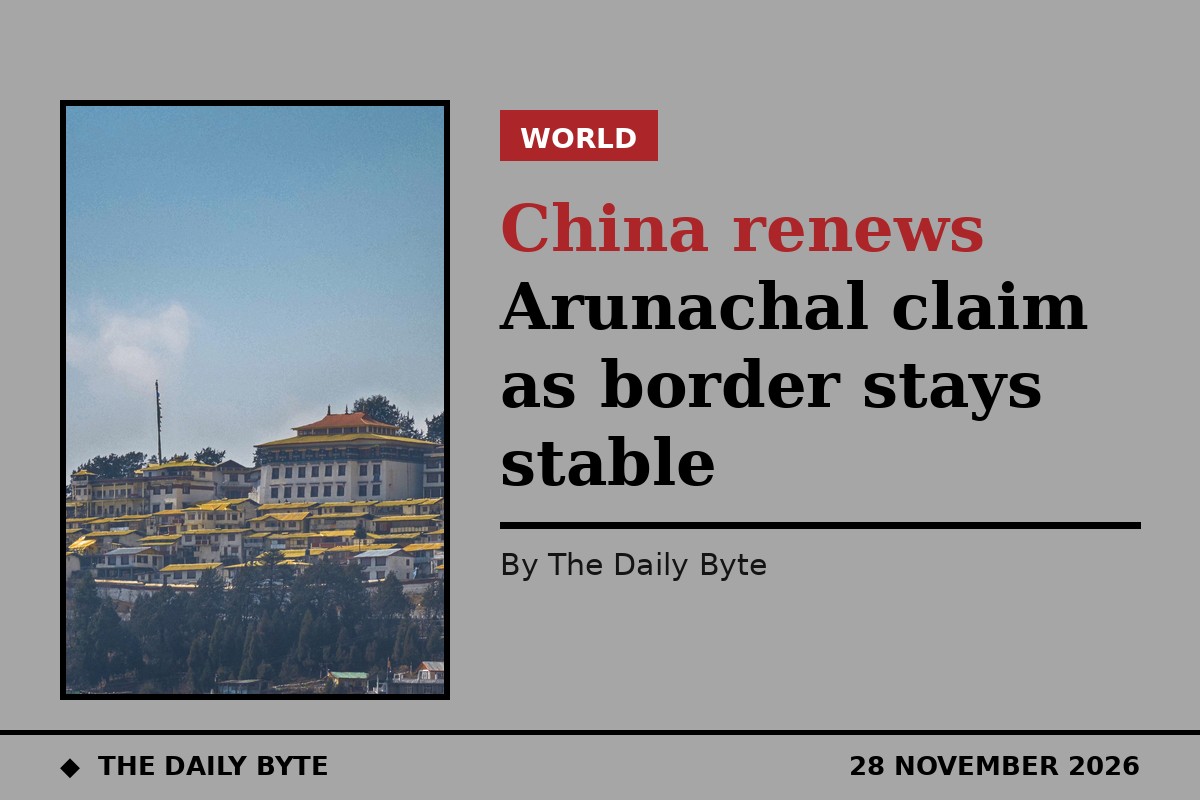
China has restated its claim to Arunachal Pradesh, calling the Indian state by the Chinese name Zangnan, while at the same time describing the situation along the disputed border as generally stable. The two messages came in a single briefing from the Chinese defence ministry on Thursday, and they capture the dual track Beijing has followed for years: firm on sovereignty, careful to keep the frontier calm.
Senior Colonel Chen Xi, spokesperson for China's Ministry of National Defense, told the ministry's monthly press conference that the Zangnan region is China's territory and that Beijing does not recognise what he called the Arunachal Pradesh illegally set up by India. He was answering a question about reports that senior Chinese and Indian military officials had held high-level talks this month in the eastern sector of the border.
Border described as stable
Chen said the situation in the border areas between China and India remains generally stable. He said the two countries were maintaining communication through diplomatic and military channels, including general-level talks, to carry out the consensus reached by both sides and safeguard peace and tranquillity along the frontier.
His remarks came a day after India's Ministry of External Affairs said a meeting of senior military commanders had been held in the eastern sector recently. The ministry's spokesperson, Randhir Jaiswal, said India and China engage regularly through diplomatic and military mechanisms, and that such exchanges are aimed at maintaining peace and preventing escalation.
The latest round of commander-level talks followed reports of aggressive posturing by Chinese troops along the Line of Actual Control in Arunachal Pradesh, particularly in the Upper Subansiri region, and is believed to have run over several days. Senior commanders from the two armies also held flag meetings in two sessions in the Arunachal sector in September.
A dispute that outlasts each round of talks
China calls Arunachal Pradesh, a state in India's north-east, Zangnan, and claims it as part of South Tibet. India has consistently rejected the claim, maintaining that Arunachal Pradesh is an integral and inalienable part of the country. The disagreement over the roughly 3,500-kilometre frontier has persisted for decades, despite repeated rounds of talks.
The two sides have built a set of mechanisms to keep local friction from escalating. At the 25th round of talks between their Special Representatives on the boundary question, held in Beijing on 25 August, they agreed to strengthen border management, address situations on the ground through existing diplomatic and military channels, and avoid misunderstandings and miscalculations along the Line of Actual Control.
That round produced eight points of agreement, including two additional meeting points for general-level talks and two new border military hotlines in the eastern and middle sectors. The Chinese foreign ministry said in October that China strictly abides by the relevant agreements and carries out normal patrol and control activities to safeguard its territorial sovereignty and stability in the border areas.
Dialogue continues alongside the claim
Analysts quoted in Chinese state media read the latest exchange as a signal that Beijing's position on sovereignty remains firm, while keeping dialogue open remains a shared understanding between the two sides. Qian Feng, director of the research department at Tsinghua University's National Strategy Institute, told the Global Times that the two sides have continued to use existing meeting mechanisms as a pressure valve to ease tensions.
For now, the pattern holds: public restatement of the claim, official-level contact to manage the border, and no change in either side's stated position. The next test will be whether the commander-level channel produces any concrete step on patrolling or disengagement in the eastern sector, where the latest reports of friction arose.


