Chinese giants sought 1.1m Nvidia chips for Asia
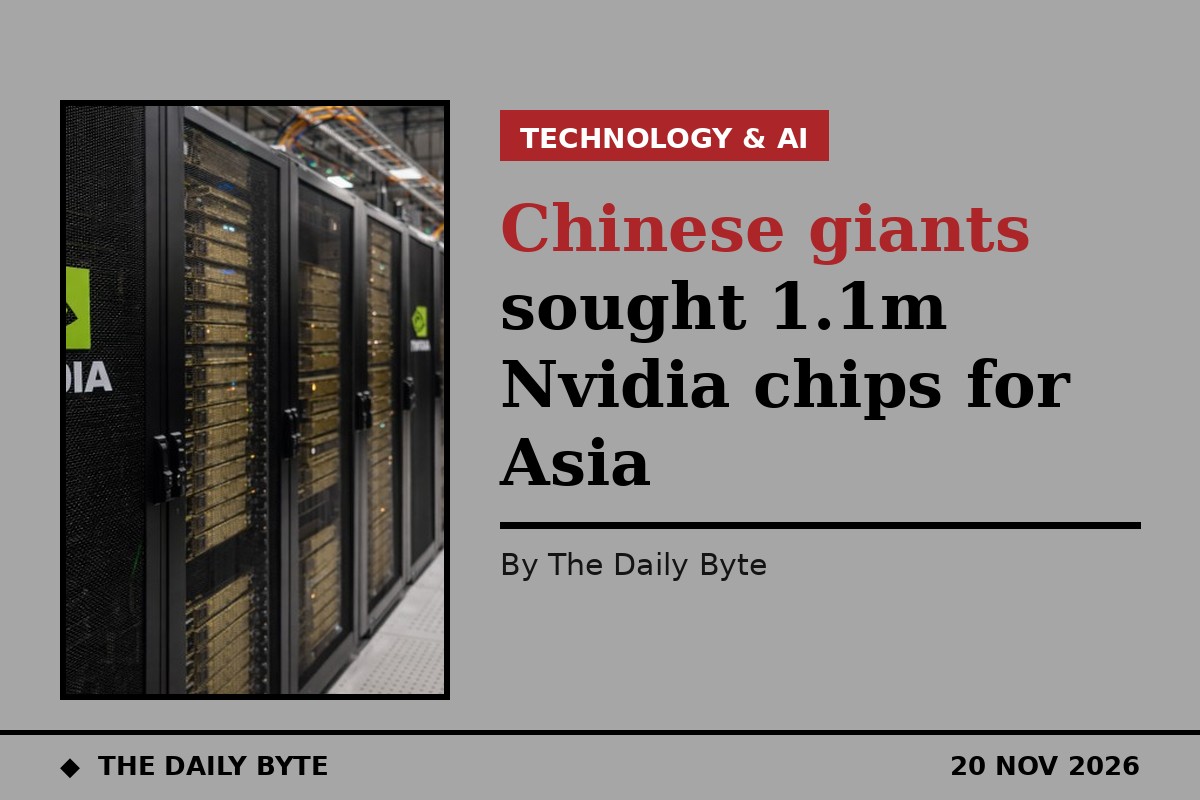
ByteDance and Alibaba sought United States approval to send more than 1.1 million Nvidia AI chips to data centres in Malaysia, Indonesia and Thailand, according to export licence records reported by Digitimes on Friday.
The two Chinese technology groups wanted the chips for facilities in Southeast Asia rather than for shipment directly into China, where Washington has restricted sales of advanced Nvidia hardware since 2022. The licence records show the scale of the demand: well over a million chips destined for three countries that have become the region's main offshore computing hubs.
The disclosure lands in the same week that the US Commerce Department moved to close the route the requests relied on. On Monday 16 November, it issued an interim final rule requiring licences before advanced chips can be supplied to data centres in Malaysia, Singapore, Indonesia, Thailand and Brazil, and before overseas facilities can provide large volumes of computing power to companies based in countries judged high-risk, including China.
New US rules changed the calculation
Until this week, renting computing power abroad sat in a grey area. Export controls stopped the most advanced Nvidia chips being shipped directly to China, but Chinese companies could legally rent the same hardware in a data centre in another country and use it remotely over the internet. That gap turned Malaysia, Indonesia, Thailand and Singapore into busy offshore bases for Chinese AI work.
The new rule treats remote access much like a physical export. Data centre operators must now obtain a US licence before supplying a significant volume of advanced computing power to restricted customers, and exports of designated advanced chips to the five named countries require individual licences because Washington judges them to pose a higher-than-normal risk of diversion. The rules take effect in 90 days, giving operators and their customers a short window to adjust.
Governments across the region have been scrambling to assess the impact. Malaysia has said it will not be used to get around export controls, Indonesia said it was seeking industry input, and Singapore said it was studying the measures carefully. Thailand's central bank said the rules would create additional difficulties but that the overall economic impact had yet to be assessed.
Why Southeast Asia became the hub
The scale of the offshore build-out is striking. The Institute for Progress, a US think tank, estimated in October that Chinese companies could have access to about 1.05 million H100-equivalent chips in overseas data centres by the end of 2026, with about three-quarters of that capacity in Southeast Asia. Bloomberg reported that Singapore cloud operator Megaspeed alone imported at least $4.6 billion of Nvidia equipment between 2023 and November 2025, much of it deployed in Malaysia and Indonesia.
ByteDance has been one of the biggest customers for that capacity, anchoring billions of dollars of hardware in Malaysia, while Alibaba has planned to use Nvidia-powered servers at a site in Senawang. Both companies need vast computing power to train and run their AI models, and the Southeast Asian route offered a lawful way to reach hardware they could not buy at home.
Nvidia itself is still assessing the fallout. Interim chief executive Colette Kress told analysts this week that the company was evaluating the new rules and had not quantified their effect on its Southeast Asia business, although she said strong demand for its newer Vera Rubin chips meant the rules would have no impact on overall revenue.
Alibaba looks homeward
Digitimes also reported on Friday that Alibaba plans to increase its reliance on domestically developed AI chips as the tighter US restrictions threaten its access to advanced Nvidia hardware overseas. The shift underlines how the controls are pushing China's largest technology companies towards home-grown alternatives, even though those chips still lag Nvidia's best hardware for the most demanding AI training.
China's leading AI companies are expanding domestic computing capacity in parallel. Digitimes reported that they are converging on Ulanqab, in Inner Mongolia, in a race to build a major computing hub by 2028, a response both to export controls and to growing restrictions on remote computing.
What happens next
Whether the 1.1 million chips ByteDance and Alibaba sought will ever reach Southeast Asia now depends on the licence process the new rule created. Each shipment to the five named countries needs individual approval, and data centre operators must also seek permission before selling large volumes of computing power to Chinese customers.
For Nvidia, the stakes are commercial as well as political. The licence records show demand from Chinese customers running into the millions of chips, but Washington's direction of travel is clear: the offshore route that carried that demand is being narrowed, and the companies that relied on it are already planning for a world in which they must make do with less.


