Chiquita Canyon Families Housed Until December 3
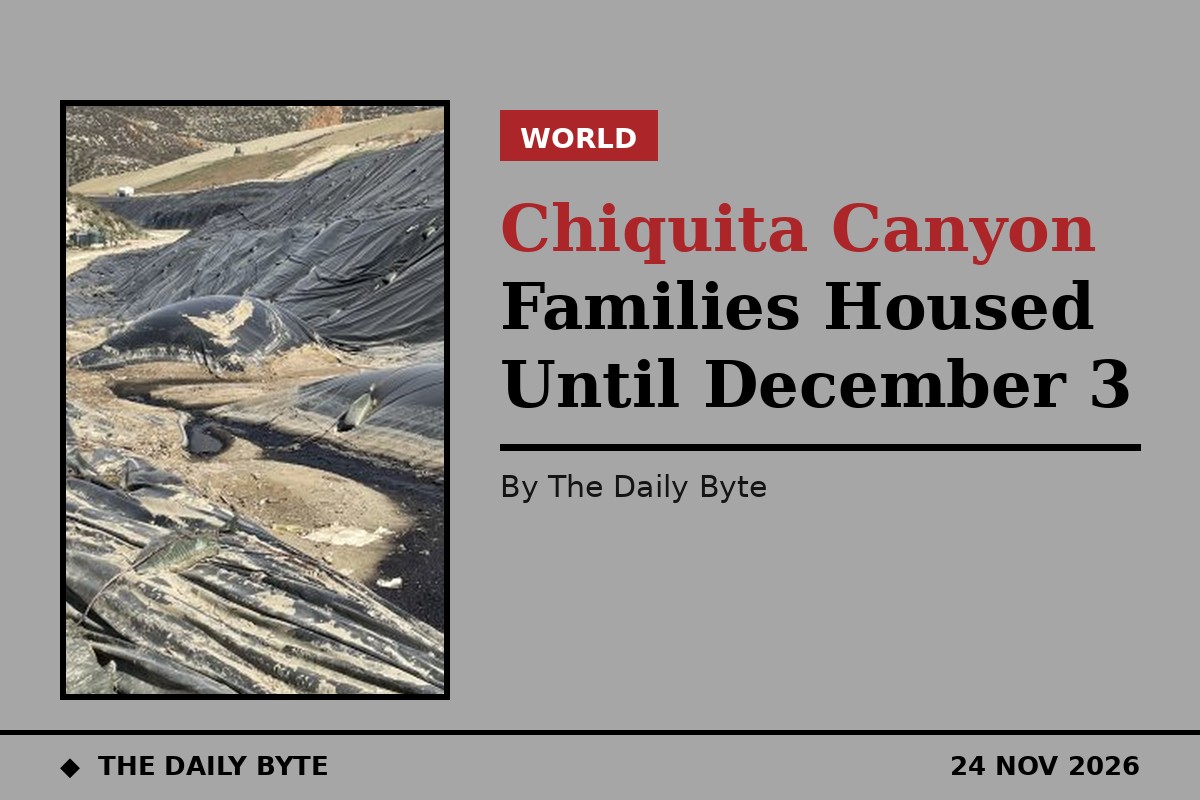
Families forced from their homes by a gas eruption at Chiquita Canyon Landfill in Castaic, California, will be given free hotel rooms until 3 December, after the landfill agreed on Monday to extend the stays through Thanksgiving.
The extension was announced on Monday, following pressure from Los Angeles County Supervisor Kathryn Barger and a directive from the county Department of Public Health. The landfill had originally offered three free nights to residents of Val Verde and Hasley Hills, then extended that by three more nights, with families due to check out on Monday morning before the latest extension was agreed.
“This is the responsible thing to do, especially while families are still waiting for answers about the potential health impacts of last week’s incident,” Barger said in a statement. “Residents should not have to worry about losing access to a safe place to stay while testing continues.”
The incident happened at around 4pm on Monday 16 November, when a drilling crew installing a new gas well at the landfill struck a pocket of pressurised methane about 150 feet underground. Gas and debris erupted through the borehole, sending a dark plume hundreds of feet into the air above the site in the 29200 block of Henry Mayo Drive. Fire crews were first sent to the scene on a report of a structure fire, but found no fire. The release was capped just after 10pm that night.
Six workers were treated at the scene and four were taken to hospital as a precaution, according to the county fire department. None was seriously injured. Evacuation advisories were issued for five nearby zones — Val Verde, Hasley Hills, Hillcrest, Cambridge and Industry — and were lifted later that night.
Residents reported headaches, scratchy throats and dizziness after the release, and some said their vehicles were coated with specks of dark material. Jennifer Elkins, a mother of three who lives about 1,500 feet from the landfill, told the California Post that her family left as soon as they saw the eruption and spent the following week in a hotel, unsure where they would be for Thanksgiving.
Cher Arabalu, a 58-year-old retired sheriff’s captain, said she moved to a hotel along with about 100 other families, describing the experience as “our worst nightmare” and “terrifying”. With Thanksgiving falling on Thursday 26 November, many displaced families still do not know where they will spend the holiday.
Air monitoring carried out during and after the release has not found an exceedance of any short-term exposure limits, according to the US Environmental Protection Agency, and county health officials have said the available data did not indicate a need for broader community-wide emergency protective actions. Twelve monitoring stations are taking hourly measurements for hydrogen sulfide, methane, benzene and other volatile compounds.
Even so, residents are still waiting to learn exactly what was released. Barger has urged the state Department of Toxic Substances Control to speed up its testing of material from the geyser, saying a week on, “residents are still waiting to understand what was released and whether there are potential health or environmental impacts”.
Assemblywoman Pilar Schiavo, whose district covers the landfill, told reporters on Monday that a fire burning underground at the site had reached 275 degrees Fahrenheit and could take up to 20 years to extinguish. She has repeatedly criticised the county and its health officials for not doing enough over the years to regulate the landfill, and has publicly called for the leaders of the county Department of Public Health to be dismissed.
The landfill, a 639-acre site that has served Los Angeles County since 1972 and stopped accepting waste on 1 January 2025, has been dealing with a subsurface elevated temperature event since about May 2022. The reaction has driven up leachate production and odour complaints — residents reported almost 6,800 odour complaints in 2023 — and regulators have issued more than 100 notices of violation. California’s attorney general sued the landfill’s owners last month, alleging repeated hazardous waste violations.
On 18 November, local, state and federal agencies formed a rapid response team to deal with the health and environmental effects of the pressure release. The EPA has ordered the landfill to stop all new vertical well drilling beyond 100 feet deep until a mitigation plan to prevent future releases is approved.
County department heads are due to give a full report on the incident to the Board of Supervisors on Tuesday. In the meantime, pre-paid rooms are available at four hotels in Valencia, and a relief centre at the Embassy Suites Valencia is offering help to residents of Castaic and Val Verde. Residents finding debris were advised to avoid dry sweeping and to wash their hands afterwards.


