Choi Kyo-jin resigns over South Korea AI exam cheating row
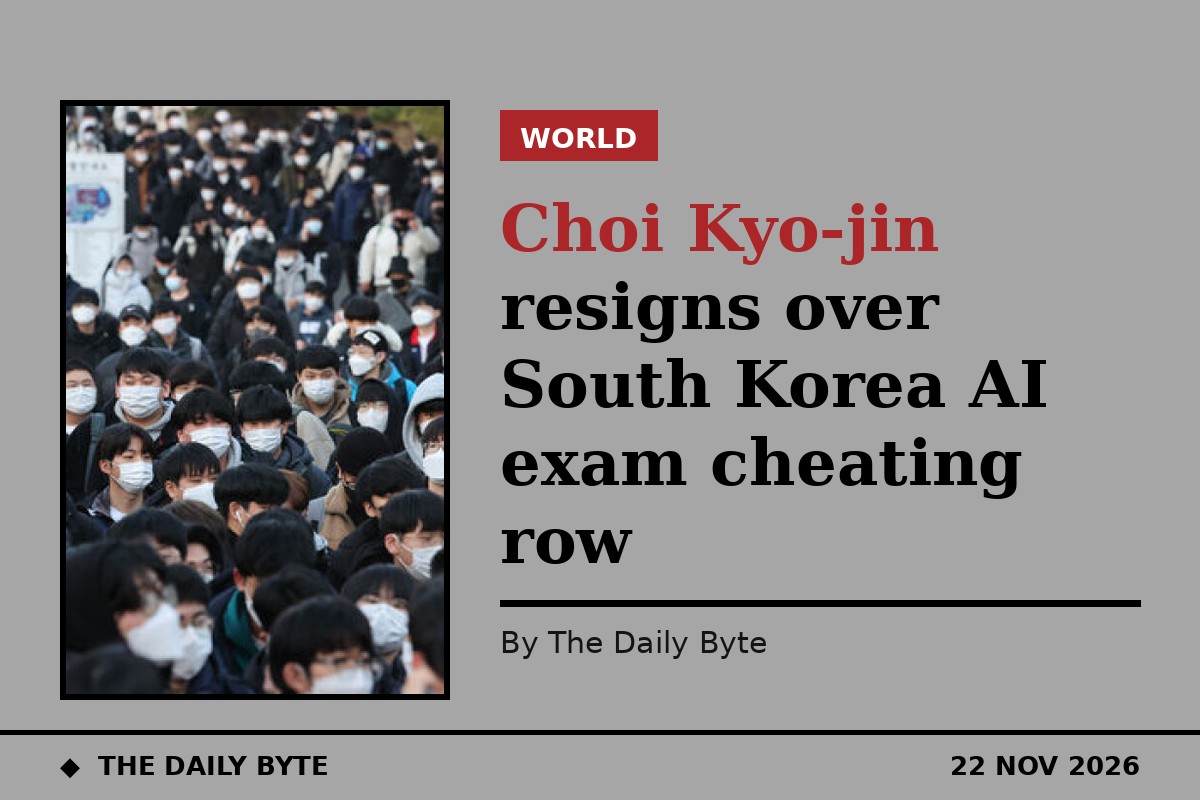
South Korea's Education Minister Choi Kyo-jin has resigned after last-minute measures against cheating assisted by artificial intelligence threw preparations for the country's national college entrance exam into turmoil. President Lee Jae Myung accepted the resignation on Sunday, 22 November, within about an hour of it being offered.
Choi, 72, said in a statement released through the Ministry of Education that he felt keenly responsible now that the exam was over. "Now that the CSAT is over, I keenly feel responsible and am offering my resignation," he said, referring to the College Scholastic Ability Test, known in Korean as the Suneung.
What triggered the crisis
The crisis began on 15 November, four days before the exam, when the top scorer in this year's certified tax accountant examination admitted cheating with a miniature camera, a smartphone and generative AI to secure a near-perfect score. With the Suneung only days away, the Education Ministry, which had focused its planning on smart glasses, rushed out a series of extra safeguards that changed repeatedly in the final days.
The new measures included stickers to cover clothing buttons, tighter inspections of glasses and watches, limits on the writing tools candidates could bring, the blocking of public Wi-Fi around test centres, and emergency mobile alerts sounded at maximum volume during the exam to expose concealed phones.
Choi's standing had already been damaged at a parliamentary hearing on 16 November, three days before the exam, when he was asked whether he could be confident of catching all AI-assisted cheating. "I don't think that I can," he replied. "Because of my age." He was largely absent from ministry briefings in the final days, leaving Vice Minister Choi Eun-ok to announce the measures while Prime Minister Han Seong-sook stepped in to oversee the response.
111 suspected cheating cases detected
The exam itself was held on Thursday, 19 November, with around 550,000 candidates sitting the nine-hour test that largely decides which university a student can attend. The ministry said on Friday that 111 suspected cases of cheating with electronic devices had been detected, including 54 traced to the emergency alerts, 52 involving possession or Wi-Fi signals, and five involving actual use of smart glasses, miniature cameras or smartphones.
President Lee wrote on X after accepting the resignation that concerns over cheating that exploits AI were spreading beyond the CSAT to essay-based admission exams and school tests. "The fairness of exams is a principle that can never be compromised," he wrote, adding that he would order a review of plans to add identification marks to question papers so their source can be identified if they are photographed or leaked.
What happens next
The presidential office said the choice of a new education minister would follow due procedure, and instructed Prime Minister Han to take charge of follow-up measures for the exam. The ministry plans to decide final disciplinary action for the 111 detected cases through its cheating review committee before CSAT results are announced on 11 December.
The resignation is believed to be the first time a cabinet minister anywhere has stepped down over AI-assisted cheating in a national exam, underlining how quickly cheap cameras, smartphones and generative AI have outpaced the safeguards around high-stakes testing. South Korea treats the Suneung as a national event: flights are grounded during the listening section, financial markets open late, and military exercises are halted while candidates sit the test.


