Christie's Pulls Frida Kahlo Painting After Mexico Protest
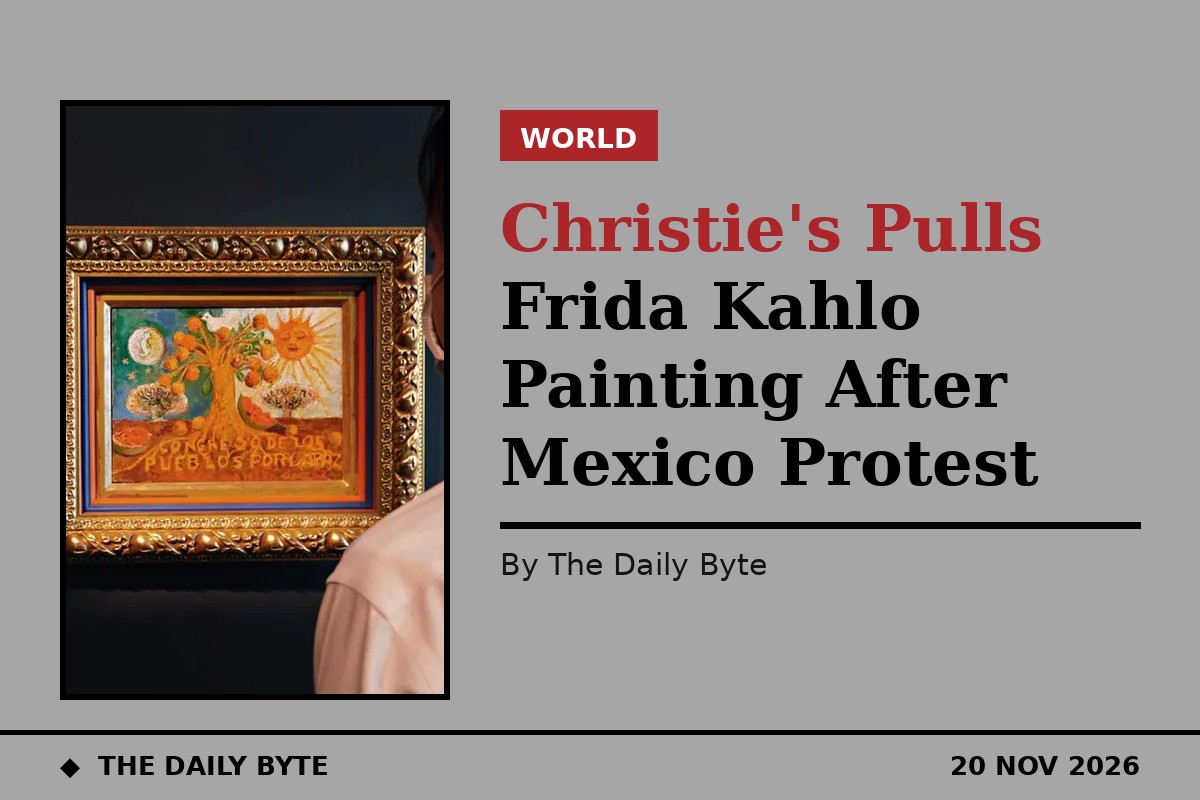
Christie's has withdrawn a Frida Kahlo painting from auction in New York hours before it was due to go under the hammer, after Mexican authorities asked for more information about how the work left Mexico. The auction house confirmed the withdrawal on Thursday 19 November, pulling the 1952 painting "Congreso de los pueblos por la paz", or "Congress of the Peoples for Peace", from its 20th Century Evening Sale.
The small painting had been expected to fetch between $2.5 million and $3.5 million. Experts had seen it as one of the highlights of the sale, sharing the pre-auction spotlight with works by Wassily Kandinsky, Gustav Klimt and a long-lost Georgia O'Keeffe landscape recently rediscovered in a Manhattan closet.
A painting with a disputed past
Kahlo painted the work in October 1952, two years before her death, to mark the Congress of the Peoples for Peace held in Vienna that year. It shows a white dove perched on a fruit-bearing tree, flanked by a smiling sun, the moon and slices of watermelon. Kahlo, whose health was seriously deteriorating, sent the painting to the congress through her husband, the painter Diego Rivera.
The dispute centres on whether the painting should ever have left Mexico at all. A group called Defendamos la Coleccion Gelman, which campaigns to protect Mexico's cultural artefacts from illegally leaving the country, says the work was listed in a 1957 inventory Rivera created for the Casa Azul Trust, the trust that left thousands of the couple's artworks and personal items to the Mexican people. The group alleges the painting "left the Casa Azul for strange reasons" and passed through a New York gallery before ending up in private hands.
The claim traces back to Hilda Trujillo Soto, who directed the Frida Kahlo Museum from 2009 to 2020. In a blog post published in April 2025, she alleged that her own investigations showed several Kahlo works had gone missing from the collection in the years before she took charge, and that by 1988 records indicated "Congress of the Peoples for Peace" was in private hands.
What the Mexican authorities say
The Frida Kahlo Museum told reporters that the painting is part of an ongoing investigation by the Mexican authorities, and that the legal department of the National Institute of Fine Arts and Literature has asked Christie's for documentation proving the painting's provenance and ownership. Kahlo's works in Mexico are considered artistic monuments and are protected under the country's federal law on monuments and archaeological, artistic and historical sites. Mexican authorities said they were working with the Diego Rivera and Frida Kahlo Museums Trust, which is administered by the Bank of Mexico.
The institute has also taken a different position in the past, saying in a statement to the Mexican newspaper Excelsior that Kahlo donated the work during her lifetime and that it left Mexico before the 1984 decree declaring her work an artistic monument, a decree that prohibits the permanent export of her works that were in Mexico when it was published. The same painting was auctioned by Sotheby's in 2020 without any objections, and the latest estimate would have been about 52 percent higher than that sale price.
Christie's said only that it had decided, "in collaboration with the seller", to withdraw the lot for further research. "We look forward to selling this work at a later date," a spokesperson said. For now, the painting's future, and the wider question of how effectively Mexico is protecting the legacy of its most famous artist, remains unresolved.
A wider pattern of disputed sales
The Kahlo withdrawal is not an isolated case. Earlier this month a French court annulled the $1.6 million sale of a Camille Pissarro landscape after allegations that it had been looted by the Nazis during the Second World War. This week, the contested auction of a $180 million Van Gogh painting, alleged to have been originally sold under Nazi pressure in the 1930s, was allowed to go ahead only after a settlement with its rightful heirs was reached.
Kahlo's market, meanwhile, has never been stronger. Last year her 1940 self-portrait "El sueno (La cama)", or "The Dream (The Bed)", sold for $54.7 million, setting an auction record for a work by a female artist. That record is one reason the provenance fight over a small 1952 painting matters so much: the stakes, financial and cultural, keep rising.


