CIA Breach Exposes Unclassified Intelligence Data
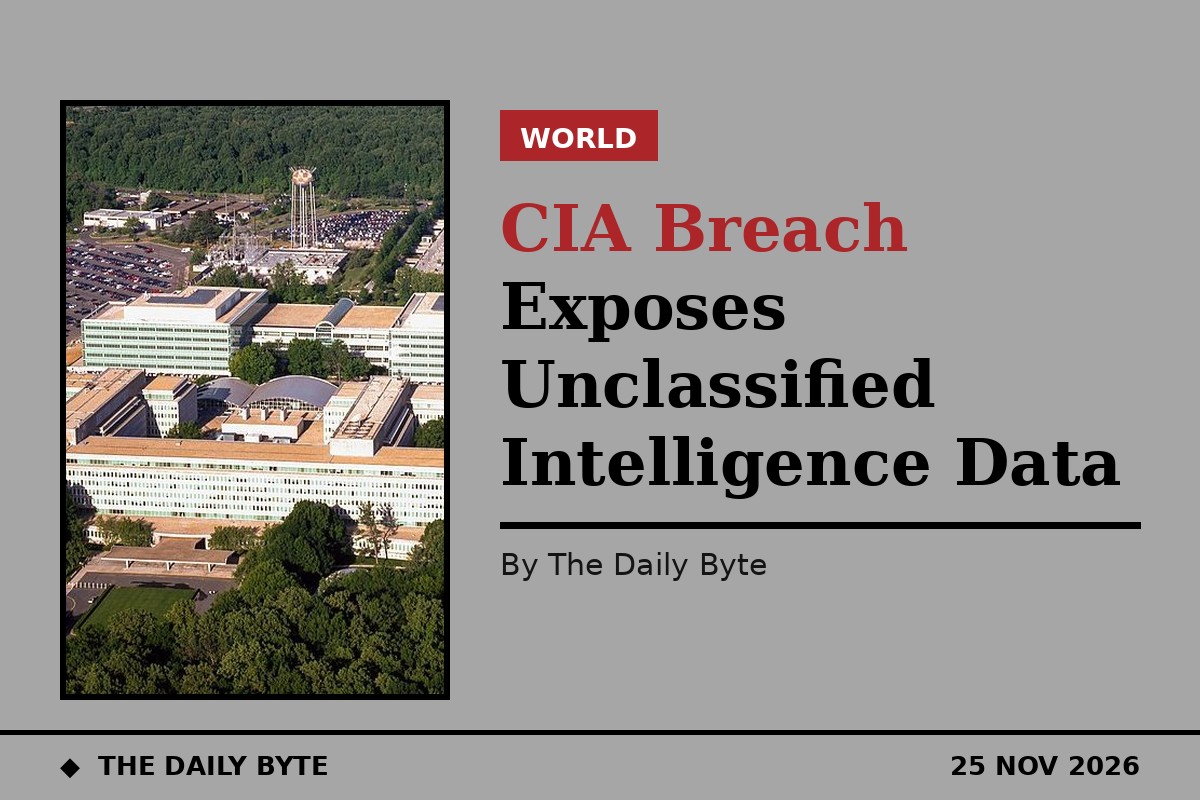
The Central Intelligence Agency and the Office of the Director of National Intelligence have discovered a cybersecurity breach that exposed some of their unclassified information, the New York Times reported on Tuesday. Reuters carried the Times account the same day, and CNN later confirmed the incident with four sources familiar with the matter.
The intrusion affected a shared network used to analyse publicly available material in search of intelligence insights. Open-source intelligence of this kind draws on social media, news reports, satellite imagery and data bought from commercial vendors, rather than on secret collection. The Times reported that it was not clear what specific information was compromised, and CNN reported that it was not immediately clear when the hack took place.
Officials moved quickly to limit the damage. An official with the Office of the Director of National Intelligence told CNN there had been no disruption to critical capabilities or classified systems, and a person familiar with the incident told the Associated Press that the disruption had been resolved. The CIA declined to comment. The National Geospatial-Intelligence Agency, which the Times said was also affected, had not issued a statement at the time of reporting.
Tool points investigators towards China
The most sensitive question, who was behind the intrusion, remains unanswered in public. The Times reported that the attack was carried out using ARTEX, an artificial-intelligence-powered penetration-testing framework, and that two of the people it spoke to said the early signs, including the use of that tool, suggested China may have been behind it. CNN reported separately that two sources said early indications suggested the hack may have originated in China, while adding that it was not immediately clear whether the Chinese government was involved.
That is a suggestion, not a finding. Investigators have not publicly named who was responsible, and the reporting is careful to separate the tool used from the identity of the attacker. ARTEX is a legitimate testing tool used by cybersecurity professionals to simulate attacks, so its presence alone does not prove who directed the operation.
Part of a wider run of incidents
The breach is the latest in a string of cybersecurity incidents and technology outages to affect the United States government. The Associated Press reported that an internal network the National Security Agency uses to communicate classified information was offline for a time last week, in an episode officials attributed to software patching rather than malicious activity. The Federal Bureau of Investigation is also examining an apparent hack of a national law enforcement database that it maintains.
The episode also underlines how much of modern intelligence work now rests on unclassified material. The Office of the Director of National Intelligence, which oversees 17 American intelligence agencies including the CIA, has in recent years invested heavily in open-source work, which is often unclassified by design. That makes the systems that hold it a target even when they contain no secrets: the value lies in knowing what analysts are looking at, and in the commercial and satellite data that feeds their assessments.
What happens next
For now, the public record leaves the full scope unclear. No agency has said how long the intruders were inside the network, how they gained access, or which files or records were exposed. What is established is narrower but still striking: hackers reached a system used by three of the most secretive agencies in the United States government, took unclassified material from it, and were only discovered after the event. The agencies say the issue is resolved and classified systems were untouched. Whether that assurance holds up will depend on what the continuing investigation finds about the scale of the exposure.


