CISA adds four exploited flaws to KEV including Synology CVE-2024-10441
By The Daily Byte
·20 Nov 2026
·4 min read
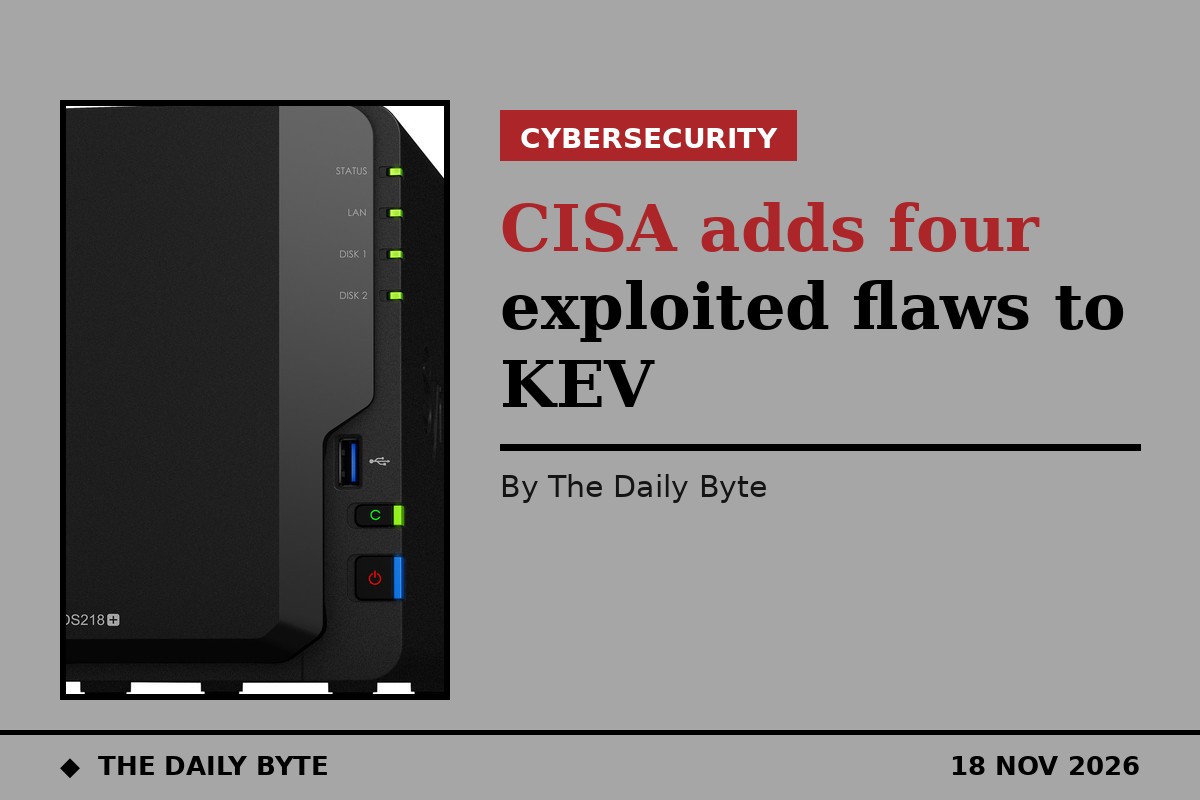
The US Cybersecurity and Infrastructure Security Agency (CISA) has added four vulnerabilities to its Known Exploited Vulnerabilities (KEV) catalogue, based on evidence of active exploitation. The additions, published on 18 November 2026, cover Synology DiskStation Manager, BerriAI LiteLLM, Apache Axis and Vanderbilt REDCap, and take the catalogue to 1,786 entries.
Three of the four carry an unusually short deadline: US federal civilian agencies must fix them by 21 November 2026, just three days after the additions. The fourth, affecting LiteLLM, must be patched by 2 December 2026. CISA also ordered forensic triage under Binding Operational Directive 26-04 for the Synology, Apache Axis and REDCap entries. Ransomware use is listed as unknown for all four.
## The four flaws at a glance
- **CVE-2024-10441** (Synology DiskStation Manager and BeeStation OS, rated 9.8): an improper encoding of output flaw in the system plugin daemon. A remote attacker can trigger it without logging in to run code on the NAS device.
- **CVE-2026-40217** (BerriAI LiteLLM, rated 8.8): a code injection flaw disclosed by X41 D-Sec. A logged-in user can send crafted Python input to the `/guardrails/test_custom_code` route, bypass the AST sandbox using bytecode rewriting, and run code on the AI proxy server.
- **CVE-2026-90436** (Apache Axis 1.x, rated 9.8): an unsafe reflection flaw in the end-of-life SOAP engine. When Axis parses an inbound SOAP fault containing an exception name and string data, it loads the named class and runs its string constructor before checking whether the object is an Axis fault, so authentication rules do not block the attack.
- **CVE-2026-90817** (Vanderbilt REDCap, rated 9.8): a code injection flaw found by Securifera. An attacker with a valid public survey hash can alter HTTP requests in the survey routing logic, reach an internal data import route and run code without a login.
Public proof-of-concept exploit code already exists for the LiteLLM, Apache Axis and REDCap flaws, according to [SecurityOnline](https://securityonline.info/cisa-adds-4-exploited-flaws-kev-synology-litellm/).
## Synology owners should check neglected devices first
The Synology flaw is the oldest of the four and, in some ways, the most awkward. The fix has been available for about a year, in DSM 7.2.2-72806-1, 7.2.1-69057-6, 7.2-64570-4, 7.1.1-42962-7 and 6.2.4-25556-8, as well as BeeStation OS 1.1-65374 and DSMUC 3.1.4-23079. But many small offices and homes run a Synology box that nobody has logged into since it was set up, and Synology warned in October 2026 that threat actors were encrypting NAS devices running outdated DSM versions. Anyone with a Synology device should check its DSM version now and make sure the admin page is not exposed to the internet.
## What to patch, and in what order
Synology administrators should update to DSM 7.2.2-72806-1, 7.2.1-69057-6 or BeeStation OS 1.1-65374. LiteLLM users should update to builds after 8 April 2026 or apply Red Hat errata RHSA-2026:24866 and RHSA-2026:30056, which cover the affected Red Hat products including Ansible Automation Platform 2.6, OpenShift AI 3.3 and Lightspeed Core. REDCap teams should upgrade to fixed builds 16.0.49, 17.3.10 or 17.4.4. Apache Axis 1.x is end of life with no new release planned, so teams still running it must move to Axis2 or Java, or apply the upstream commit 41f3b4e8d04e310ca81f86b92630ab2c11d608bd.
The additions underline a familiar pattern: the catalogue now includes a two-year-old NAS flaw, an AI gateway flaw, an end-of-life SOAP library and a research data tool. The common thread is not the age of the software but that attackers are using these flaws now, which is why CISA's three-day deadline is about as short as it ever sets. The full list is in [CISA's alert](https://www.cisa.gov/news-events/alerts/2026/11/18/cisa-adds-four-known-exploited-vulnerabilities-catalog), with a day-by-day breakdown of the additions from [Carthage Electronics](https://carthageelectronics.com/november-18-2026-cve-threat-brief/).
## Frequently asked questions
**What is CISA's KEV catalogue?**
It is CISA's list of vulnerabilities with evidence of active exploitation. US federal civilian agencies must fix listed flaws by the stated deadline; other organisations are urged to treat the list as a priority.
**Do I need to patch if I am not a US federal agency?**
Yes, in practice. KEV entries mean attackers are exploiting the flaw now, and the same patches protect any organisation running the affected software.
**Is the Synology flaw new?**
No. CVE-2024-10441 was disclosed in 2024 and the fix has been out for about a year. It was added to KEV on 18 November 2026 because CISA now has evidence of active exploitation.


