Climate Finance Pledges Fall 70% as COP31 Opens
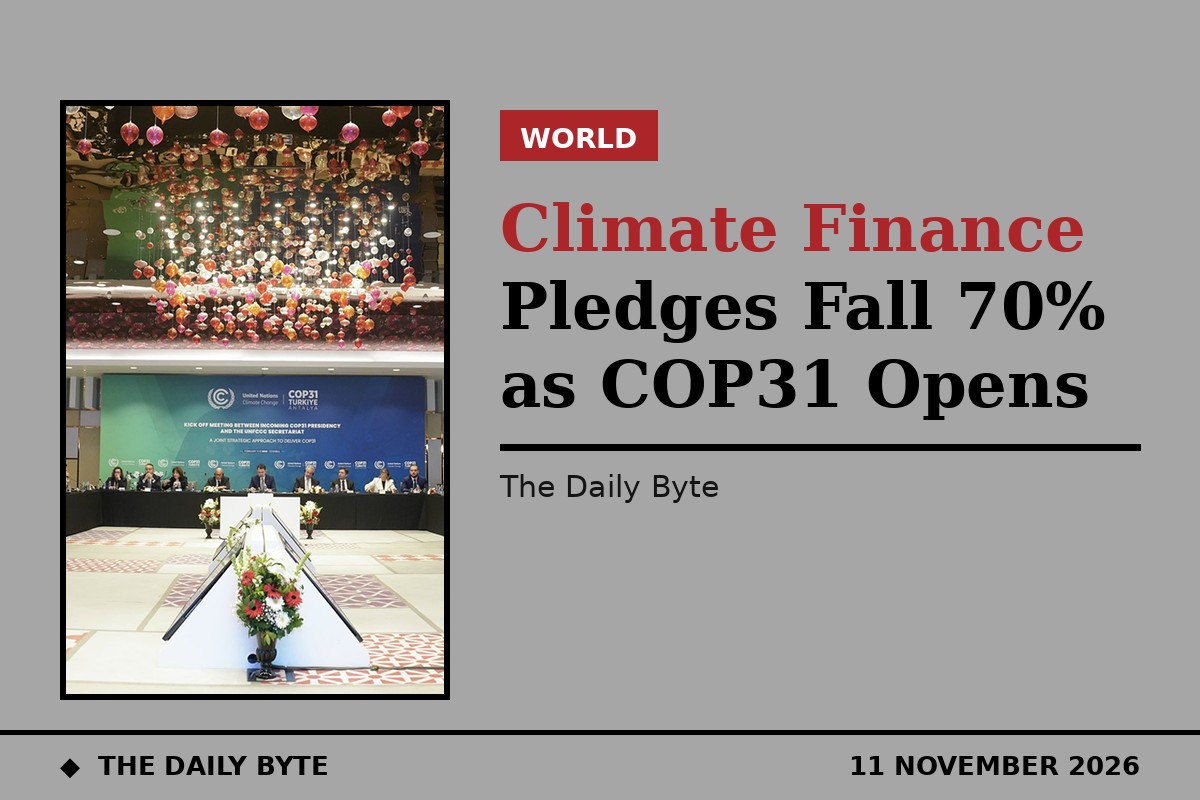
Public funding pledged to help developing countries tackle climate change has fallen by more than 70% in 2026, according to new analysis published as the COP31 climate summit gets under way in Antalya, Turkey.
Analysis by Carbon Brief, based on a tracker of commitments run by the climate groups NRDC and E3G, puts the total amount of public climate finance pledged over the next few years at just $11.7bn a year, down from recent levels of around $40bn. On an annualised basis, pledges have fallen by around 71%, from about £42bn a year to £11.8bn.
The shortfall comes at an awkward moment. COP31 runs from 9 to 20 November, and developing countries are pressing for new money after nations agreed just two years ago to scale up annual climate finance from $100bn in the early 2020s to $300bn by 2035.
Why the pledges have dried up
Most of the previous multi-year pledges expired in 2025, and hardly any major donors have announced replacements. Only five nations have announced new multi-year pledges, including just one major donor — the UK.
The United States, once the largest contributor, is the most significant absence. It had committed to reaching $11.4bn in annual support by 2024 under the previous administration, but has since withdrawn from the Paris Agreement for a second time and shrunk its aid budget. No official US climate finance is expected in the coming years.
Europe, which provides the majority of international climate finance, has also pulled back. European governments have cut aid spending sharply in recent years, citing economic strain and the need to fund defence.
Germany and France yet to renew
Germany and France, the two largest European climate-finance contributors, both pledged to reach €6bn a year by 2025. Neither has committed to anything beyond that, and both have slashed their aid budgets, including funding for climate programmes. Germany missed its 2025 climate-finance goal as a result of the cuts.
Germany's centre-right government, in office since the 2025 election, has pushed climate finance down the agenda, according to Germanwatch, while in France the approach of a presidential election and the growing influence of the far right are expected to make new international commitments harder to agree.
Spain's centre-left government has triggered a snap election for the end of November, making a new pledge during COP31 less likely, and a centre-left bloc in Sweden is still trying to form a coalition government after a narrow election win.
The UK is the exception — with a caveat
Of the major donors, only the UK has announced a new pledge, committing £6bn of aid between 2026-27 and 2028-29, plus £6.7bn from outside its aid budget. That accounts for about half of all the annual funds pledged from 2026 onwards, averaging $5.7bn a year.
But the UK figure flatters the picture. The government has changed how it counts climate finance to include the £6.7bn in additional public finance, and on a like-for-like aid basis the new pledge amounts to a drop in ambition.
The European Commission makes up most of the remainder, with an average annual contribution of $4.5bn promised out to 2027, largely because it pledged to spend €28bn over its 2021-2027 budget period. Its contribution after 2027 is being discussed as part of wider EU budget negotiations. Canada has promised CA$5.3bn by 2030, while the Netherlands, Switzerland and Belgium have pledged relatively small sums.
What it means for COP31
Developing countries are using the summit to champion a climate-finance work programme, which could provide a space to discuss scaling up public finance. The EU has responded by stressing that its member states are the largest providers of public climate finance — they provided a record €32.3bn in 2025 — and by calling on developing countries to submit overdue plans for cutting emissions.
EU climate chief Wopke Hoekstra recently told Bloomberg that any conversation about new fresh money was dead in the water. Joe Thwaites, international climate finance director at NRDC, said the lack of new announcements was making the finance negotiations tougher than they need to be, because developing countries have little clarity about how much public climate finance there will be in the coming years.
With Australia, which is jointly hosting COP31 alongside Turkey, yet to announce a pledge of its own, the summit's opening days have underlined how far the money on the table has fallen short of the promises made two years ago.
Sources: Carbon Brief and Le Monde.


