Coldcard seed flaw 'linked to $116m bitcoin theft'
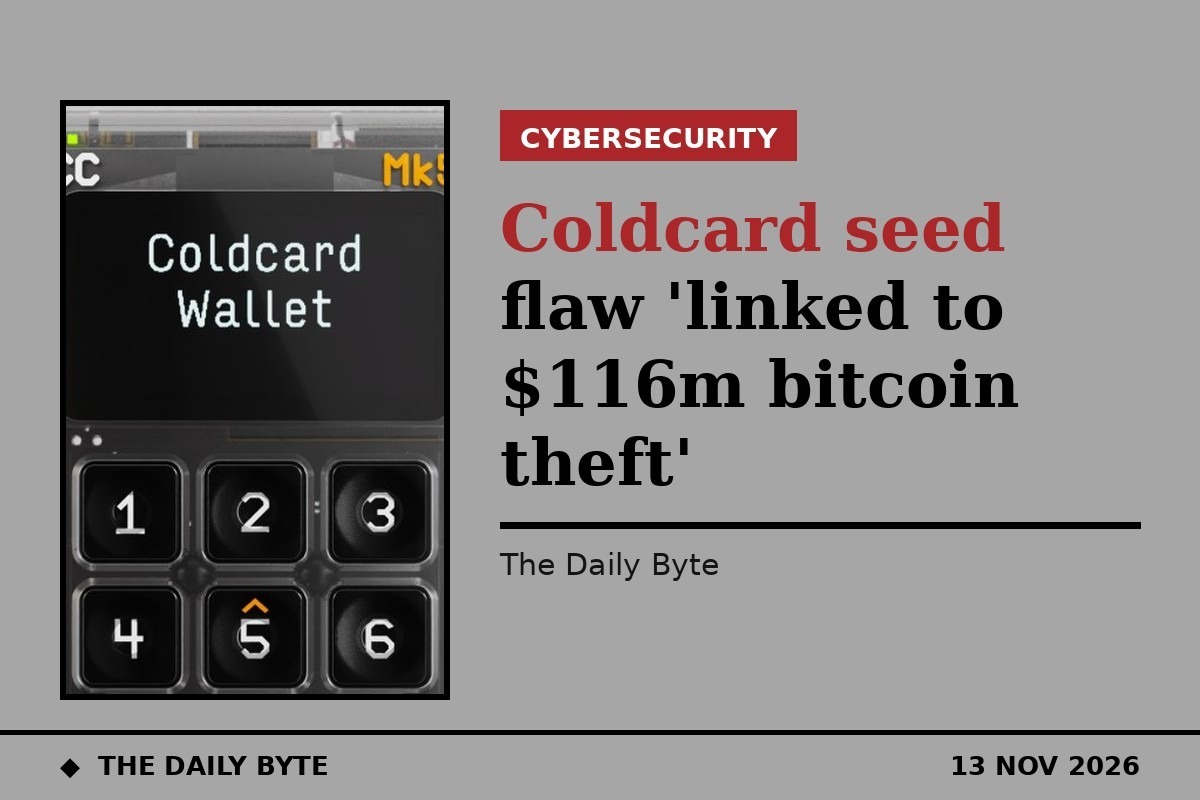
A flaw in Coldcard hardware wallets that left recovery phrases far weaker than owners believed has been linked to the theft of about 1,816 bitcoin, worth roughly $116 million, in a series of sweeps that began in July 2026. The figure comes from a preliminary estimate by blockchain analytics firm TRM Labs, reported this week, and it has reopened a public argument over whether the flaw should have been caught years earlier.
Coldcard wallets, made by the Canadian firm Coinkite, are small offline devices that store the private keys for bitcoin. Their main job is to generate a recovery phrase, a set of words that can restore a wallet if the device is lost. That phrase is only as safe as the randomness behind it, and in this case the randomness was badly weakened.
The thefts
According to TRM Labs, the thefts ran in four waves beginning on 30 July 2026 and took about 1,816 BTC from more than 5,200 addresses. The first wave alone took about 594 bitcoin, worth around $38 million, from some 500 wallets in 25 minutes. The attackers never needed the devices, their PINs or the owners' computers: with weak seeds, the wallets could be reconstructed offline and emptied remotely.
Other trackers put the total in a similar range, and TRM Labs described its own tally as preliminary. What is not in dispute is the scale: thousands of wallets were drained in a matter of days.
What went wrong
TRM Labs traced the flaw to a build configuration error in firmware version 4.0.1, released in March 2021. The change meant that when some Coldcard devices created a seed, they skipped the chip designed to produce unpredictable numbers and instead used a software tool, known as Yasmarang, fed by the chip's serial number and a timer.
The result was seeds with only around 40 bits of real randomness on affected Mk2 and Mk3 devices, far below the 128 bits that the BIP-39 standard assumes. A properly random 128-bit seed cannot realistically be guessed; a 40-bit seed can be worked through offline. Coinkite shipped fixed firmware in August 2026, but a firmware update cannot repair a seed that was already generated under the faulty code. Affected owners have been told to create a new seed on fixed firmware and move their funds, and that even a strong passphrase does not repair a weak seed.
The row over security reviews
The argument now is about who should have spotted the problem. Rodolfo Novak, Coinkite's chief executive, known as NVK, said at least 15 external reviews or research efforts had examined Coldcard-related systems, including a 2022 audit of the Mk4 model, and that an AI-assisted security assessment had produced dozens of findings that led to fixes, but not this one. "The uncomfortable truth is that it took a new artificial intelligence model to find what humans couldn't," he said.
That claim drew a swift response. Bitcoin Core developer Luke Dashjr said he had raised nine concerns about Coldcard's random-number code with Coinkite privately, and disputed the idea that only AI could have found the flaws. Researcher James O'Beirne said he had privately raised concerns about the randomness implementation as early as May 2025. Others, including the analyst known as Shinobi, defended Coinkite's reviewers, arguing that outside teams had examined the entropy system without isolating the exact flaw, and that a preliminary warning is not the same as a formal vulnerability disclosure.
A proposed class action has also been filed in the Ontario Superior Court of Justice against Coinkite and its co-founders, on behalf of affected customers.
The episode has already changed practice elsewhere: Trezor, a rival wallet maker, raised its maximum passphrase length from 50 to 128 characters on 2 November, citing the Coldcard attacks and saying strong, unique passphrases had protected some affected users. No attacker behind the thefts has been publicly identified.
Sources: Crypto-Economy, Adbytes Media, Cryptopolitan