Colombia Airstrike Kills 4 in FARC Camp Raid
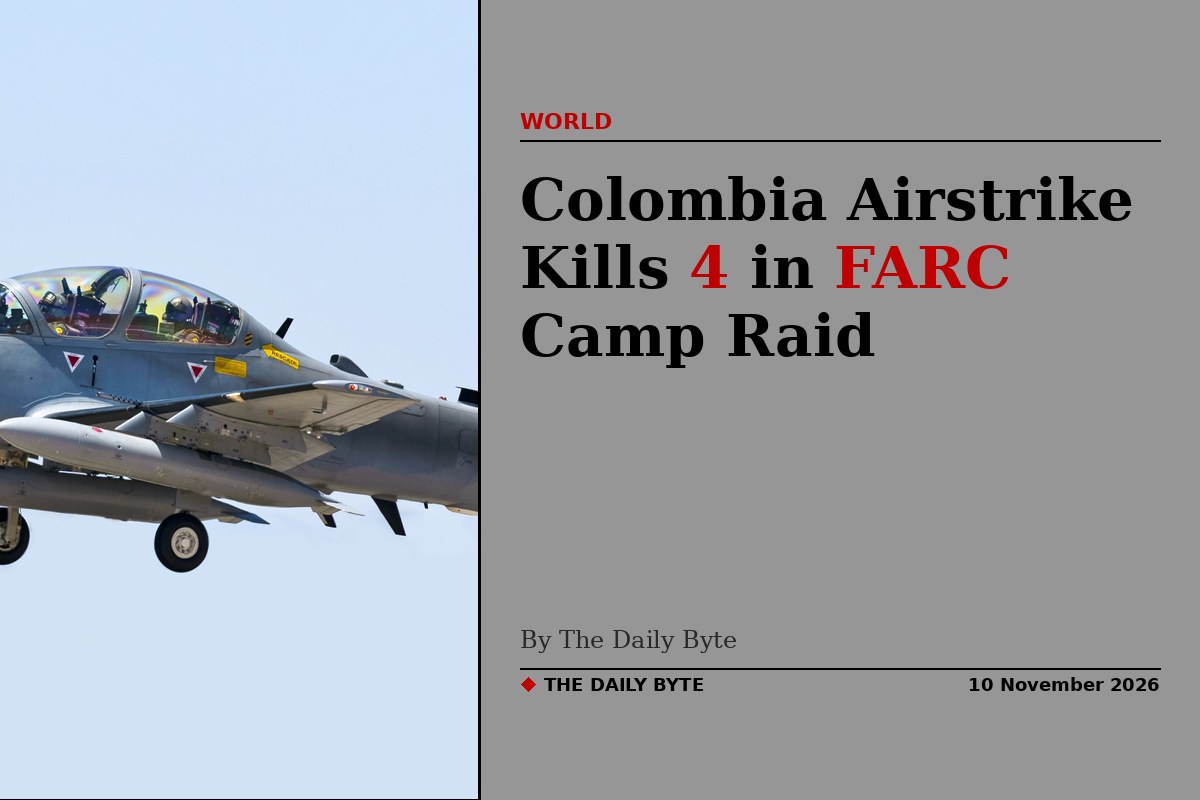
Colombia's military has carried out an airstrike against a FARC dissident camp in the Catatumbo region, killing four fighters and capturing six more, the government said on Monday, 9 November 2026.
The operation, codenamed Operation Noah, targeted a camp belonging to Frente 33, a FARC dissident faction, in the rural municipality of Tibú, Norte de Santander, near the Venezuelan border. It was carried out by the Colombian Army and the Colombian Air Force in the early hours of the morning, according to The City Paper Bogotá.
Who was captured
Among those captured was Jorge Luis Galvis Rodríguez, known by the aliases Barba Chivo and Costeño. The authorities describe him as a commission leader within Structure 33 and a trusted associate of Andrey Avendaño, the faction's top leader. Security officials say he has an 11-year criminal history and link him to the killing of community leaders, extortion, the recruitment of minors, forced displacement and drone attacks on security forces.
The official account of the operation says troops seized seven rifles and 15 grenades adapted to be dropped from drones, and disrupted three camp areas with room for about 35 fighters. The identities of the four people killed have not been released, and the exact location of the camp has not been made public.
Seventh bombing under De la Espriella
President Abelardo de la Espriella, who took office in August, announced the operation publicly and travelled to Cúcuta to present the results. It was the seventh aerial bombing authorised during his administration and the third in Norte de Santander, a department that has become one of Colombia's most contested security zones.
During the presentation in Cúcuta, the president, dressed in camouflage, confronted Barba Chivo in person and referred to a 460-kilogramme bomb used in the strike, which he said he had signed and blessed with the words "Bienvenidos a la Patria Milagro", according to Caracol Radio. He said the military offensive in the Catatumbo would continue until every territory was recovered.
A wider border campaign
The strike comes ten days after a camp attributed to the National Liberation Army, the ELN, was hit in Venezuela's Apure state, close to the Colombian frontier, on 30 October. That attack reportedly killed at least 20 people, although the precise number and identities of those killed remain disputed. The New York Times reported that Washington provided intelligence and drone support for that operation, and there are indications that Colombia's National Police supplied coordinates identifying the ELN camp.
The two operations were not necessarily planned together, and there is no evidence they formed part of a single campaign. But together they point to a shift along the 2,100-kilometre Colombia-Venezuela border, where armed groups have long used Venezuelan territory as a refuge and a corridor for drug trafficking, illegal mining and fuel smuggling.
Under De la Espriella, Bogotá has sought closer military cooperation with the Trump administration, while Washington has stepped up its campaign against drug trafficking networks and armed groups across Latin America. For the ELN and the FARC dissident factions, the change matters because their ability to move across the border has given them strategic depth, allowing commanders to exploit the limits of cross-border cooperation.
Whether the new approach lasts will depend on what happens next in the Catatumbo, where Frente 33, the ELN and other groups continue to fight over territory, and where civilians have borne the cost of drone attacks and displacement. For now, the government is presenting Operation Noah as proof that its offensive will not stop.


