Colombia Battles Fire-Prone Gorse As El Nino Looms
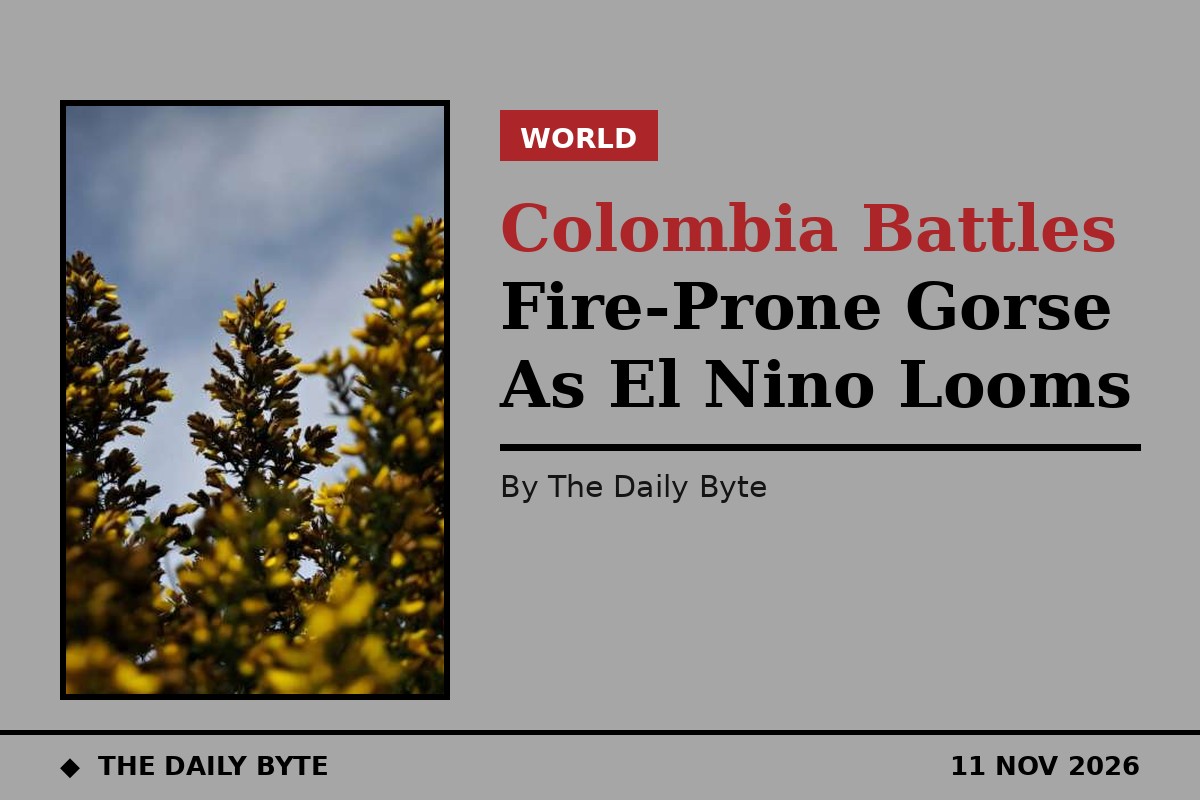
Colombian farmers are racing to clear a highly flammable invasive plant before a strong El Nino brings worse wildfires, as gorse spreads across thousands of hectares of farmland and high-altitude moorland. The thorny shrub, known as Ulex europaeus, has yellow flowers that belie the danger it poses in dry conditions, and farmers near Bogota are cutting it back by hand before the fire season peaks.
Farmer Albert Montano, 43, was working with a group of men in the Cogua municipality on the outskirts of Bogota, revving an electric cutter as they advanced on what they call "the plague", according to AFP, reported by Phys.org. Farmers are rushing to eradicate the plant, which Montano said is "invading us more and more".
A thorny invader with yellow flowers
Gorse reached Colombia from Europe in the mid-20th century and spread rapidly from the capital to the rest of the country, including its paramo ecosystems, the high-altitude moors that store a massive proportion of Colombia's water supplies. The International Union for Conservation of Nature counts it as one of the 100 most aggressive invasive species in the world.
Although no official estimate exists, gorse covers thousands of hectares across Colombia. The plant can grow up to three metres tall and was originally used to delineate land. Those farmers "never thought about what it would cost in the future, nor about how it should be managed," biologist and invasive plant expert Edinson Sesquile told AFP. TBS News also carried the AFP report on 11 November.
Why El Nino raises the danger
Gorse is highly flammable, and that is what alarms Montano and his fellow farmers as wildfires are expected to intensify during this cycle of El Nino, which AFP reports is predicted to be the strongest since comparable records began four decades ago. El Nino raises surface temperatures in the central and eastern equatorial Pacific Ocean and causes global changes in winds and rainfall, as well as erratic weather conditions.
Forest fires in the Andean mountain range near Ecuador have already intensified amid drier conditions caused by the phenomenon. Higher temperatures also "promote the dispersal of seeds," Sesquile said, meaning the plant can spread further even as the fire risk grows.
"If we don't find a way to control it ... in about 20 or 30 years we're going to have an area covered only in gorse instead of native vegetation, crops and livestock," Montano told AFP.
Clearing it by hand, a pool at a time
The work is slow and physical. Salomon Castro, 61, used a pickaxe to hack at the plant's root while younger farmers cut its branches with machetes. Every day, the group collects 1,500 kilograms of gorse from an area of roughly 170 square metres, about the size of a semi-Olympic swimming pool.
"The work is pretty tough," Castro said, "but it has to be done." Affected communities have spent years trying all kinds of methods to get rid of the plant, some spraying agrochemicals such as glyphosate while others resort to burning it despite the risk of wildfires. Permanent eradication entails sending it to certified incineration or biodegradation sites, and without a "coordinated" approach, "what we are doing is containing it," according to Sesquile.
Turning a fire risk into fuel
In nearby Zipaquira, an industrial machine turns the invasive plant into products "from the root to the flower," Daniel Jimenez, production director at organic waste company Adaptica, told AFP. The company reduces the plant, dries it and compacts it into pellets, a popular biofuel in Europe but relatively unknown in Colombia. Its high flammability inspired this particular environmental solution, according to Alejandro Nunez, 30, the mechanical engineer responsible for coordinating the gorse project.
For Montano, every eradicated gorse plant reflects "a duty fulfilled". "It's the feeling of satisfaction that comes from reclaiming your own surroundings," he said.
Frequently asked questions
What is gorse? Gorse, or Ulex europaeus, is a thorny shrub with yellow flowers that arrived in Colombia from Europe in the mid-20th century and is listed among the world's 100 most aggressive invasive species.
Why is gorse a wildfire risk in Colombia? The plant is highly flammable, covers thousands of hectares including water-storing paramo moorland, and is expected to burn more easily as El Nino brings drier, hotter conditions.
What is El Nino? El Nino is a weather pattern that raises surface temperatures in the central and eastern equatorial Pacific, changing winds and rainfall worldwide and bringing drought and wildfire risk to parts of South America.


