Colombia opens 1,722-bed Riohacha mega-prison
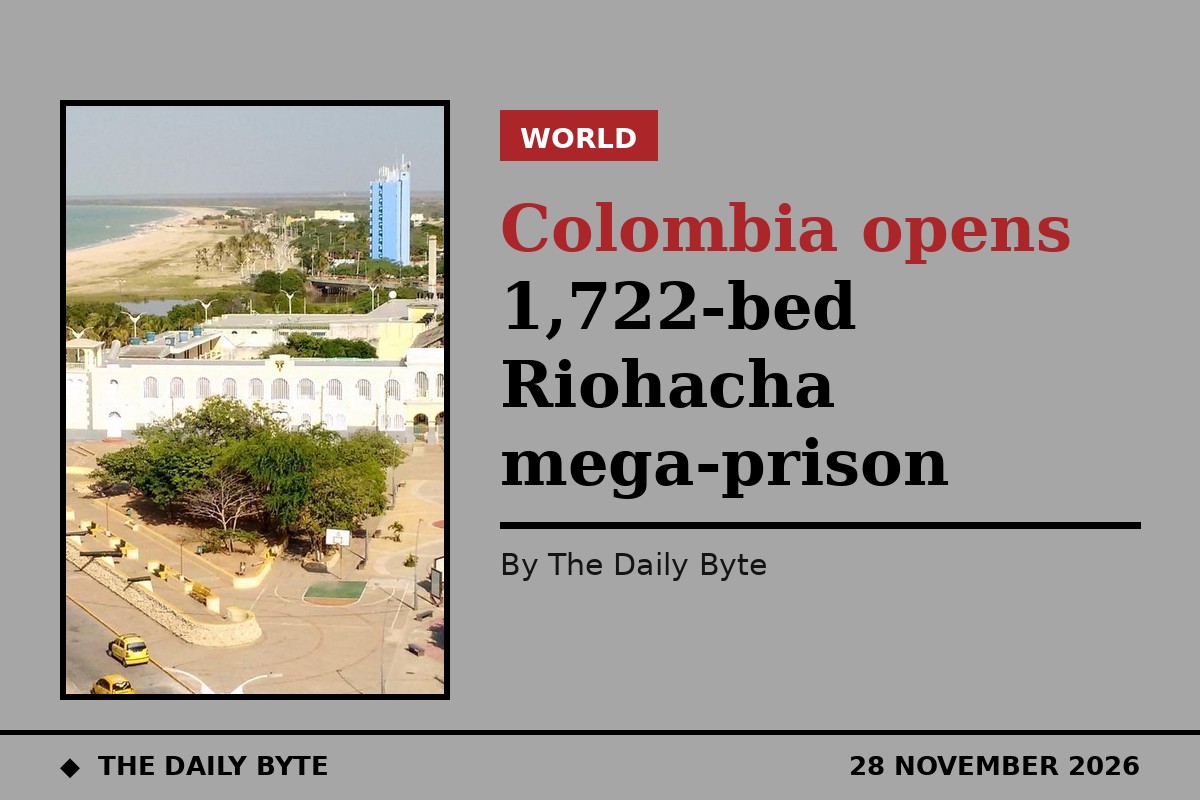
Colombia has opened a new 1,722-bed national prison in Riohacha, La Guajira, as President Abelardo de la Espriella vowed to stop criminal gangs from running their operations from behind bars.
The president inaugurated the Establecimiento de Reclusión del Orden Nacional, known as the ERON, on Wednesday. The complex has 476 cells and 36,000 square metres of built space on a 10-hectare site, and represents an investment of more than 362 billion Colombian pesos, about 100 million US dollars.
The project was contracted in 2020 under former president Iván Duque and was originally due for delivery in January 2023, but it stalled for nearly four years amid technical, financial and prior-consultation hurdles. It is the first large-scale prison project delivered in Colombia since 2011. The final investment reached 362.974 billion pesos, a 69 percent increase over the initial 181.957 billion peso contract.
Easing severe overcrowding
The prison includes seven pavilions for men, 152 places for women, 218 places for ethnic populations and a dedicated sociocultural pavilion for the Wayuu community indigenous to the region. It also has a child development unit and staff quarters, and is classified as a medium-security facility with rehabilitation, education and healthcare facilities.
It aims to relieve the existing Riohacha medium-security prison, which held a 261 percent overcrowding rate as of 21 October, the second-highest in Colombia after La Paz in Itagüí at 273 percent. Nationally, the prison system operates at 25.3 percent overcapacity, with 101,543 inmates held against 80,992 places, according to figures presented at a Constitutional Court hearing on 4 November.
"Prisons will be under state control"
At the ceremony, de la Espriella said: "Colombia's prisons will be under state control, not under the control of criminals." He ordered the National Penitentiary and Prison Institute, known as INPEC, to intensify controls against contraband mobile phones and to investigate how the devices reach inmates. He warned officials who facilitated criminal activity from inside prisons that they "will have to answer to the justice system".
"The prisons cannot become operations centers from which extortions are ordered, innocent citizens are threatened and murders are planned," he said. He demanded that the new facility's jamming systems operate "from the first moment".
Figures cited by the president showed progress on phone blocking: disabled phone lines rose from 593 in September to 974 in October, while handsets blocked by their IMEI numbers climbed from 538 to 738.
Opposition disputes the "mega-prison" label
Former justice minister Néstor Osuna contested the "mega-prison" description, arguing that the term applies to facilities above 5,000 capacity, such as El Salvador's Cecot prison that inspired the model. Osuna said the previous administration had handed over the project at 93 percent completion, with financing secured for the final works.
The government says the Riohacha opening is part of a wider programme. Medellín plans to open a facility with capacity for 1,339 people in May 2027, and the Sábanas de San Ángel prison in Magdalena, with nearly 2,000 beds, is expected before the end of the year, Justice Minister Iván Cancino told the Constitutional Court on 4 November.
De la Espriella, who took office in August after defeating the left's candidate, has made security and control of state institutions the centrepiece of his government. The Riohacha prison is the first test of whether that approach can deliver results inside a system where, for years, gangs treated prisons as headquarters.


