Colombia Quits Fossil Fuel Coalition, Ends Amazon Ban
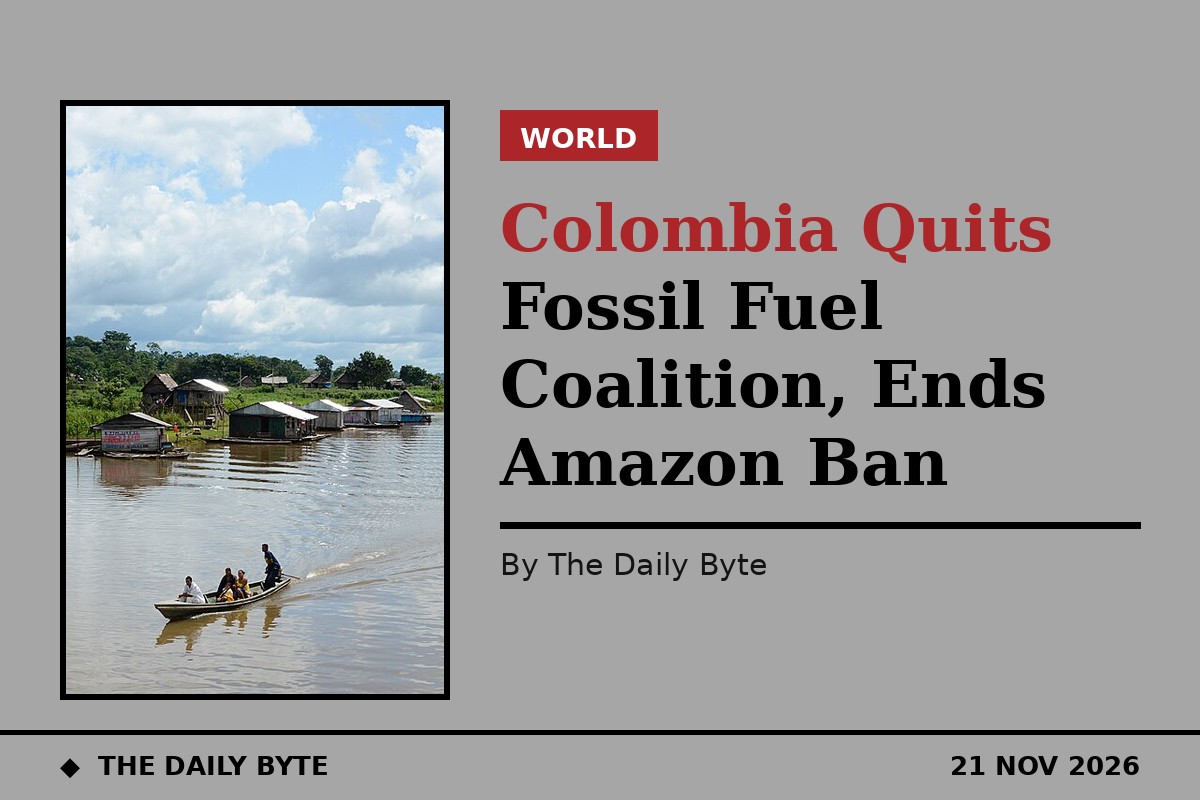
Colombia has withdrawn from the international coalition it created to move the world away from fossil fuels, and its new government has also revoked a reserve that protected the country's Amazon region from new mining and oil and gas contracts.
Ireland's Department of Climate, Energy and the Environment confirmed the withdrawal to the Associated Press. The coalition is pressing ahead without its founder at the COP31 climate summit in Antalya, Turkey, where leadership is passing from Colombia and the Netherlands to Ireland and Tuvalu, with a formal handover during the summit and a second conference planned for July 2027 in Tuvalu.
The coalition grew out of a conference Colombia hosted in April in the Caribbean city of Santa Marta, which brought together representatives of 57 countries. Its aim was to turn the global pledge to transition away from coal, oil and gas, agreed at COP28 in Dubai, into concrete national plans. The process was deliberately informal, with no binding agreements or deadlines, and the International Institute for Sustainable Development says 23 countries have announced or are developing national or regional road maps for moving off fossil fuels.
A reversal of Petro's policies
Both decisions reverse signature policies of former president Gustavo Petro. Petro made moving away from fossil fuels a central part of his environmental agenda and stopped awarding new oil and gas exploration contracts. His successor, Abelardo de la Espriella, took office in August promising to strengthen the country's oil and gas industry and revive exploration.
Colombia is Latin America's largest coal exporter and a significant exporter of crude oil, so its exit removes the coalition's most prominent producer-country champion just as negotiators at COP31 debate the future of the fossil fuel transition.
The second reversal concerns the Amazon. In August, in the last days of Petro's government, the Environment Ministry issued Resolution 0961, which declared the Colombian Amazon biome, about 483,000 square kilometres or roughly 42 per cent of the country, a permanent reserve. It barred new mining concessions and new oil and gas exploration and production contracts across the whole area.
The new government revoked that resolution in an administrative act dated 23 October and announced on 26 October, according to the news site Colombia One. The ministry argued that prior consultation had not been completed with Black, Afro-Colombian, Raizal and Palenquero communities that could be affected, which it said undermined the measure's legal validity.
The government's case
Environment Minister Fabio Arjona also argued that a broad resolution was not an effective tool against illegal mining, deforestation and land grabbing. "Resolution 0961 did not, on its own, guarantee effective protection of the Amazon biome," he said.
Arjona has said in recent days that Petro's restrictions on gas exploration contributed to domestic shortages and pushed some industries towards more polluting fuels, according to the AP. He argued that producing more natural gas would lower emissions by replacing dirtier fuels and would improve energy security.
The government stresses that the revocation does not itself authorise any extraction. Projects still need environmental licences, national parks keep their protections, and other legal safeguards, including a 1959 forest reserve law and court rulings recognising the Amazon as a subject of rights, remain in force. The ministry has said it may adopt new protective measures after consultations.
Critics call it a setback
Former officials from the Petro government have criticised both moves. Irene Velez-Torres, a former environment minister who co-chaired the Santa Marta conference, described the changes as "an ecocide taking place in Colombia" in an interview with Democracy Now! at COP31. She warned of risks to water supplies, noting that water from the Amazon region flows towards Bogota.
She also told the AP that the coalition would survive the change of government. "Santa Marta has a life of its own, beyond the change of government in Colombia," she said.
Colombia had been one of the few fossil fuel producers willing to stop issuing new exploration licences, which gave its climate diplomacy unusual weight. Its exit tests whether a voluntary coalition built around national plans can keep its momentum when its founder walks away, and whether the progress report due at COP31 can show enough movement from the remaining members to matter.


