Colombia Venezuela Border Security Pact After Kidnappings
Colombia and Venezuela have agreed to work together on security along their shared border after two high-profile kidnappings that Colombian officials blame on the ELN armed group, in a rare show of cooperation between the two neighbours.
The two governments said on Thursday, 12 November 2026, that they were willing to coordinate efforts to combat transnational crime along the 2,219-kilometre frontier, where armed groups, drug trafficking and smuggling have long been part of daily life.
Colombia is seeking Venezuelan help to find Nancy Gomez, the wife of the mayor of Uribia, a town in the northern department of La Guajira about 30 kilometres from the Venezuelan border. Colombian authorities believe she was kidnapped on 11 November and taken into Venezuela in an attempt to evade Colombian law enforcement.
Troops sent to La Guajira after mayor's wife seized
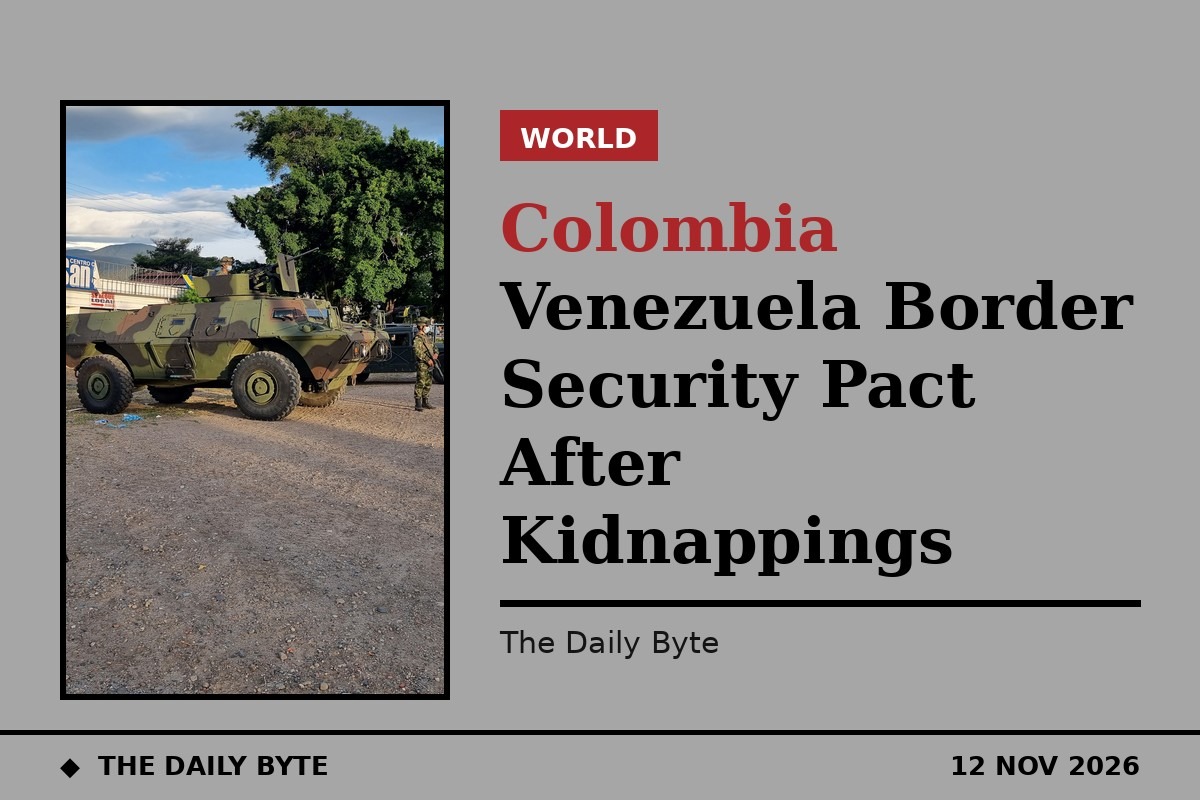
Colombian President Abelardo De La Espriella deployed military troops to the area to help with the search for Gomez, and said the ELN, the National Liberation Army, was believed to be behind her kidnapping. He also ordered security forces to put in place a plan aimed at preventing the abductors from crossing into Venezuela.
The kidnapping of Gomez is the second such case in just over a week. On 4 November, a Colombian army officer was kidnapped by the ELN in the town of Saravena, in the border state of Arauca, according to Colombian authorities. Colombia is still searching for the officer.
Venezuela's government said it was "fully willing to carry out all necessary coordination" with Colombian authorities on security matters, the Venezuelan foreign ministry said in a statement. Colombia's foreign ministry said it had spoken with the Venezuelan government "to coordinate efforts to rescue" Gomez.
US asked to help find kidnapped officer
Colombian Defence Minister Jorge Eduardo Mora said on Wednesday that Colombia had asked the United States to work with Venezuela to help find the kidnapped army officer. "We are hoping that with this transition happening in Venezuela, there will be cooperation," Mora said.
The reference is to the change of government in Caracas earlier this year, when Delcy Rodriguez became Venezuela's interim president and began governing the country under US oversight after a US military raid captured then-leader Nicolas Maduro and took him to New York to face trial.
Relations between Bogota and Caracas have long been strained. Colombia previously accused Venezuela of harbouring FARC and ELN rebels on its territory, charges Caracas has repeatedly denied. Armed groups, including leftist guerrillas, have historically operated along the border, where drug trafficking and smuggling are common.
A test of the new relationship
The two kidnappings now present an early test of whether the new political reality in Venezuela can translate into practical cooperation on a border that both governments have struggled to control.
For Colombia, the priority is the safe return of Gomez and the army officer. For Venezuela's interim government, the episode is a chance to show it can work with its neighbour on security after years of mutual suspicion.
Neither government has said what form the coordination will take, or whether joint patrols or intelligence sharing are planned. For now, the agreement is limited to a stated willingness to work together, with Colombian troops already deployed on their side of the frontier and the search for both victims continuing.
Sources: Reuters, Anadolu Agency