Commonwealth Summit Antigua 2026 Explained
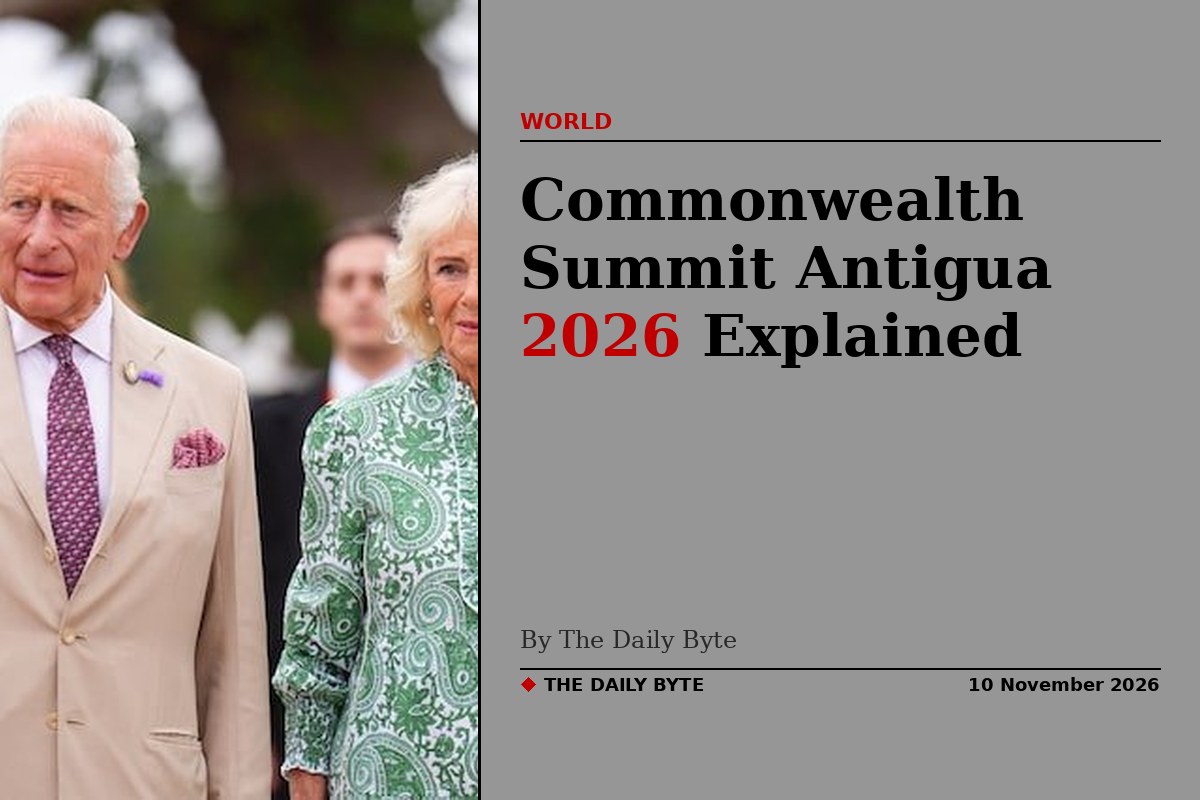
Leaders of 56 countries met in St John’s, Antigua and Barbuda, from 1 to 4 November 2026 for the 28th Commonwealth Heads of Government Meeting, known as CHOGM. It was the first summit of its kind led by the Commonwealth’s new Secretary-General, Shirley Ayorkor Botchwey, and it ended with a deal that many Caribbean and African leaders had sought for years: Britain agreed to sit down for structured talks on reparatory justice for the transatlantic slave trade.
This explainer sets out what CHOGM is, what the leaders agreed in Antigua, what the slavery talks will and will not cover, and what happens next.
What is CHOGM?
CHOGM is the Commonwealth Heads of Government Meeting, the biennial summit of the Commonwealth of Nations. The Commonwealth is a voluntary association of 56 independent countries, most of them former territories of the British Empire, with a combined population of about 2.7 billion people — nearly one-third of humanity. Its headquarters are at Marlborough House in London, and its Head is King Charles III.
Leaders meet every two years to set the organisation’s direction. Alongside the leaders’ meeting, CHOGM brings together four forums for women, young people, civil society and business. Decisions are taken by consensus, and the meeting closes with a communiqué recording what was agreed.
The 2026 meeting was held in St John’s, the capital of Antigua and Barbuda, and chaired by the country’s Prime Minister, Gaston Browne. Antigua and Barbuda became the smallest country ever to host a Commonwealth summit. The leaders’ formal sessions took place on 3 and 4 November, with associated events running from 1 November, and the private leaders’ retreat was held on Jumby Bay Island, off the north-eastern coast of Antigua.
What was on the agenda in Antigua?
The summit’s theme was “Accelerating Partnerships and Investment for a Prosperous Commonwealth”. The Commonwealth Secretariat presented the meeting as focused on money and partnerships rather than speeches alone. Its published priorities were climate resilience, trade and investment, innovation, equality and sustainable development, with particular attention to small island developing states, which face high climate risk and limited access to affordable finance.
On investment, the Secretariat said 20 developing member countries had brought forward investment-ready projects worth a combined $34 billion, covering areas such as renewable energy, youth skills, trade and economic growth. The Secretariat later said the meeting had generated $500 million in new commitments for initiatives covering renewable energy, youth skills development, trade and economic growth. A $34 billion pipeline of proposed projects is not the same as $34 billion raised or spent, and the test of the summit will be how much of that pipeline turns into signed financing.
On trade, the final communiqué endorsed reform of the World Trade Organization, including its dispute settlement system, and called for unjustified non-tariff barriers between Commonwealth members to be removed. Commonwealth Secretary-General Botchwey had argued before the summit that members should trade more with each other to reduce dependence on the United States amid rising tariffs.
On climate and debt, leaders called for accessible climate finance, operational loss-and-damage funding and technology transfer, and for changes that ease sovereign-debt pressure on vulnerable economies. The communiqué also backed a common platform on sustainable debt and concessional funding that takes a country’s vulnerability into account, rather than income alone.
What did the summit agree on reparatory justice?
The most politically charged outcome was on reparatory justice — the campaign by Caribbean and African states for Britain and other former colonial powers to address the legacy of the transatlantic slave trade. The subject was not on the summit’s formal agenda, but it dominated the discussions around the gathering, and it was included in the final communiqué.
In the communiqué, leaders recalled the 2024 Samoa Communiqué, in which they had agreed that the time had come for “meaningful, truthful and respectful conversation” towards a common future based on equity. They noted developments since then, including the adoption of United Nations General Assembly Resolution A/RES/80/250, which describes the trafficking of enslaved Africans and racialised chattel enslavement as the gravest crime against humanity, and initiatives by the African Union and the Caribbean Community (CARICOM) to advance reparatory justice and the restitution of cultural heritage.
Most importantly, the communiqué welcomed “the agreement of the Government of the United Kingdom to engage in a structured, time-bound, inclusive and good-faith dialogue with affected parties addressing the transatlantic trafficking of enslaved Africans and its historical harms”. That wording matters because it commits Britain to a formal process with a timetable, rather than an open-ended conversation. Officials have not yet fixed the timetable: the Foreign, Commonwealth and Development Office has said it will be determined in future discussions.
What did Britain offer — and what did it rule out?
Prime Minister Andy Burnham set out Britain’s position in an article for the Guardian on 30 October, days before the summit opened. He wrote that he wanted to express “sorrow and regret” for the pain and suffering of millions, and said he was open to calls for a formal apology on behalf of the British state. At the same time, he ruled out financial reparations, writing that he did not think British people today could be “held liable for historical wrongs” that happened in a different age under different laws.
Foreign Secretary Ed Miliband, who attended the summit, said Britain was willing to say it was open to an apology but would not shift its position on reparations, which he described as neither the right answer nor practical. He suggested the dialogue could conclude in around a year, and when asked whether a formal apology could come by the time Britain hosts the G20 summit in Manchester in November 2027, he replied: “Broadly speaking, yes.” No date has been fixed, and no apology has yet been given.
Instead of reparations, Britain offered other measures. The Government said it would put £40 million over three years, from within existing budgets, into critical infrastructure including green energy in the Caribbean. Burnham also asked former prime minister Gordon Brown to lead work with international lenders on restructuring the debts of the poorest Commonwealth countries. A debt reset for developing nations had already been announced by the Government before the summit.
King Charles III, who opened the summit on 3 November during a tour of the Caribbean, said the slave trade filled him with “horror” and “the most profound personal sorrow”. He did not apologise, and Buckingham Palace had said in advance that he would not. Britain has never formally apologised for its role in the slave trade. In 2007, then prime minister Tony Blair described Britain’s role as a matter of “deep sorrow and regret”.
What are Caribbean leaders asking for?
CARICOM, the Caribbean Community, has a ten-point plan for reparatory justice. It asks for a full formal apology, debt cancellation, programmes on health, education, culture and technology, and monetary compensation. Caribbean leaders welcomed Britain’s agreement to talk, but insisted that the discussions must cover the full range of their demands.
Philip J. Pierre, Prime Minister of Saint Lucia and chair of CARICOM, welcomed Britain’s willingness to discuss a formal apology and enter structured dialogue, describing it as a development that should be recognised. He insisted, however, that the talks must include the full range of reparatory demands, including the ten-point plan.
Gaston Browne, the summit’s host and Prime Minister of Antigua and Barbuda, has insisted that financial compensation remains necessary. Ralph Gonsalves, the former prime minister of Saint Vincent and the Grenadines, said British officials had been strongly opposed to placing reparations on the summit’s formal agenda, and said UK officials had raised the prospect that Burnham might not attend if reparations were formally added.
Public opinion in Britain is divided. A More in Common poll for the Repair Campaign found that 40 per cent of Britons backed talks on reparatory justice, rising to 60 per cent among 18- to 24-year-olds. The history behind the dispute is stark: when Britain abolished slavery in 1833, it borrowed £20 million to compensate slave owners, while the enslaved people themselves received nothing.
What happens next?
The dialogue agreed in Antigua has no published timetable yet. Foreign Office officials have said the timeframe will be settled in later discussions, and Miliband has pointed to a roughly 12-month horizon. The first question will be who sits at the table: the communiqué speaks of dialogue with “affected parties”, which is expected to mean Caribbean and African governments and communities, including CARICOM and the African Union, which have been coordinating their reparatory justice work.
The second question is what the dialogue can actually deliver. It is a commitment to a process, not an apology, a compensation award or a completed programme of repair. Caribbean leaders have made clear they will judge it by whether it produces an apology and concrete measures, not only by whether talks take place. Britain has made equally clear that financial reparations are off the table, and ministers have said taxpayers will not be asked to pay for historic acts.
For the Commonwealth itself, the Antigua summit was also a test of relevance. The organisation has been criticised as a talking shop, and Botchwey, in her first CHOGM as Secretary-General, staked its future on delivering investment and trade rather than declarations alone. Whether the $34 billion project pipeline and the $500 million in new commitments materialise will be the measure of that ambition — and whether the slavery dialogue produces an apology by the time Britain hosts the G20 in Manchester next November will be the measure of the summit’s most sensitive promise.


