Congo Ebola Outbreak Passes 11,300 Cases and 5,500 Deaths at Record Pace After Six Months
By The Daily Byte
·18 Nov 2026
·4 min read
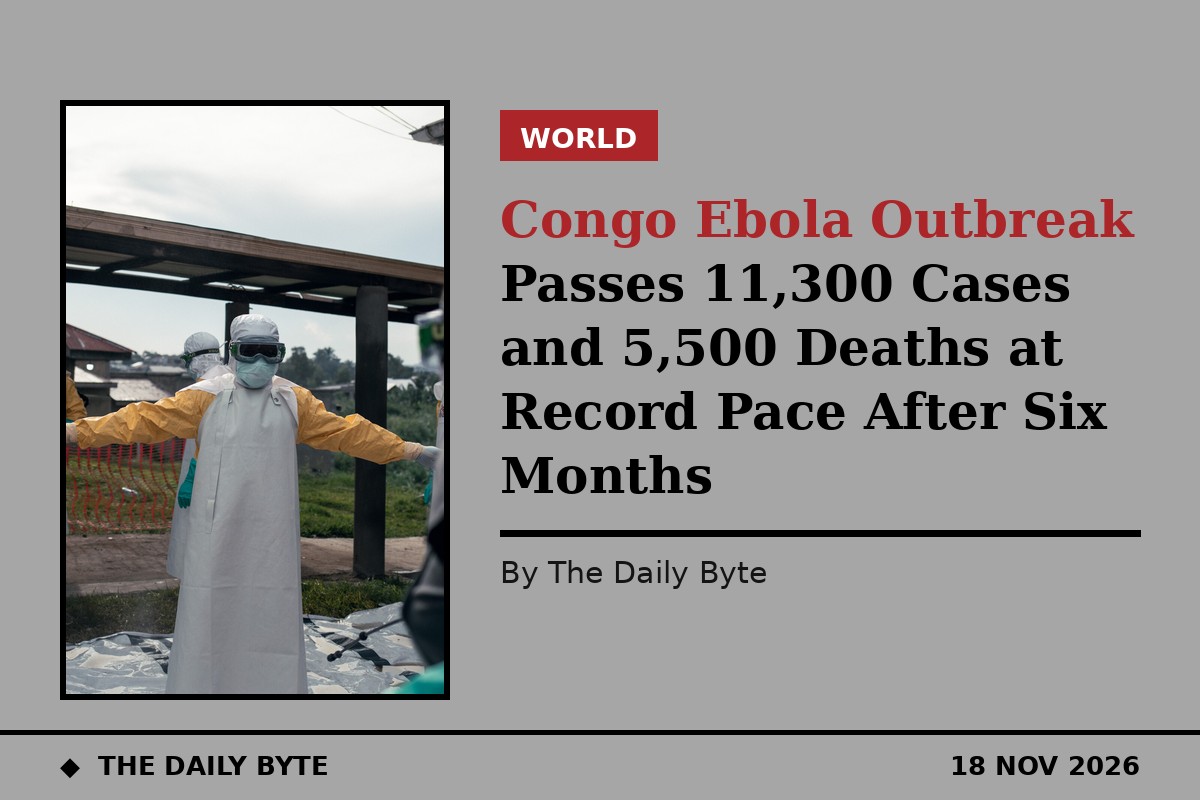
The Ebola outbreak in the eastern Democratic Republic of Congo is still out of control six months after it was declared, and it is spreading faster than any previous outbreak on record. More than 11,300 people have been infected and more than 5,500 have died since health authorities declared the outbreak on 15 May 2026, according to government data reported by Reuters.
The World Health Organization's daily epidemiological update put the toll at 11,376 confirmed cases and 5,568 confirmed deaths as of 14 November, a crude case fatality ratio of about 49 per cent. The outbreak, caused by the rare Bundibugyo strain of the virus, is now the second-largest Ebola epidemic ever recorded, behind only the 2014-2016 West African outbreak, in which more than 28,600 people were infected and over 11,000 died.
## Spreading twice as fast as West Africa in 2014
Official data shows infections and deaths are rising at double the rate seen during the first six months of the West Africa outbreak, alarming public health officials. The scale already dwarfs the Democratic Republic of Congo's previous largest outbreak, in 2018-2020, which ended with 3,481 cases and 2,299 deaths.
This is the country's 17th Ebola outbreak, but none before it has reached this size. The virus has now been reported across eight provinces and 67 health zones, and transmission remains at a high and sustained level, with around 400 to 500 new cases still reported every week.
The WHO's regional emergency director for Africa, Marie Roseline Belizaire, told a press briefing that there was still no sign of decline, even as the geographical pattern of the epidemic continued to shift. In the 21 days to 7 November, the country reported 1,472 confirmed cases, compared with 1,388 in the preceding 21 days.
## Attacks, unpaid staff and missing money hamper the response
Insecurity is among the greatest obstacles to the response, WHO Director-General Tedros Adhanom Ghebreyesus told reporters on Tuesday, as he addressed the third meeting of the International Health Regulations Emergency Committee on 17 November.
Health workers, vehicles and surveillance teams have come under attack in communities that distrust outsiders. During an attack on the town of Cantine-Aloya last week, 66 civilians were killed, including three health workers, and three health facilities were looted and burned, according to the WHO.
Médecins Sans Frontières said last week that vital resources and supplies still are not reaching hot spots outside the original epicentre in Ituri province. Health workers have gone on strike over conditions and unpaid salaries, and some have not been paid since August, according to Congolese government and health officials. Tedros said the delay was slowing the response, while the government says it is working to rectify the problem.
Some $2.9 billion has been pledged for the response, but less than half of that has been disbursed, according to Africa's top public health agency, the Africa Centres for Disease Control and Prevention, which has urged donors to work closely with Kinshasa to avoid waste through duplication. Africa CDC said on 15 November that the epidemic was still serious and not under control.
## Vaccines and a brighter note from Kenya
There has been some progress on the medical front. On 4 November, experts convened by the WHO recommended two new vaccines made specifically for the Bundibugyo strain for testing in the ongoing Tumaini trial, including ChAdOx1, developed by the University of Oxford together with the Serum Institute of India. It is the first time vaccines designed specifically for Bundibugyo virus will be tested during an outbreak, although the WHO expects first findings from the vaccine trial only in early 2027.
Almost 3,000 people have recovered, the WHO said, and there are encouraging signs that transmission is slowing in some areas. Kenya discharged its last Ebola patient on 11 November, starting the mandatory 42-day countdown towards an Ebola-free declaration, which would fall on 23 December if no new infections are reported.
## Frequently asked questions
**How many people has the DR Congo Ebola outbreak killed?**
The WHO's daily update recorded 11,376 confirmed cases and 5,568 confirmed deaths as of 14 November 2026, with a case fatality ratio of about 49 per cent.
**Which Ebola strain is behind the outbreak?**
The outbreak is caused by Bundibugyo virus, a rare strain of Ebola for which no licensed vaccine or targeted antiviral treatment exists.
**Why is the outbreak still growing after six months?**
The WHO and Reuters point to insecurity and attacks on health workers, unpaid staff, poor coordination and funding that has been pledged but not disbursed, alongside continuing high transmission across eight provinces.
Sources: [Reuters](https://943jackfm.com/2026/11/17/explainer-congos-ebola-outbreak-is-spreading-and-killing-at-a-record-pace/) reported the six-month assessment and the record pace of spread; the [World Health Organization](https://www.nzdoctor.co.nz/article/undoctored/who-director-generals-opening-remarks-member-state-briefing-ebola-outbreak) said almost 11,000 confirmed cases and more than 5,300 deaths had been reported across eight provinces, with almost 3,000 recoveries.


