Cyclone Xavier: Nassau Emergency as Storm Weakens
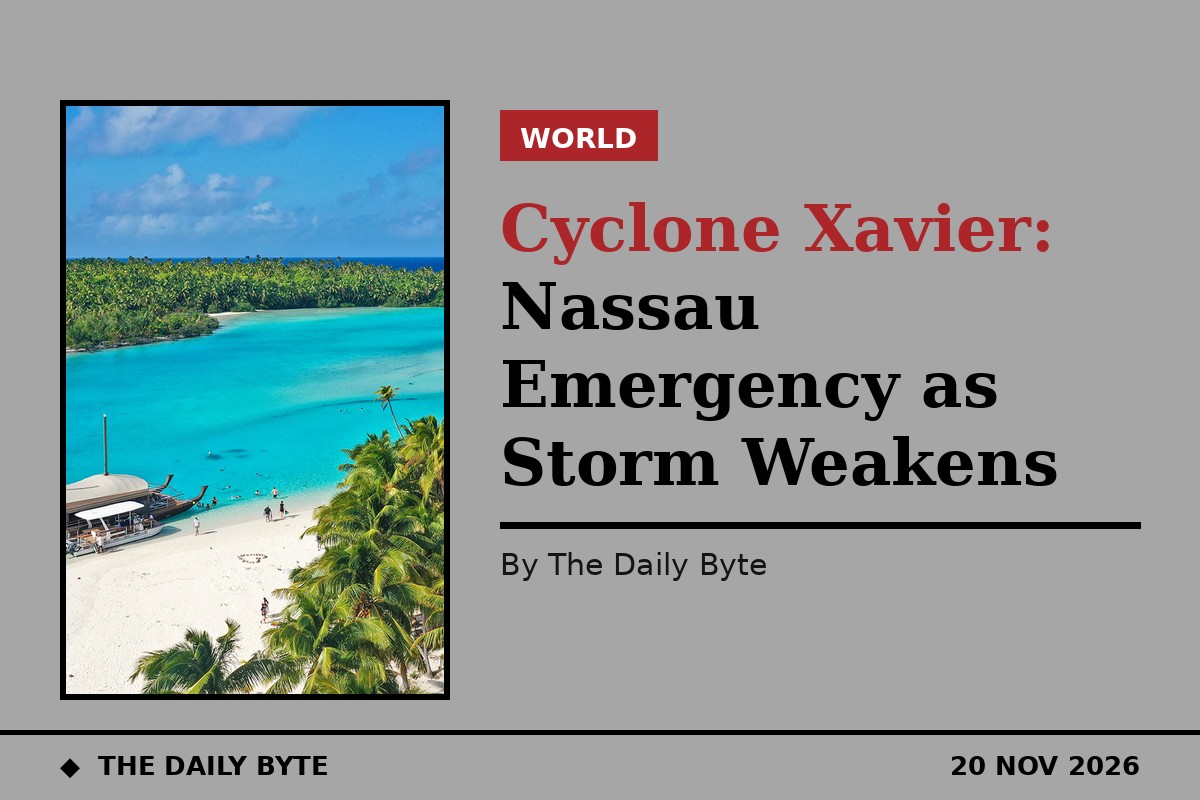
Cook Islands Prime Minister Mark Brown has declared a state of emergency for Nassau, a remote island in the northern Cook Islands, as Severe Tropical Cyclone Xavier approached. The declaration took effect at midnight on Thursday, 19 November, Cook Islands time, and was reported by RNZ Pacific on Friday, 20 November.
The emergency declaration gives response teams statutory powers to act quickly and together, according to the prime minister. It was announced after emergency management authorities identified the island's exposure to the cyclone and the need for coordinated preparations. The Fiji Meteorological Service's latest forecast track showed the storm was expected to pass south of Nassau over the weekend as a Category 3 or Category 2 system.
Xavier had strengthened with exceptional speed earlier in the week. It reached Category 5 intensity on 18 November, with sustained winds estimated at 215 to 220 kilometres per hour and gusts of up to 315 kilometres per hour. It was the first Category 5 cyclone monitored by the Regional Specialised Meteorological Centre in Nadi since Cyclone Lola in 2023. According to NASA's Earth Observatory, Xavier became one of the most intense November tropical cyclones observed in the region in decades.
Weakening, but still dangerous
By Friday morning the storm was losing strength, but forecasters stressed that the danger had not passed. At 06:00 UTC on 20 November, Xavier was a Category 3 system near 11.4 degrees south and 162.9 degrees west, with estimated sustained winds of 80 knots, about 148 kilometres per hour, and a central pressure of 958 hectopascals. A later bulletin issued at 12:57 UTC reported that it had weakened further, to Category 2.
The regional warning centre eased Nassau's storm warning to a gale warning at 14:36 UTC on Friday, while warning that damaging winds, heavy rain, high seas and coastal inundation remained possible. Gale warnings were in force for Nassau and Suwarrow, while strong wind warnings covered Manihiki, Rakahanga and Pukapuka. As of late Thursday, no casualties or damage had been reported on Nassau.
Damage already reported on Manihiki and Pukapuka
Other northern islands have already felt the storm. On Manihiki, residents reported damage to coastal infrastructure, including the wharf, as well as limited damage to walls and roofing. Electricity was a particular concern: the island's diesel generator had been out of service for more than a year, leaving residents dependent on solar energy, and prolonged cloud cover and heavy rain reduced the ability to generate power.
On Pukapuka, more than 300 residents spent the night in a cyclone shelter, and local reporting documented the destruction of a traditional community structure. Emergency authorities were working to organise supplies and maintain readiness, while the Cook Islands government prepared logistical support, including essential equipment and potential aerial assessments. New Zealand assistance was also being prepared, subject to conditions and requests from Cook Islands authorities.
A storm that strengthened fast
The Fiji Meteorological Service began issuing updates on a developing tropical disturbance on 15 November, and within days the system had strengthened dramatically. It developed over ocean waters of about 29 degrees Celsius, while relatively weak vertical wind shear allowed its circulation to organise and intensify. Warm ocean water provides energy to a storm, and low wind shear helps preserve its structure, allowing thunderstorms to remain organised around its centre.
Xavier arrived in the opening weeks of the South Pacific cyclone season, which runs from 1 November to 30 April. The Fiji Meteorological Service has predicted 11 to 15 tropical cyclones in its area of responsibility this season, with two or three likely to pass through Fiji's exclusive economic zone. For the northern Cook Islands, among the most remote inhabited places in the Pacific, the storm is a reminder of how quickly a developing disturbance can become a major threat, and how much depends on warnings reaching communities that are hundreds of kilometres from the nearest help.
Source: Open Chronicle
Source: The Overlooked
Source: UANWorld


