COP30 Draft Drops Fossil Fuel and Deforestation Roadmaps
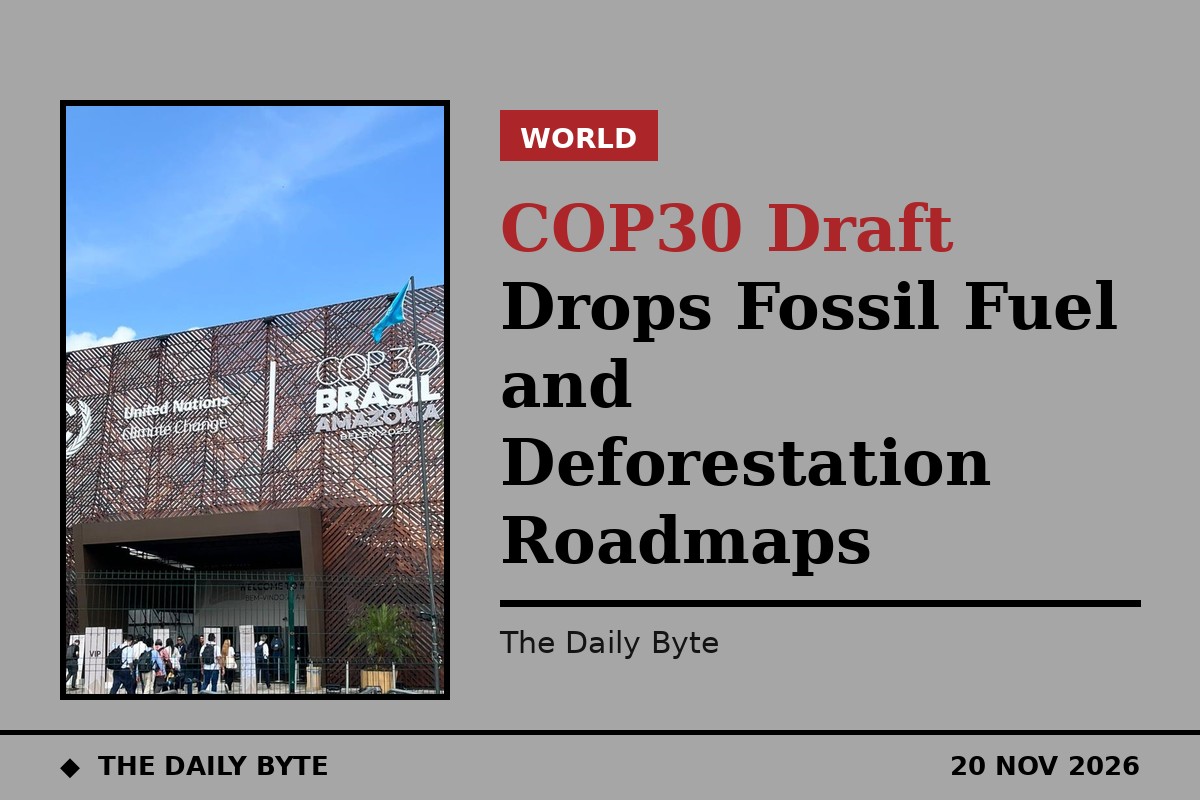
Negotiators at the COP30 climate summit in Belém have been handed a draft deal that drops the two roadmaps many countries wanted most: one to move the world away from fossil fuels, and one to halt deforestation. The text, published by the Brazilian presidency early on Friday morning, immediately drew a warning from 29 countries that they would not accept a deal without a roadmap.
What the new text says
The document, known as the Mutirão Decision after the Portuguese word for collective action, replaces an option in Tuesday's draft that would have encouraged countries to work together on moving away from fossil fuels and convened a high-level ministerial roundtable to help them draw up roadmaps away from fossil fuels and deforestation. Instead, the new text proposes a Belém Mission to 1.5C, a presidency-led effort to help countries carry out their national climate plans, and a voluntary Global Implementation Accelerator to speed up cooperation. The presidency's work would be summed up in a report before next year's COP31 in Türkiye.
The talks had already been running behind schedule. The presidency had hoped to push the decision through on Wednesday as part of a wider Belém package, but negotiations dragged on through Wednesday and Thursday, and were interrupted on Thursday afternoon when a fire broke out in the venue and thousands of delegates were evacuated.
Twenty-nine countries push back
A group of 29 countries responded on Friday morning with a letter to the Brazilian presidency. “We express deep concern regarding the current proposal under consideration for a take it or leave it,” they wrote. “We cannot support an outcome that does not include a roadmap.” The signatories include France, Germany, Spain, the United Kingdom, Mexico, Chile, Colombia, Sweden, Austria, Belgium, Costa Rica, the Netherlands and Switzerland. More than 80 countries had publicly backed a roadmap since the summit began nearly two weeks ago.
The European Union's climate commissioner, Wopke Hoekstra, was blunt during the presidency's consultations on the text. “Under no circumstances are we going to accept this,” he said on Friday, adding that the draft contained no science, no global stocktake and no move away from fossil fuels. He told reporters separately that what was on the table was “clearly no deal” and that the summit risked ending without an agreement.
Campaigners were equally direct. “This Mutirão text might as well be blank, as it does so little to bridge the 1.5C ambition gap or push countries to accelerate action,” said Tracy Carty, a climate politics expert at Greenpeace International, urging countries to reject it and send it back to the presidency for revision.
Finance and trade still unresolved
The draft does keep some pressure on wealthy countries over climate finance. It refers back to an earlier call to triple adaptation finance by 2030, measured against 2025 levels, and urges developed countries to raise the trajectory of their contributions. But developing countries had called for at least $120 billion a year for adaptation, and that figure is not in the text. The tripling provision is “far, far lower than the $120 billion called for by developing countries, thereby slashing ambition”, said Salome Lethman, an advocacy adviser at the humanitarian group Mercy Corps.
On trade, the text asks United Nations climate bodies to meet national delegates and groups including the World Trade Organization to discuss cooperation on climate and trade, and reaffirms that climate measures should not become arbitrary discrimination or a disguised restriction on trade. The issue has grown heated as the EU prepares to impose a carbon border fee from January, with the UK and Norway following in 2027.
A summit running out of time
Agreement requires consensus among nearly 200 nations, and the summit was supposed to end on Friday evening. With countries sending staff back to their hotels well after that hour, the talks looked likely to spill into the weekend. The United States is not taking part, after President Donald Trump shunned the event.
The stakes are high because the roadmap fight goes back to COP28 in Dubai in 2023, when countries agreed to transition away from fossil fuels and to halt and reverse deforestation by 2030. This year's scientific consensus has made clear that warming of 1.5C is now likely by the 2030s, so the argument has shifted to keeping the overshoot as small and as short as possible. Whether the Brazilian presidency can produce a revised text that restores the roadmaps without losing the countries that blocked them will decide whether Belém ends with a deal at all.


