COP31: Africa Wants $120bn Climate Cash, EU Refuses
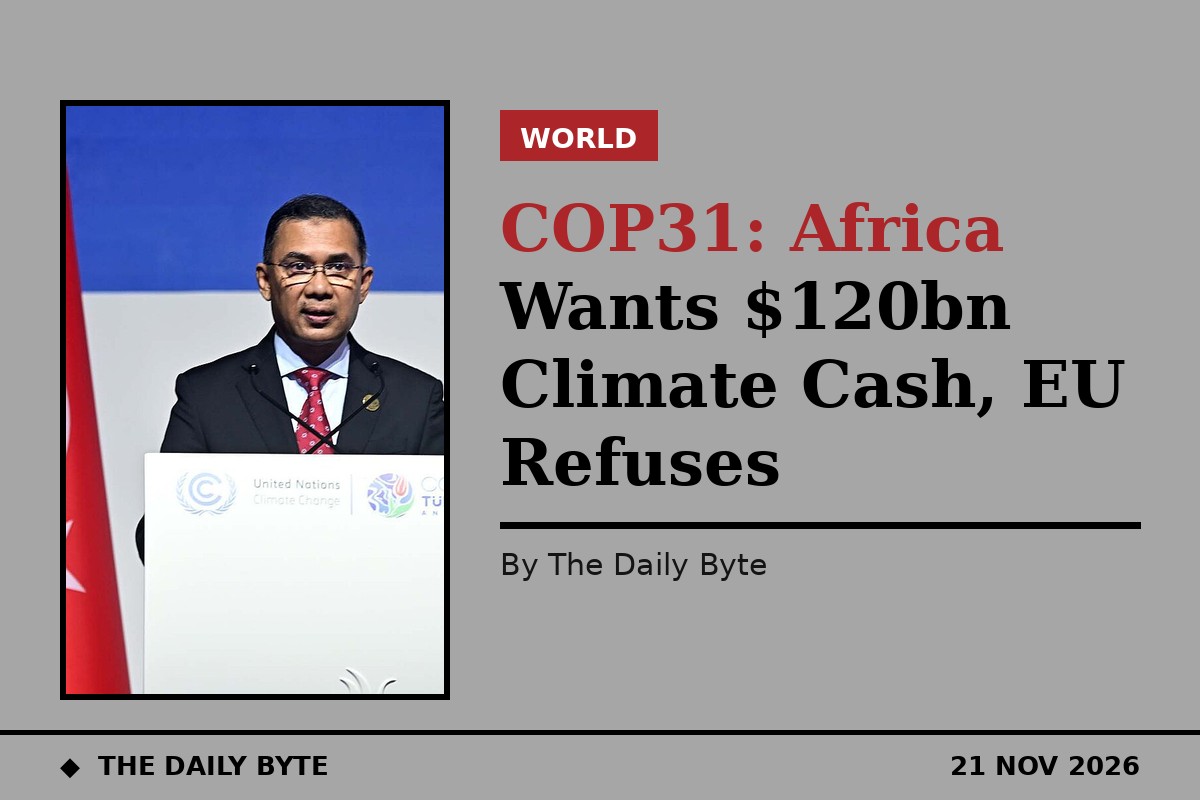
African countries at the UN climate summit in Turkey are demanding that funding to help them adapt to climate change be tripled to at least $120 billion a year by 2035 — but the European Union says it will not put new money on the table until the money already pledged reaches the people who need it.
The African Group of Negotiators, speaking for 54 countries at COP31 in Antalya, wants adaptation finance tripled from an annual $40 billion baseline that it says developed countries committed to providing by 2025. How that commitment should be interpreted remains disputed, and the proposal was not accepted for formal negotiations at the summit, although African delegates kept pushing it as the talks entered their final hours on Friday.
The European Union, one of the largest providers of climate finance, says the priority should be ensuring existing commitments reach vulnerable countries rather than setting new funding targets. “We haven’t come to the table with additional monies or additional capital. It’s about what we have committed already and ensuring it’s deployed,” Darragh O’Brien, who leads the EU delegation at COP31 on behalf of the Irish presidency of the Council of the EU, told a press conference.
European Commission climate commissioner Wopke Hoekstra made the same argument, saying new pledges would mean little if existing commitments were not reaching vulnerable communities. “If you are a vulnerable nation in the Pacific or one of the LDCs [Least Developed Countries] and the money is in the bank but does not land on the ground then it is effectively meaningless,” he said.
What the money is for
Adaptation finance pays for the measures that help vulnerable countries prepare for and withstand climate change: drought-resistant seed, early-warning systems, sea walls and water storage. It is meant to protect communities against the droughts, floods and wildfires that are already hitting the continent.
The scale of the need is substantial. According to the UN’s Adaptation Gap Report, sub-Saharan Africa requires about $51 billion a year in adaptation finance, while the Middle East and North Africa needs $112 billion. Globally, developing countries will need about $300 billion a year by 2035, yet developed countries provided only about a tenth of that amount in 2024.
Hoekstra said the EU had provided $30 billion of the $100 billion in climate finance committed by developed countries in recent years, and argued that other wealthy nations should contribute more.
The draft text drops the number
A revised draft of the COP31 cover decision published on 19 November ran to 80 paragraphs, down from 144, and dropped the $120 billion target, along with references to phasing out fossil fuels and to net-zero dates. The African Group’s demand to triple adaptation finance was not in the text.
The financing dispute has also exposed a capacity problem. Some African countries have yet to develop National Adaptation Plans, the documents that identify climate risks, prioritise investments and provide a framework for attracting international support. Twenty-three African countries, including Uganda and Malawi, have yet to submit their plans to the UN climate secretariat.
African negotiators acknowledge that adaptation plans help countries prioritise investments and attract funding, but argue that their absence should not be used to deny them financial support.
What happens next
COP31 in Antalya ran from 9 to 20 November, and its final hours were dominated by the fight over adaptation finance. Under the 2015 Paris climate agreement, developed countries are required to provide financial support to developing nations, including for adaptation.
With the summit closing without agreement on a new finance number, the argument now moves to the next round of talks, where African negotiators are expected to press the tripling demand again — and where the EU will again be asked whether delivering existing pledges is enough.


