COP31 Final Day: Africa's $120bn Finance Fight
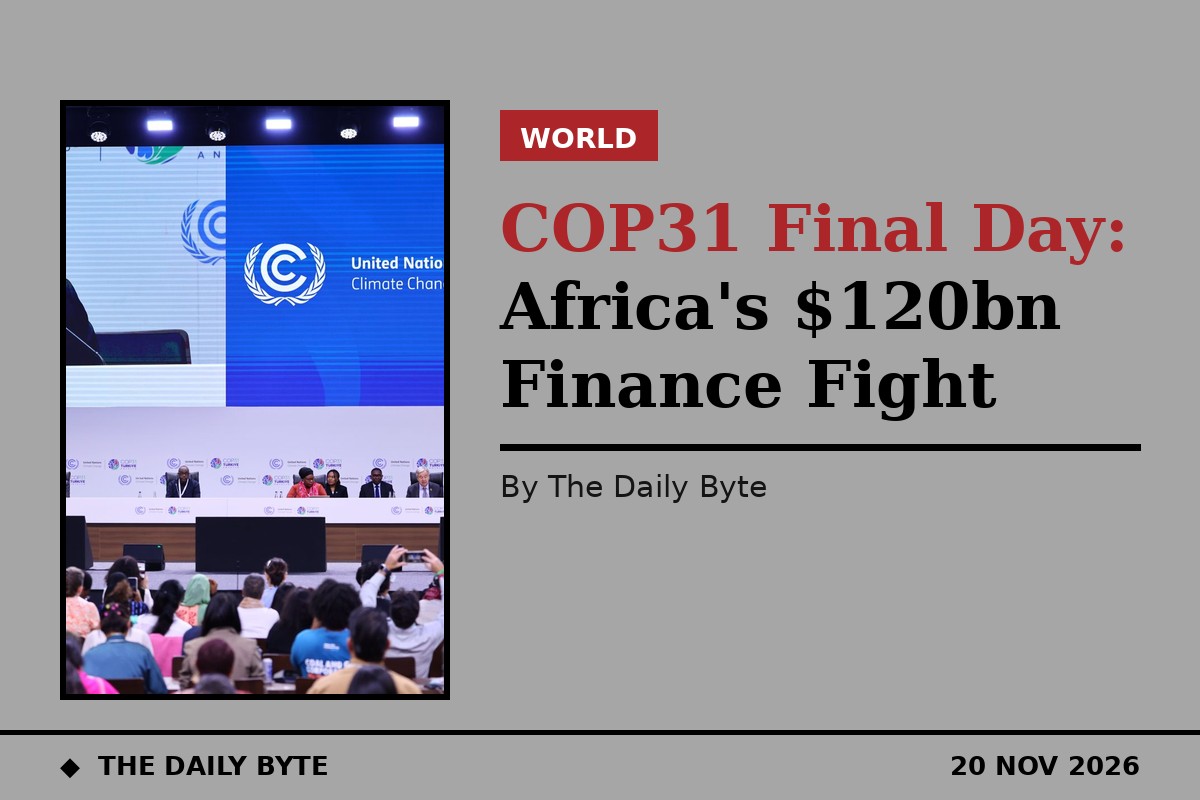
The UN climate summit in Antalya, Türkiye, reached its scheduled final day on Friday, 20 November, with African negotiators at the centre of a fight over money and fossil fuels, and talks expected to run into overtime on Saturday.
Countries that do not usually negotiate together stood side by side at a press conference in Antalya with a message for the COP31 Presidency: the agreement on the table is not good enough. Led by France and Panama, ministers and representatives from countries including Belgium, Côte d’Ivoire, Finland, Greece, Guatemala, Spain, Sweden and Vanuatu joined forces to demand stronger climate action.
The draft that dropped fossil fuels
The row centres on a revised draft of the summit’s cover decision, published on Thursday, 19 November. At nine pages it is significantly shorter than the earlier version, and it removes explicit language calling for an accelerated transition away from fossil fuels, one of the most contentious issues in the negotiations. It also drops a proposed target of at least $120 billion a year in adaptation finance by 2035, and removes references to net-zero dates.
The draft retains a broader commitment to at least triple adaptation finance by 2035, but without the specific figure or a baseline against which progress could be measured. One of the draft’s earlier versions had stated that at least $120 billion would be needed annually.
African negotiators, speaking for 54 countries through the African Group of Negotiators, came to Antalya demanding that adaptation finance be tripled by 2035, to at least $120 billion a year, to pay for drought-resistant seed, early-warning systems, sea walls and water storage. The draft also leaves open an electrification goal to raise electricity’s share of total energy use from roughly 21% today to 35% by 2035, without spelling out that this should come from renewable energy, leaving the door open for fossil fuel power plants to be counted.
Panama threatens to block the deal
Panama’s environment minister, Juan Carlos Navarro, who announced earlier in the week that his country would formally object to any COP31 agreement failing to include fossil fuels language, was direct. “It is not acceptable to have a COP or a cover document that does not even mention fossil fuels, and we simply will not put up with it,” he said. Decisions at UN climate summits are generally adopted by consensus, so a single country’s formal objection can prevent an agreement.
Navarro said the talks were being held hostage by a “petroleum mafia” and needed to be reformed, calling the COPs “an exercise in hypocrisy and futility”. France’s minister for ecological transition, Monique Barbut, added: “We cannot [tell] the world we are now getting to 1.5 [degrees of warming] and then do business as if nothing was happening.” She also pointed to a contradiction in the draft: while fossil fuels are absent from it, several paragraphs promote carbon capture technologies.
Africa’s case and the “worst COP ever” warning
UN Secretary-General António Guterres told world leaders in Antalya last week that governments must accelerate the transition away from fossil fuels, protect workers and communities, and deliver the climate finance promised to developing countries. He called for adaptation funding to triple by 2035 and urged governments to tax windfall profits from fossil fuel companies to help vulnerable nations recover from climate disasters.
Campaigners accused wealthy countries of blocking progress on finance, emissions reductions and support for workers and communities affected by the shift to cleaner economies. Mohamed Adow, director of Power Shift Africa, warned that if fossil fuels do not make it into the final agreement, the summit risks being the “worst COP ever”. “Removing those words from a document will not remove the pollution from the atmosphere,” he said. “It simply exposes how far these negotiations have become detached from what is needed outside this conference center.”
Tasneem Essop, executive director of Climate Action Network International, told a Friday event where attendees chanted and held signs reading “SHAME!”: “There is nothing on the table that protects people, or addresses the priorities of the Global South.”
By Friday afternoon the COP31 Presidency had not published a new version of the proposed Antalya Accord, leaving delegations still working from Thursday’s draft after an all-night negotiating session. Negotiators said they expected the summit to go into overtime on Saturday. The United States, the world’s largest economy and a major emitter, did not participate directly in this year’s talks. Next year’s climate summit is scheduled to take place in Addis Ababa, Ethiopia, in November 2027. Read the full reporting at UN News and Fast Company.


