Copper eases as Chile opens door to Codelco investors
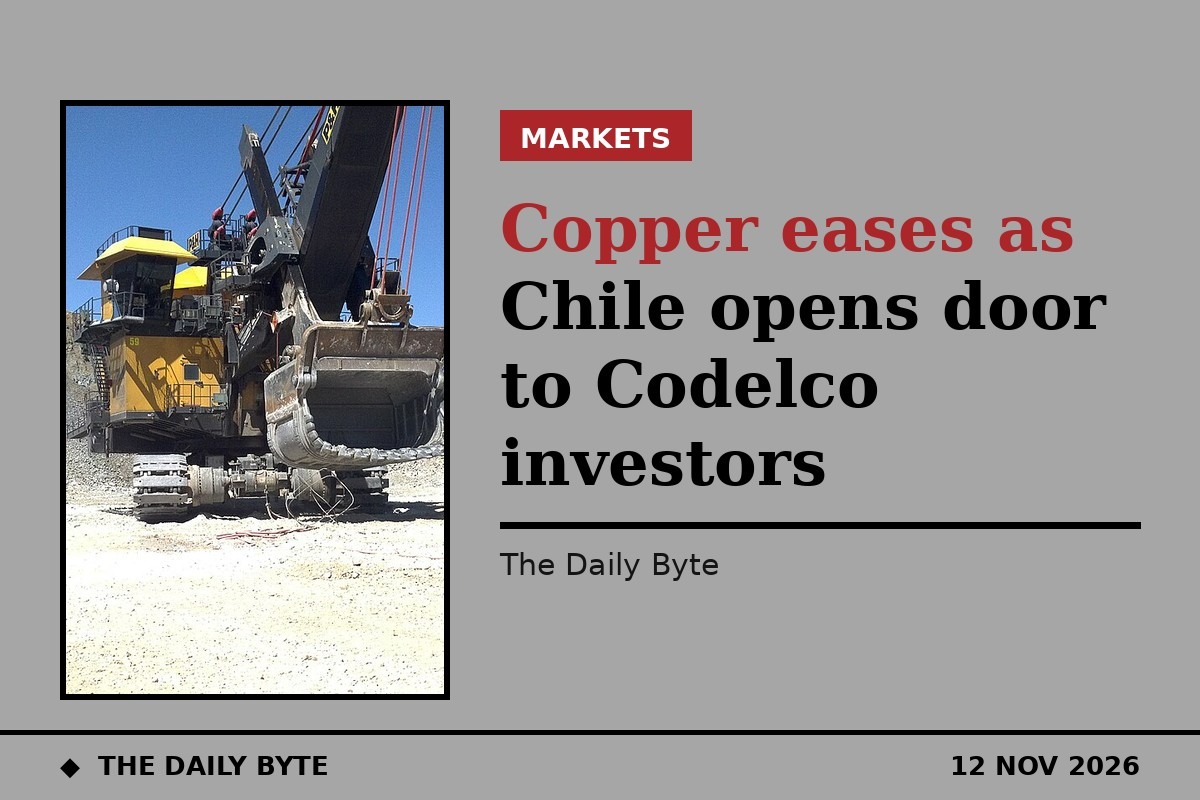
Copper eased on Thursday, 12 November, trading at $13,697 a tonne against $13,840 the previous day, as Chile's government opened the door to private investment in Codelco, the state-owned copper giant whose output troubles worry the global copper market. London-listed miners eased as copper weakened, and the metal's soft tone contrasted with record highs in European equities.
The news came from Santiago, where Finance Minister Jorge Quiroz said the government could eventually allow private investors to acquire minority stakes in Codelco while keeping state control. The immediate priority, he said, is cutting costs and debt, improving management and expanding partnerships with private miners. The shift matters because Codelco is one of the world's largest copper producers, and whether it can reverse a multi-year output slide is pivotal for a market struggling to add supply fast enough for electric vehicles, power grids and data centres.
A historic shift for the state miner
Opening Codelco to outside capital would break a long-standing political taboo. The company has played a central role in Chile's economy since copper was nationalised in the 1970s, and the idea of private ownership has long been off limits. Quiroz was careful to draw a line: any stake sale in the company itself would come later, would keep the state in charge, and would need broad political support. Asked whether it could happen within the current government's four-year term, he answered: “Perhaps not. But we will see. You never know. Four years is a long time.”
The pressure to change is financial. Codelco's chairman, Bernardo Fontaine, told Chilean radio station Radio Duna on Monday that the state-owned company lacks the resources to finance an investment programme valued at roughly $34 billion from its own funds, and that taking on more debt is not its favoured route. He said the company is examining selling holdings in private firms and redeploying the proceeds into its own operations, with that review due in November. Output fell to record lows in 2022 and 2023, and Fontaine warned that the company's current production trend puts its 2026 target of 1.34 million tonnes out of easy reach, although the goal has not been abandoned.
Scandal adds urgency to the overhaul
The overhaul has gained urgency from an accounting scandal in which reported copper production figures for 2024 and 2025 were inflated, in some cases by counting output from the same divisions more than once. Codelco has dismissed managers, brought in external auditors and referred the matter to prosecutors. Chairman Fontaine has stressed that selling shares in the company itself is not part of the current restructuring plan, but he has also said partnerships with private firms are the only way Codelco can grow or even hold output steady.
The proposals have drawn fierce opposition. Labour unions and opposition lawmakers have condemned any move that could weaken public ownership, and the Federation of Copper Workers has warned against what it calls privatisation by pieces, insisting that “Codelco is not for sale”. That political resistance is likely to slow any broader reform, even as the company's finances argue for it.
New projects move ahead anyway
While the ownership debate continues, Codelco's project pipeline is advancing through partnerships. The company and its junior partner Pucobre have won environmental clearance for the $870 million Tovaku copper venture in the Antofagasta region, removing a major regulatory barrier before construction starts in 2027. The open-pit mine is designed to produce about 46,000 tonnes of copper cathodes a year over a 21-year life, with construction taking three years and employing as many as 984 people at peak. The project is held through Minera Puntilla, in which Pucobre owns 60% and Codelco 40%.
Codelco has also signed a deal with Kutch Copper, part of India's Adani Group, to explore the Kaburkaala copper project in Antofagasta, with Adani funding the work and potentially taking long-term supply for its Mundra smelter in India. Codelco already works with private miners including Rio Tinto and BHP, but Fontaine has said the law limits what state-owned companies can do, and that the long and complex process of forming partnerships deters many potential investors.
Why London investors care
Codelco itself is not listed, so European investors cannot buy its shares. But its struggles feed directly into the copper price and into the shares of listed miners such as Rio Tinto, BHP, Glencore and Antofagasta, which feature in many European funds and in the FTSE 100. If private capital helps Codelco finance its undeveloped resources and reverse its production declines, that could support copper supply over time. If the overhaul stalls, the market will stay tight, and the copper price will keep reflecting the difficulty of digging up enough metal to wire the energy transition.
Sources: Seeking Alpha via TradingView; Mining.com; SP Angel market view.