Cornell Faculty Rebukes President Over Rape Case
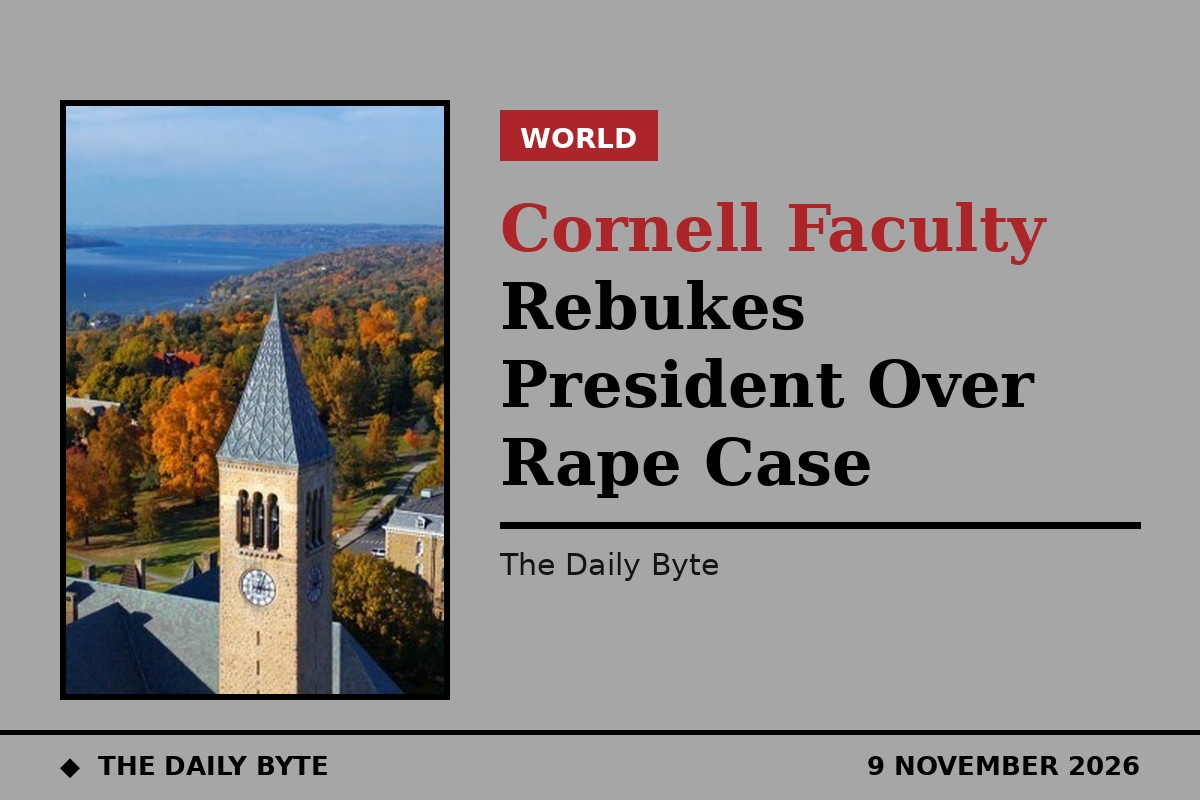
Cornell University's Faculty Senate has voted no confidence in President Michael Kotlikoff over the university's handling of an alleged gang rape by seven fraternity members, deepening a crisis that has already forced a criminal investigation to change hands and drawn weeks of campus protests.
The resolution passed by 75 votes to 50 on Friday 6 November, with five senators abstaining and five not voting. It was introduced by Paul Ortiz, a professor of labour history at Cornell's School of Industrial and Labour Relations, and followed weeks of demonstrations demanding accountability.
The vote does not remove Kotlikoff from office, but it is a public rebuke of the university's leadership from its own academic staff at a moment when the case is under renewed criminal investigation and the subject of a civil lawsuit.
What the case involves
A former Cornell student, identified in court papers as Jane Doe, alleges she was sexually assaulted by seven members of the Chi Phi fraternity at its chapter house in Ithaca on the night of 19 to 20 October 2024. She says she was pressured to take ketamine, incapacitated and assaulted over several hours. She reported the matter to Cornell University Police on 8 November 2024.
In September 2026 she filed a civil lawsuit against Cornell University, the fraternity chapter and seven current and former students. The claims in that lawsuit are allegations. No court has ruled on them, and none of the seven men has been charged with a crime.
The Tompkins County district attorney, Matthew Van Houten, decided within days of the original report not to pursue charges, saying the evidence available did not establish a crime under New York law. He reopened the investigation on 28 September 2026 and set out his reasons in a public statement the same day.
University discipline and a new prosecutor
Cornell conducted its own disciplinary process under Title IX, the federal law barring sex discrimination in education. Its panel expelled two of the men, suspended two more, barred one from campus and imposed lesser sanctions on two others. None was found responsible for every allegation against him. The Chi Phi chapter was suspended in November 2024 and closed later that year.
On 1 October, New York Governor Kathy Hochul signed an executive order removing the case from the local district attorney and appointing Attorney General Letitia James as special prosecutor. James has since appointed Jacqueline Kelly, a former federal prosecutor, to lead the investigation as outside counsel. The investigation continues, with no deadline and no charges filed as of Monday 9 November.
Challenge to the special prosecutor
Lawyers for the accused men have asked a court to remove James from the case, arguing that a social media post she made in September expressing solidarity with the complainant shows bias. A judge heard arguments on 29 October without ruling, and told the defence to bring all seven men onto the petition rather than run seven separate proceedings.
By a deadline of 5 November, five of the seven had signed on to the petition, according to court documents reported by WAMC, the public radio station. The remaining two had not responded. No court has ruled on the challenge.
Independent review under way
Cornell's Board of Trustees has also commissioned an independent review of how the university prevents and responds to sexual misconduct, led by Sally Yates, a former US deputy attorney general, and the law firm King & Spalding. That review, announced on 6 October, remains under way.
The university has also suspended parties in fraternity houses for the rest of the academic year and announced more support for survivors. For now, three separate processes — the criminal investigation, the civil lawsuit and the independent review — are running in parallel, and the faculty vote has made clear that many inside Cornell believe its leadership has not done enough.


