Costa Proposes EU Budget Cuts and Digital Tax
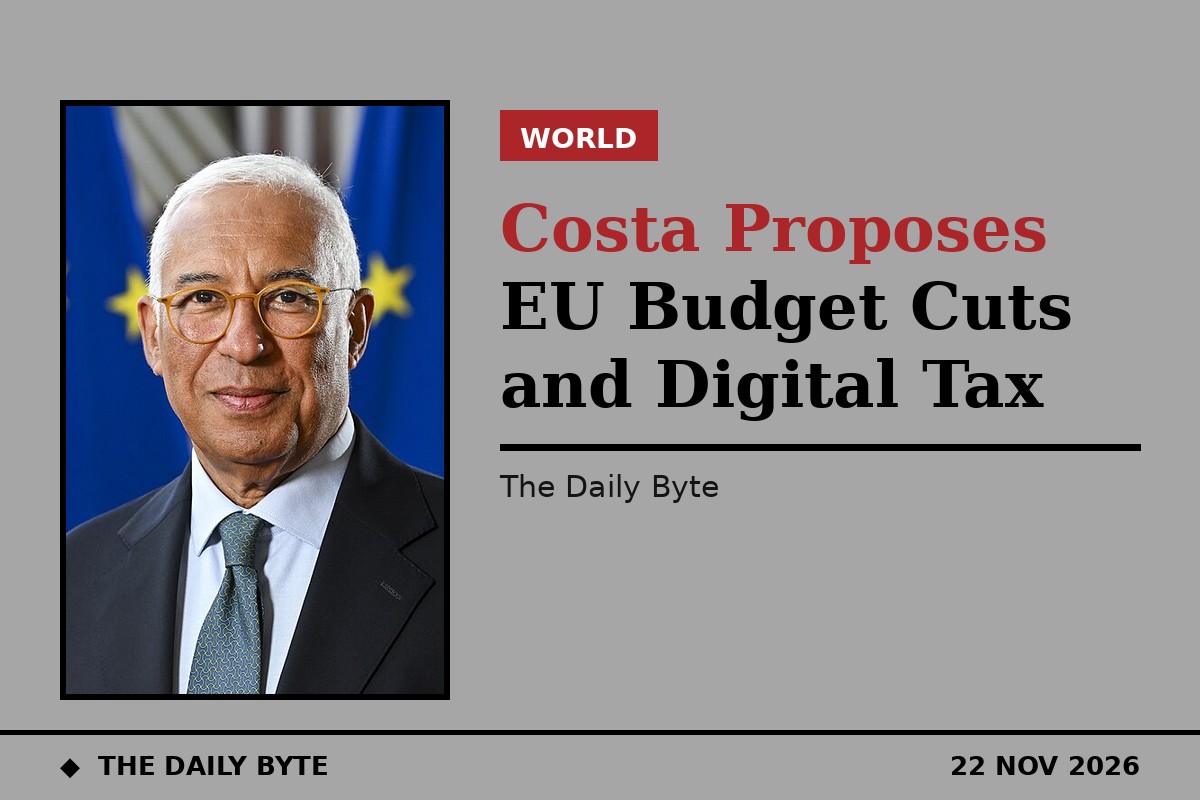
European Council President António Costa has proposed cutting €180.6 billion from the European Union's next seven-year budget and introducing a new tax on digital giants, in a plan published on Saturday 21 November 2026 aimed at breaking the deadlock before EU leaders meet next week.
The proposal would reduce the 2028–2034 budget to €1.582 trillion, down from the European Commission's original €1.76 trillion plan and €40 billion below the figure put forward by the Irish EU presidency in October, according to Reuters. The cuts fall mainly on the European Competitiveness Fund, defence and external spending, while farm subsidies and cohesion funding for poorer regions are largely protected.
What the digital tax would cover
The most eye-catching part of the plan is a proposed 3% tax on annual net turnover from online advertising, digital intermediation services and the monetisation of user data. It would apply to companies with more than €50 million of digital turnover in the EU and more than €750 million of global turnover. The idea revives a 2018 Commission proposal that EU governments never adopted, and the Commission has previously estimated that a 3% EU-wide digital services tax would raise about €5 billion a year.
Costa's document, known in Brussels as the "negobox", sets out five possible new sources of EU income: the digital levy, revenue from the carbon border adjustment mechanism, a fee on uncollected electronic waste, a share of emissions trading revenue and a levy on tobacco. Together they could raise around €60 billion a year, according to figures accompanying the proposal reported by Demócrata. Costa has insisted the digital tax "is not aimed at any specific company".
Opposition already building
The plan has already drawn fire. The European Parliament has signalled that the cuts are unacceptable as a basis for its consent, calling the EU budget an investment budget. Ireland's Taoiseach Micheál Martin has said Ireland does not support the digital tax proposal, arguing that "global taxation has to be done globally" and warning it could lead to further clashes with US President Donald Trump, the Irish Times reported.
Costa also proposed slowing repayment of the capital on the more than €600 billion the EU will have jointly borrowed by the end of 2026 for its post-pandemic recovery fund, easing pressure on national contributions, which would rise only slightly, from 0.80% to 0.82% of gross national income.
What happens next
EU leaders will discuss the proposals at a special summit on 26–27 November, with the aim of narrowing the gap between net contributors and net beneficiaries and reaching agreement in December. Although the budget only has to be ready for 2028, leaders want a deal by the end of 2026 because elections next year in France, Italy, Poland, Greece, Estonia, Finland and Slovakia are expected to make agreement harder.
Frequently asked questions
How big is the proposed EU budget cut?
António Costa proposes cutting €180.6 billion from the European Commission's original €1.76 trillion draft for 2028–2034, bringing the total to €1.582 trillion in constant 2025 prices.
What is the proposed EU digital tax?
A 3% levy on turnover from online advertising, digital intermediation and user-data monetisation, applying to firms with over €50 million of EU digital turnover and over €750 million of global turnover.
When will EU leaders decide on the budget?
Leaders will discuss Costa's proposal at a special summit on 26–27 November 2026, with the aim of reaching agreement by the end of the year.
Source: Reuters via Euronext; second source: Irish Times.


