CPJ Urges Tunisia to Free Jailed Journalists
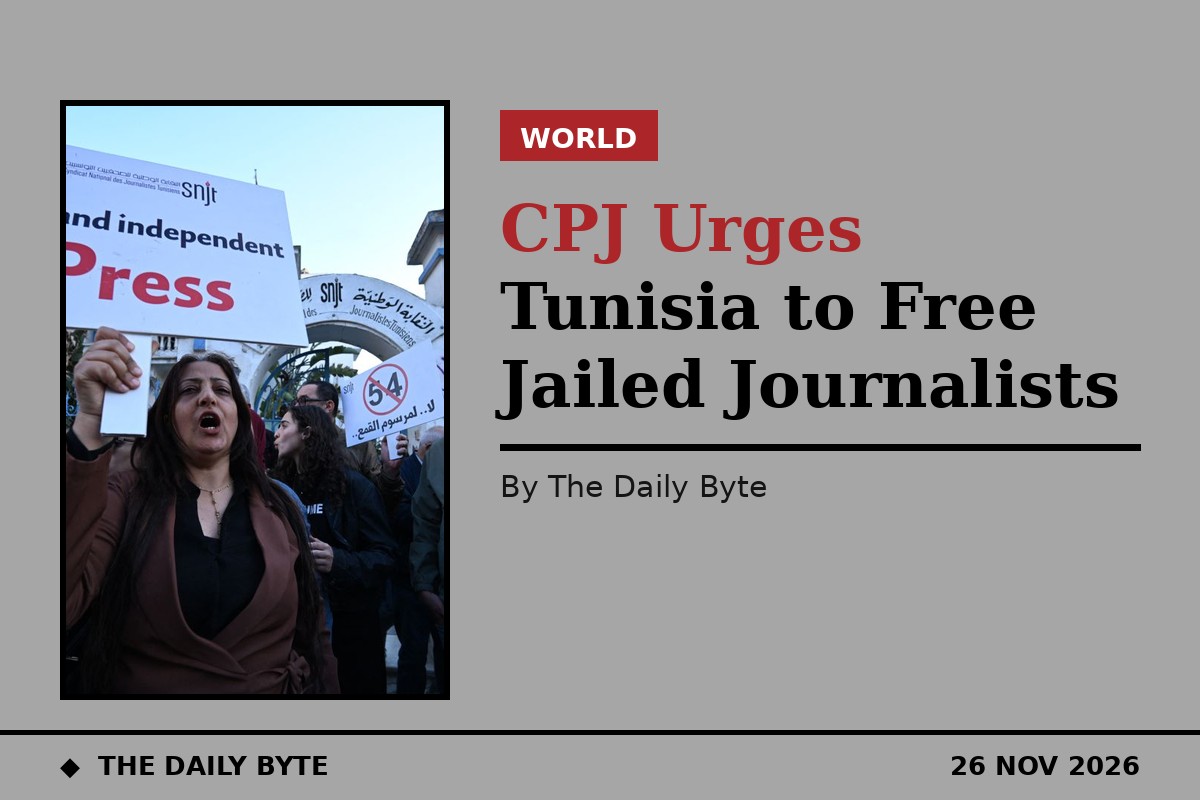
The Committee to Protect Journalists has called on Tunisia to free all journalists jailed for their work, one year after the release of lawyer and media commentator Sonia Dahmani, whose case has become a symbol of the country's crackdown on critical reporting.
The press freedom group issued the call on Thursday, 26 November 2026, from New York. It said Dahmani's release had not changed the reality facing journalists in Tunisia, where reporting critically on those in power can still lead to prison.
Dahmani's case
Dahmani, a lawyer and commentator for IFM radio and Carthage Plus television, was conditionally released on 27 November 2025 after spending more than 18 months behind bars over her media commentary. Despite her release, she continues to face multiple prosecutions and prison sentences under Tunisia's cybercrime law, Decree-Law 54, leaving her at risk of imprisonment once again.
The Committee to Protect Journalists said she faces at least five prosecutions. In May 2026, a court sentenced her to two years in prison over comments she made in 2023 criticising conditions in Tunisian prisons. Her lawyers appealed, which suspends the execution of the sentence. In April 2026, an appeals court upheld a separate conviction over remarks about the treatment of sub-Saharan migrants, reducing a two-year sentence imposed in June 2025 to 18 months. She remains free, but at risk of being returned to prison.
Sara Qudah, the group's regional director, said Tunisian authorities cannot claim progress on press freedom while using the courts as a weapon against independent journalism. She said journalists remain behind bars, others are handed prison sentences, and the threat of prosecution hangs over anyone who dares to speak out.
Who remains behind bars
The group named four journalists who remain in prison: Zied el-Heni, Mourad Zghidi, Borhen Bsaies and Mohamed Yousfi. Their prosecutions involve criminal, financial and terrorism-related allegations. Blogger Hajer Awadi is also serving a 26-month prison sentence over her social media commentary.
Beyond those in prison, other journalists and commentators face prison sentences, ongoing prosecutions or the threat of arrest. The group named Ghassen Ben Khalifa, Haythem el-Mekki, Khaoula Boukrim, Hamza Belloumi and Insaf Boughdiri, saying their cases show how judicial harassment continues to restrict press freedom even outside prison walls.
The law at the centre
The pressure on journalists has grown since President Kais Saied consolidated power in July 2021. The Committee to Protect Journalists said Tunisian authorities have increasingly relied on Decree-Law 54, the Telecommunications Code, and criminal and counterterrorism legislation to prosecute journalists over their reporting and commentary. It said these prosecutions have contributed to a climate of fear and self-censorship, undermining Tunisia's commitments to freedom of expression and press freedom.
Decree-Law 54 is a cybercrime law that criminalises spreading false news. Dahmani was first arrested in May 2024 and convicted under the law over comments made on radio and television. Her case drew international attention, and she received the Committee to Protect Journalists' International Press Freedom Award in 2025. She was released from Manouba prison near Tunis on the day the European Parliament adopted a resolution calling for her release.
A human rights dossier published on 26 November by HuMENA for Human Rights and Civic Engagement sets out the same timeline, recording her arrest on 11 May 2024, her conditional release on 27 November 2025, and the series of convictions and appeals that followed. It records that she remains at liberty but faces further prison terms, including the two-year sentence from May 2026 that is under appeal.
What CPJ is asking for
The Committee to Protect Journalists set out three demands for the Tunisian authorities. It called for the immediate and unconditional release of all journalists imprisoned for their work. It called for all pending charges to be dropped and convictions against journalists and commentators prosecuted for their reporting or peaceful expression to be overturned. And it called for reform and an end to the misuse of repressive legislation to silence independent journalism, including Decree-Law 54, the Telecommunications Code and broadly worded criminal and counterterrorism provisions.
The group said the anniversary of Dahmani's release was a moment to measure what had changed in Tunisia. On its account, the answer is very little: the prosecutions continue, journalists are still in prison, and the laws used against them remain in force.


