Croatia Marks 35 Years Since Ovcara Massacre
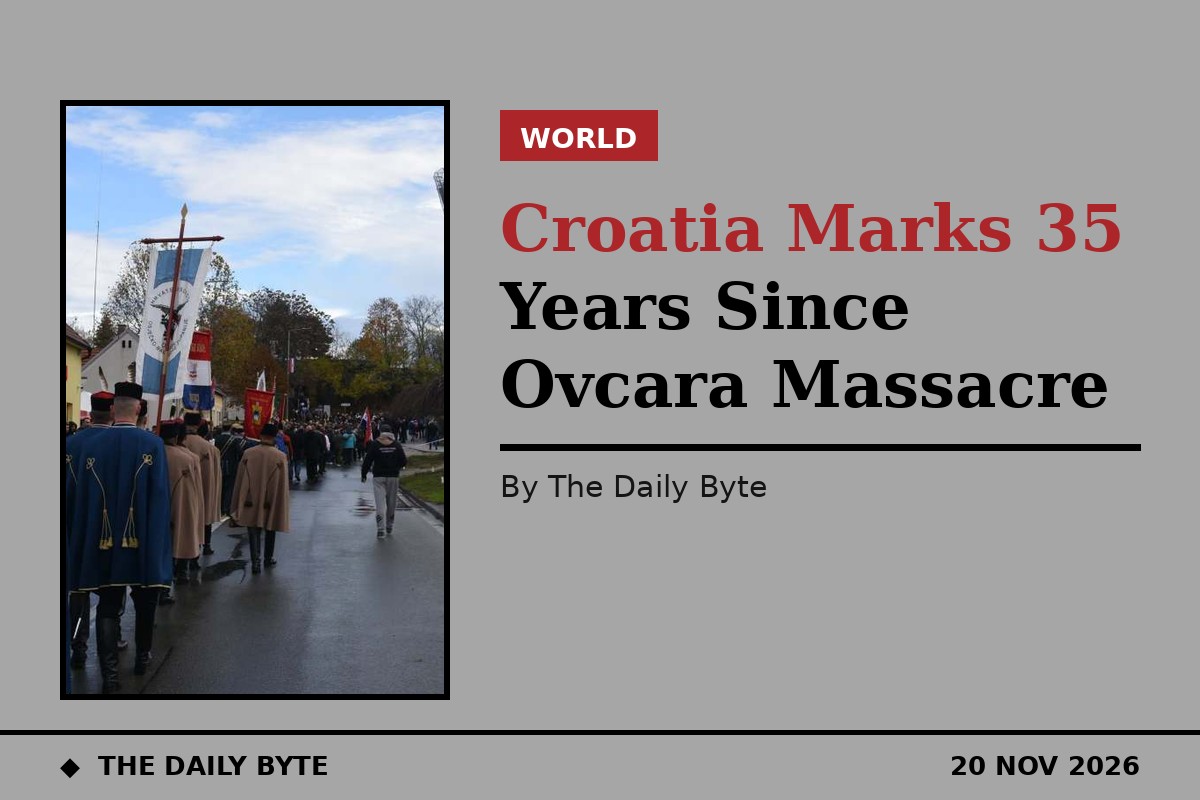
Croatia is marking on Friday, 20 November, the 35th anniversary of the Ovcara massacre, when more than 200 people taken from Vukovar hospital were killed after the city fell in the Croatian War of Independence. Commemorative events are being held today at the former Velepromet camp and at Ovcara, closing a week of remembrance that began with the main ceremonies on 18 November.
On 20 November 1991, Serb forces removed patients, wounded defenders and civilians from Vukovar hospital and transported many of them to the nearby Ovcara farm. There, prisoners were beaten and humiliated before being taken in groups to an execution site near Grabovo, where they were murdered and buried in a mass grave.
Croatian accounts put the death toll at at least 264 people. The International Criminal Tribunal for the former Yugoslavia, which examined the killings, found that 194 of those taken from the hospital were killed. The difference reflects the different ways the victims have been counted over 35 years, not any doubt that a massacre took place.
A city under siege for 87 days
Vukovar fell on 18 November 1991 after an 87-day siege by the Yugoslav People's Army and Serbian paramilitary formations. Around 2,000 Croatian defenders, many of them ordinary civilians before the war, held out against an attacking force estimated at some 30,000 troops while the city was subjected to relentless bombardment.
By the time the city fell, much of it had been reduced to rubble, and at least 2,717 Croatian defenders and civilians had been killed during the siege. More than 22,000 residents were displaced, and thousands were detained in prison camps. Even the hospital, where the wounded had sheltered in the basement, was not spared the shelling.
On the same day Vukovar fell, Yugoslav People's Army forces and Serbian paramilitary units entered the village of Skabrnja, in the hinterland of Zadar. Thirty-eight people were murdered in the initial attack, and by February 1992 at least another 26 people who had been unable to escape had also been killed.
More than 70,000 walk in remembrance
The main commemorative ceremony this year was held on 18 November under the motto Courage, Sacrifice, Freedom. The traditional Procession of Remembrance set out from the National Memorial Hospital Dr Juraj Njavro and walked about 5.5 kilometres through the city to the Memorial Cemetery of the Victims of the Homeland War.
According to the HRT news report, more than 70,000 people took part in the procession this year. It was led by around 70 doctors and nurses who had worked in the wartime hospital, alongside defenders of the city. President Zoran Milanovic, Prime Minister Andrej Plenkovic and parliament speaker Gordan Jandrokovic were among those who walked, and wreaths were laid at the memorial cemetery and at the Ovcara mass grave site.
Across the country, candles were lit in windows and along streets named after Vukovar, and church bells rang. In Zagreb, thousands of candles illuminated Vukovar Street along its ten-kilometre stretch.
The search for the missing continues
Thirty-five years on, the search for those who disappeared during the war remains one of Croatia's most painful unresolved tasks. Croatia is still searching for 1,725 people missing from the war, including 389 defenders, according to figures given by Deputy Prime Minister and Veterans Minister Tomo Medved on 16 November. Around 320 people remain missing in connection with the wartime events in and around Vukovar alone.
Excavations at Petrovacka Dola, near Vukovar's municipal waste site, have recovered and identified the remains of 38 Croatian defenders and civilians since systematic investigations began in April 2022, most of them people forcibly taken from the Vukovar area in the autumn of 1991.
Medved has said Serbia's progress towards European Union membership must be conditional on addressing unresolved wartime issues, including the missing persons, recognition of detention camps and compensation for former camp inmates. Speaking to HRT, he said that until Serbia confronts its role in the aggression against Croatia, the closing of Chapter 23 of its accession talks is excluded.
For the families of the missing, the anniversary is not only about the past. Every excavation, and every identification, offers the possibility of ending decades of uncertainty, and of giving a victim the dignified burial that was denied to them in 1991.


