Croatia: Montenegro Must Settle Border for EU Talks
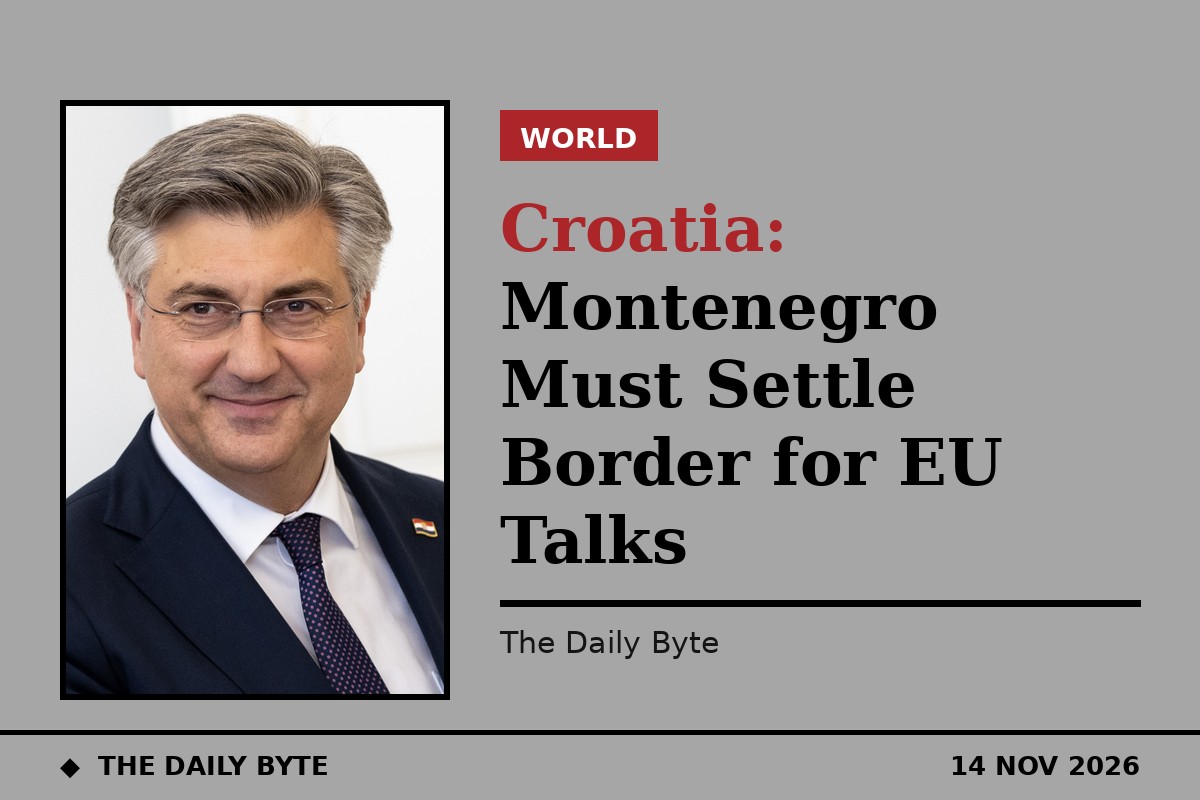
Croatia has warned Montenegro that it will not be able to close its European Union accession negotiations as planned unless it accepts the principles of the Badinter Commission for delimiting the land border between the two countries. The warning, delivered by Prime Minister Andrej Plenkovic in the Croatian parliament, puts one of the Western Balkans' oldest border disputes at the centre of Montenegro's bid to become the EU's 28th member state in 2028.
Plenkovic told lawmakers that Zagreb has already sent Podgorica a draft agreement on delimiting the land border, based on the principles set out by the Badinter Commission, the body that advised on the borders of the republics emerging from the former Yugoslavia. He argued that the proposal should be acceptable to Montenegro because the temporary border regime currently in force between the two countries rests on the same approach.
"If it doesn't suit them, it means that they are sending a message: we can't accept the principles of the Badinter Commission, we don't believe that republican borders are borders between countries that emerged after the former SFRY. Then it's a serious problem. And in that variant Montenegro will not close the accession negotiations as it plans," Plenkovic said, according to Montenegrin broadcaster RTCG.
Three of eight demands close to resolution
Speaking in Dublin on 13 November, on the sidelines of the European Political Community summit, Plenkovic struck a more encouraging note on the wider list of Croatian demands. Of the eight issues Zagreb has raised with Podgorica in the context of Montenegro's EU accession, three are close to being resolved, he said.
The first concerns compensation for Croats detained at the Morinj camp in the early 1990s. Plenkovic said the two countries' foreign ministers have "practically finalised the text" of a bilateral agreement on the issue. Montenegro took decisions in October on two further issues, and Zagreb is now awaiting their implementation: the renaming of the municipal swimming pool in Kotor, which bears the name of a former guard at the Morinj camp, and approval of the commemorative plaque installed at the entrance to the former camp. The guard's name is still displayed at the swimming pool entrance, the prime minister noted.
"There is not a single one that is not solvable. I think that the political will of the Montenegrin side is crucial," Plenkovic added, saying that other member states were exerting "no pressure" on Croatia.
What Croatia is asking for
Croatia circulated a document to fellow EU member states setting out eight conditions that Podgorica must meet before it can join the bloc. Six of the demands fall under Chapter 23 of the accession negotiations, covering the judiciary and fundamental rights, and two under Chapter 31, covering foreign, security and defence policy.
At the Morinj camp, more than 300 Croatian citizens, mainly from the Dubrovnik area, were detained between October 1991 and August 1992. Croatia is seeking compensation for the former detainees, preservation of the memorial plaque at the site, and the renaming of the Kotor swimming pool. The remaining Chapter 23 demands concern the fate of 14 missing Croatian citizens, the prosecution of war crimes, including on the basis of command responsibility, and property claims by Croatian families, including 51 families from Tivat and others from the Bay of Kotor.
The two Chapter 31 demands concern the return of the training ship Jadran, which was in Montenegro for repairs when the war began in 1991, and the border itself. Montenegro has been unable to close Chapter 31 since 2024 because of Croatia's opposition following the Montenegrin parliament's adoption of a resolution on Jasenovac. The document states that the outstanding issues "must be solved before Montenegro joins the EU".
Podgorica's reply
Montenegro's prime minister's office has replied that it does not question the application of the Badinter principle, but that the point at issue is how the border ran in the specific area, and how the land section, the sea and the tripoint are determined by a single state border treaty. Podgorica wants the three elements covered by one treaty, and has proposed a two-step approach: bilateral dialogue first, and if no solution is reached within a reasonable time, a joint appearance before an appropriate international body.
Montenegro has provisionally closed 23 of its 33 negotiating chapters, most recently chapters on the free movement of goods and food safety on 6 November. With the accession treaty already being drafted, the border question is now the clearest test of whether Podgorica can finish the talks by the end of 2026 and stay on course for membership in 2028. Sources: Agence Europe and bne IntelliNews via Bytes Europe.


