CVE-2026-103788: Dell SONiC Flaw Allows No-Login RCE
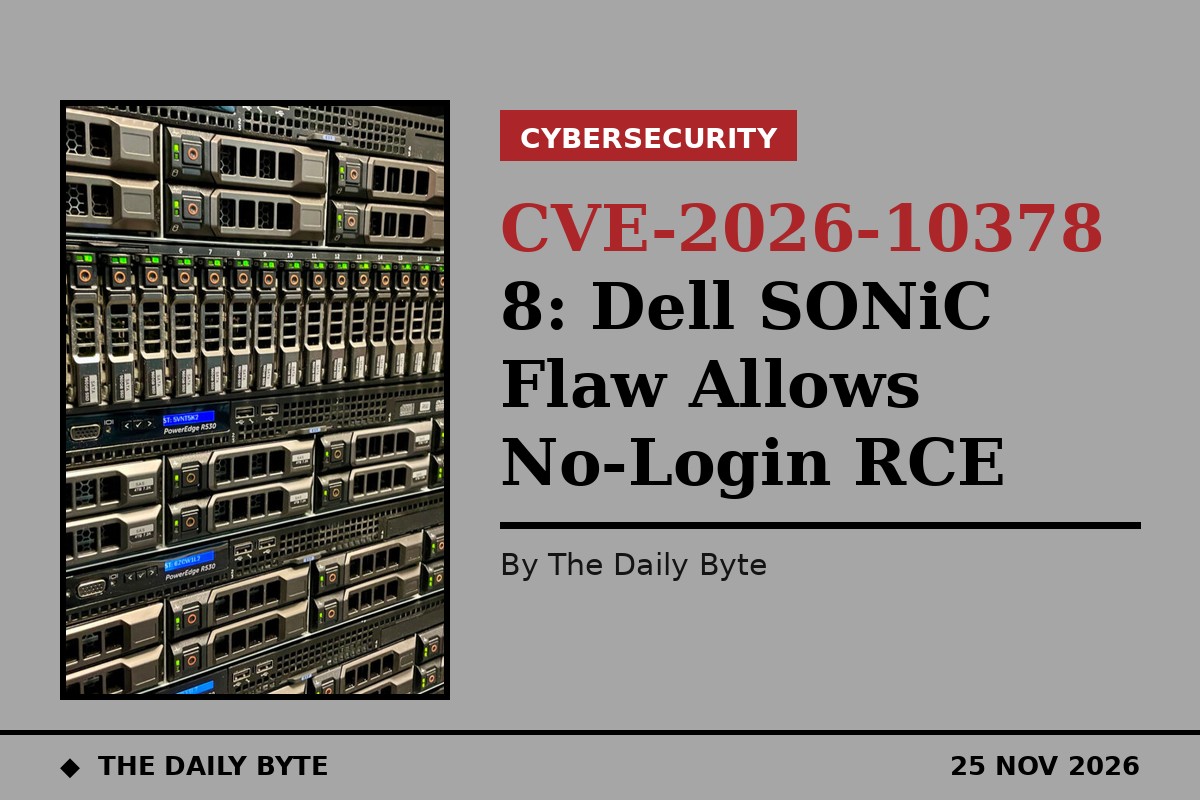
Dell has disclosed a second critical flaw in its Enterprise SONiC Distribution software that could let an attacker run commands on affected network switches without logging in at all. Tracked as CVE-2026-103788, the operating-system command injection flaw scores 9.6 out of 10 and affects all versions before 4.6.1. An unauthenticated attacker on an adjacent network could exploit it to execute arbitrary commands. Dell's advisory, DSA-2026-451, was published on 19 November 2026, the CVE record was published on 23 November, and the fix is version 4.6.1. This is a different flaw from CVE-2026-103782, the 9.9-rated argument injection bug in the same advisory that was covered on 23 November; it needs no privileges and no user interaction, only a network position next to the switch.
No exploitation has been confirmed, and CISA has not added the flaw to its catalogue of vulnerabilities known to be exploited. That is the position defenders should act from: the patch exists, the attack needs no credentials, and network switches are the kind of device that tends to stay unpatched for years once installed.
What the flaw lets an attacker do
The weakness is classified as CWE-78, improper neutralisation of special elements in an operating-system command. In plain terms, the software builds a system command from input it does not properly separate from the command itself, so crafted input can break out and run as an extra command. Dell's description, carried in the NVD record, says an unauthenticated adjacent-network attacker could potentially exploit the flaw, leading to arbitrary command execution, and calls it critical precisely because the command execution needs no login.
The severity vector makes the shape of the risk clear: attack vector adjacent, attack complexity low, no privileges required, no user interaction, and scope changed, with high impact on confidentiality, integrity and availability. "Adjacent" means the attacker must be on a network directly reachable from the switch, such as the same segment, rather than anywhere on the internet. "Scope changed" means the commands run beyond the application itself, on the underlying switch system. A low-privileged remote attacker was the condition for the sibling flaw CVE-2026-103782; this one removes even that requirement for anyone already on the neighbouring network.
Which switches are affected
Every release of Dell Enterprise SONiC Distribution before 4.6.1 is affected, and 4.6.1 is the remediated release. Dell's advisory lists the affected PowerSwitch platforms, and Dell notes that its affected-products table may not cover every supported version and could change as more information becomes available. The practical step is to check the exact distribution version running on each switch against the current advisory, rather than assuming a model is safe because it is not named.
Switches deserve the same urgency as servers here. They sit at the centre of the network, they usually run with high privilege by design, and a compromised switch can watch, redirect or disrupt the traffic passing through it. The fix is a software upgrade, not a configuration change, so there is no setting to toggle as a substitute.
What to do now
Upgrade affected switches to Enterprise SONiC Distribution 4.6.1 through Dell's normal update path, starting with any switch whose management network is reachable from less trusted segments, and confirm the new version is actually running afterwards. Until the upgrade is done, keep switch management interfaces off networks that untrusted devices can reach, and treat any device on the same segment as the switches as part of the trust boundary.
Administrators should also check whether the sibling flaw CVE-2026-103782 has been addressed on the same devices, since both are fixed by the same 4.6.1 release. Upgrading once closes both. With no exploitation reported yet, the window to patch before this becomes an actively exploited flaw is still open, but a 9.6 unauthenticated command execution bug in network infrastructure is not the kind of window to test.