CVE-2026-106169: Google Cloud RCE Flaw Patched
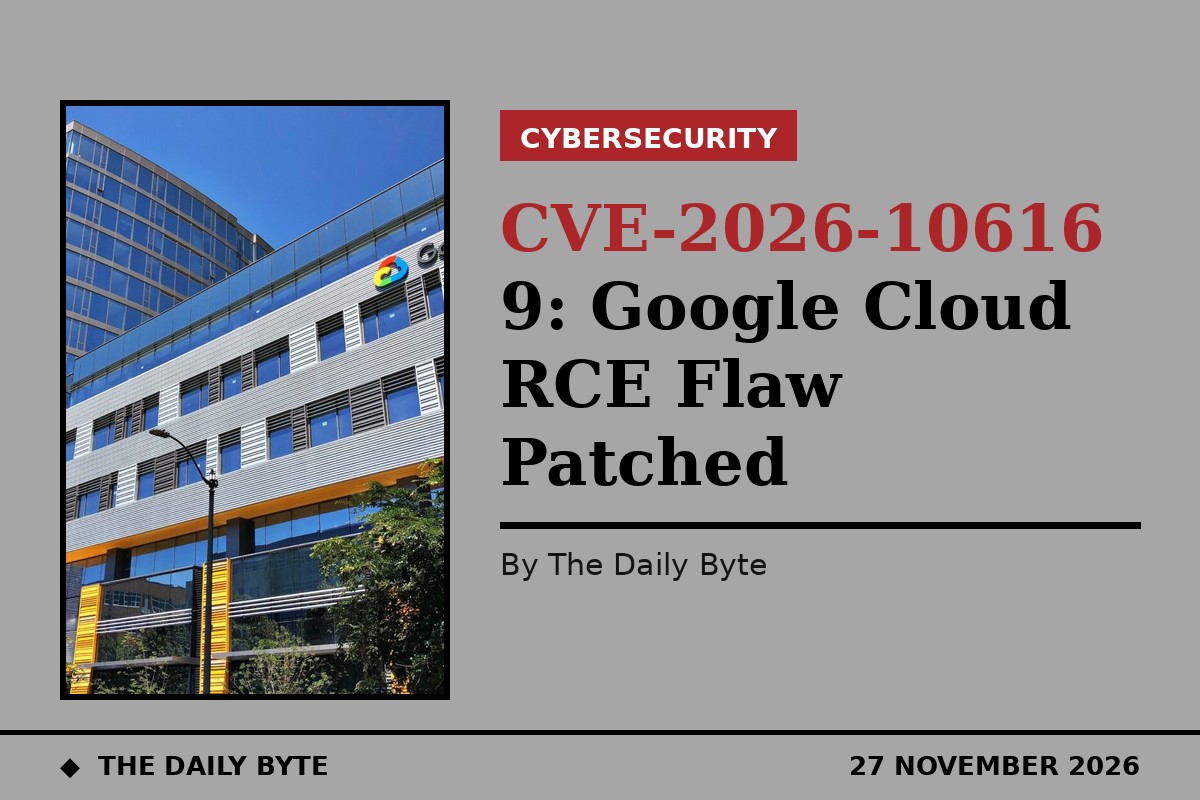
Google has disclosed a critical remote code execution flaw in its Cloud Application Integration service, a managed platform that businesses use to connect applications and automate workflows. The vulnerability, tracked as CVE-2026-106169, carries a CVSS severity score of 9.4 out of 10.
Google published security bulletin GCP-2026-083 on 18 November 2026, and the CVE record was published on 27 November. The flaw is a deserialization of untrusted data issue, tracked as CWE-502, in the way Application Integration handled execution parameters. An authenticated attacker could send a specially crafted serialized Java object and achieve remote code execution inside the service.
How the flaw worked
Deserialization is the process of turning stored or transmitted data back into a working object inside a program. It becomes dangerous when a system accepts data it has not properly checked and reconstructs it as code, because an attacker can smuggle in instructions the system then runs. In this case Google says the flaw sat in the eventbus execution path of Application Integration, which moves data between connected systems.
Application Integration is a managed service on Google Cloud Platform for building enterprise workflows that link applications, data and external systems through event-driven or scheduled integrations. Because it is managed by Google, the vulnerable code ran on Google's own infrastructure rather than on customer servers.
Already patched, no action needed
The important point for customers is that Google has already fixed it. The company patched the service on 22 September 2026, and the bulletin states that no customer action is needed. There is no package to install, no restart to schedule and no change to integration definitions required. Organisations only need to confirm that their inventory records match the service and note Google's remediation date.
Google has not reported any active exploitation of the flaw, has not published proof-of-concept code and has not identified any affected customers. The flaw required the attacker to be authenticated, so it could not be reached by an anonymous visitor; even so, a 9.4-rated code execution flaw in a cloud integration service is serious, because such services often hold credentials and access to the systems they connect.
Google retains local execution logs for no more than 32 days, which limits how far back any investigation can reach. Organisations that used Application Integration before 22 September 2026 were in scope of the flaw, and security teams should check whether any unusual integration activity occurred in that period. The disclosure is a reminder that even fully managed cloud services can carry critical flaws, and that the fix can be complete before customers ever hear about it.


