CVE-2026-129713: Danfoss flaw puts fridges at risk
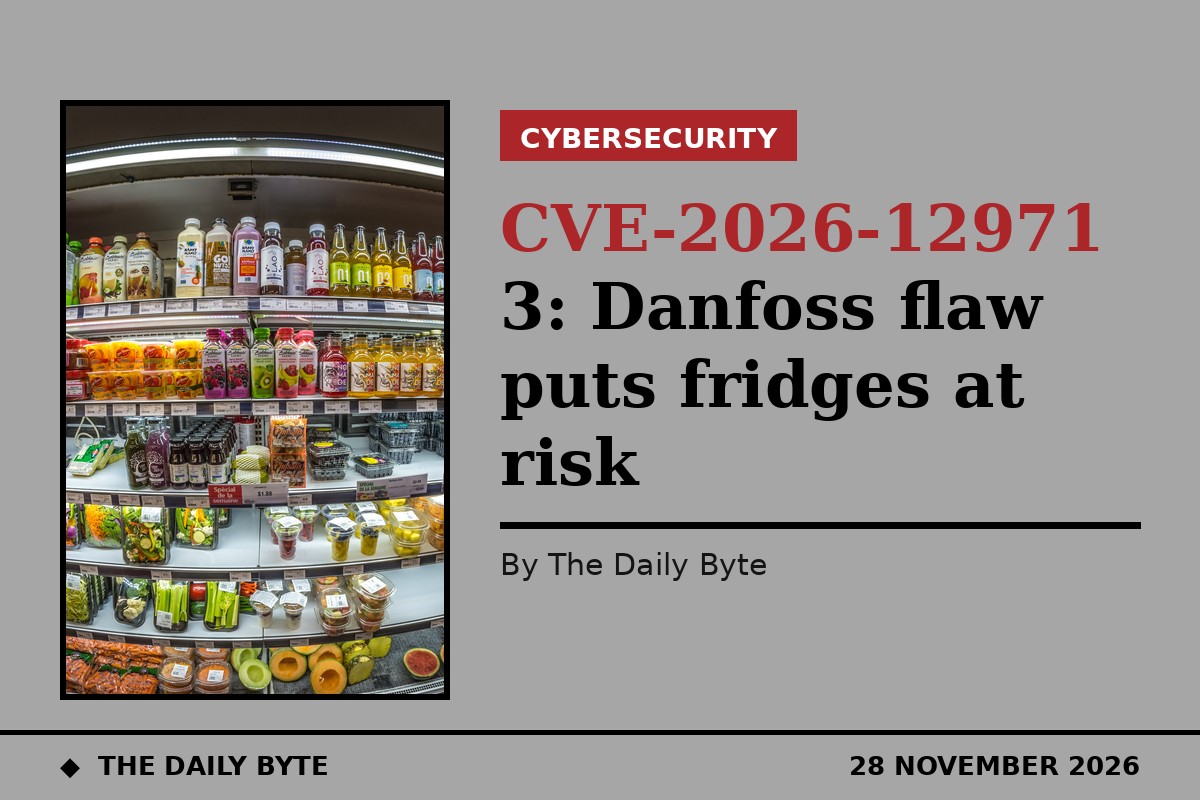
The United States cyber defence agency has given a formal identity to a serious flaw in the refrigeration controllers that keep supermarket food cold, and there is still no patch to install. The Cybersecurity and Infrastructure Security Agency (CISA) published advisory ICSA-26-328-03 on 24 November 2026, assigning CVE-2026-129713 to a stack-based buffer overflow in the Danfoss AK-SM 8xxA series of controllers. The flaw scores 9.8 out of 10 under version 3.1 of the Common Vulnerability Scoring System, the highest severity band, and 9.3 under version 4.0.
These controllers are the quiet workhorses of the food chain. A single AK-SM unit in a supermarket back room or a cold storage warehouse manages case temperatures, compressor racks and defrost schedules for a whole store. CISA lists the affected sector as commercial facilities, notes the controllers are deployed worldwide, and says every version up to and including 5.4.0 is affected. The flaw was reported to CISA by Carlo Meijer of the Dutch security firm Midnight Blue.
What the flaw allows
The problem sits in an unauthenticated CGI handler, the part of the controller's web interface that answers requests before any login. According to CISA, a remote attacker can send specially crafted HTTP or HTTPS POST requests that corrupt the controller's memory, restart its web server and could hypothetically allow arbitrary code to run with the web server's privileges. No password is needed and no user has to click anything.
That combination is what makes the flaw dangerous. The advisory's wording is careful: memory corruption and a web server restart are certain, while code execution is described as hypothetical. But a login-free flaw in a device that is often reachable from the internet is exactly the kind of opening attackers scan for, and CISA says the successful exploitation of this vulnerability could allow an attacker to execute arbitrary code with webserver privileges.
No patch yet
There is no fix available today. CISA says the flaw will be addressed in an upcoming Danfoss AK-SM 800A series software release, version 5.5.x, and that Danfoss will also remove the ability for users to turn off Strict Mode in future software releases. Until that release lands, owners have only mitigations to work with, and one of the most important is that moving to version 5.4.0 does not help: CISA lists 5.4.0 and earlier as affected, so the current release is still vulnerable.
Danfoss recommends keeping the controllers in Strict Mode, which provides enhanced security protections, and the fact that the company plans to take away the option to disable it shows how seriously it views that setting. Owners are also told to use strong, unique passwords for all user and administrative accounts.
Why it matters now
The advisory lands in the middle of an active campaign against refrigeration equipment. Since October, attackers have reached internet-exposed refrigeration controllers from Danfoss, Copeland and Dixell in France and across Europe, triggering unwanted defrost cycles and spoiling stock. France has attributed the October attack to a cyber unit of Iran's Islamic Revolutionary Guard Corps, and United States agencies issued a joint fact sheet on hardening refrigeration and cold chain monitoring systems on 5 November.
Those attacks have not been tied to CVE-2026-129713, and CISA says no known public exploitation specifically targeting this vulnerability has been reported to it at this time. The connection is one of exposure rather than proof: attackers are already hunting for these controllers on the internet, and a login-free flaw with no patch is the worst thing they could find.
What owners should do
CISA's first instruction is to take the controllers off the internet. Devices should not be exposed directly or given public IP addresses, and remote access should run through a secure virtual private network or other protected network architecture, behind a firewall and isolated from business networks. Owners should check every AK-SM 8xxA they own, including any a contractor connected through its own modem, confirm its software version, and check whether its web interface can be reached from the internet.
Controllers that have been exposed should be checked for changed setpoints, defrost schedules, user accounts and remote access settings, and alarms should be set for unexpected defrost cycles or temperature changes. The same pattern reaches beyond supermarkets into food and drink plants, pharmaceutical cold chains and any commercial building where a contractor manages equipment from outside. For all of them, the advice is the same: isolate the controllers now, keep Strict Mode on, and plan to install version 5.5.x as soon as Danfoss releases it.


