CVE-2026-129968: LiteSpeed PrestaShop Flaw Scores 9.3
A flaw in LiteSpeed Cache for PrestaShop lets an attacker with no account take over an online store by sending a specially crafted request. Tracked as CVE-2026-129968, the flaw scores 9.3 out of 10 under CVSS version 4.0, the highest severity band. It was published on Tuesday, 25 November 2026, after coordinated disclosure through CERT Polska, Poland's national computer emergency response team, which credited researcher Karol Susicki of DIVEZONE.PL with the report.
The problem sits in how the plugin handles the "pd" request parameter. The plugin takes the value of that parameter and uses it to render a template, without first checking that the value is genuine and without checking that it names a real template file ending in .tpl. An attacker can therefore supply their own content and have the server process it as a template. That is a server-side template injection flaw, classified as CWE-1336, and it is the step that turns an ordinary web request into control of the store.
What an attacker can do
The attack needs nothing the victim has to give it. The CVSS vector records network access, low complexity, no privileges and no user interaction, with high impact on confidentiality, integrity and availability. According to the CVE record, a successful attack can give the attacker full control of the store and access to customer and payment data. For a shop, that is the worst combination: the attacker can read orders and customer details, change what the shop shows and charges, and use the server as a base for further attacks.
Template injection is dangerous because the template engine runs with the application's own privileges. Content the attacker controls is not treated as text to display; it is treated as instructions to carry out. The plugin was supposed to restrict rendering to its own template files, and the missing check is what removes that boundary.
Who is affected
Every version of LiteSpeed Cache Plugin for PrestaShop before 1.6.2 is affected. The fix is version 1.6.2, which LiteSpeed has already released. Store owners running PrestaShop should check which version of the plugin is installed and update to 1.6.2 or later. Because the flaw needs no login, any store with the plugin reachable from the internet is exposed until it is updated, whether or not the shop itself is large.
The flaw is not listed in the US CISA catalogue of exploited vulnerabilities, and no exploitation has been reported in the sources checked. That is a snapshot, not a guarantee: the CVE record was published only today, and template injection flaws in widely used shop plugins are exactly the kind of issue automated scanners look for first.
What to do now
Update the plugin to version 1.6.2. After updating, check the shop's logs for unusual requests carrying template code, and look for unexpected administrator accounts, changed payment settings or unfamiliar files. If anything looks wrong, treat the store as compromised: rotate the shop's administrator and database passwords, review recent orders for tampering, and check with the payment provider whether any customer card data was at risk.
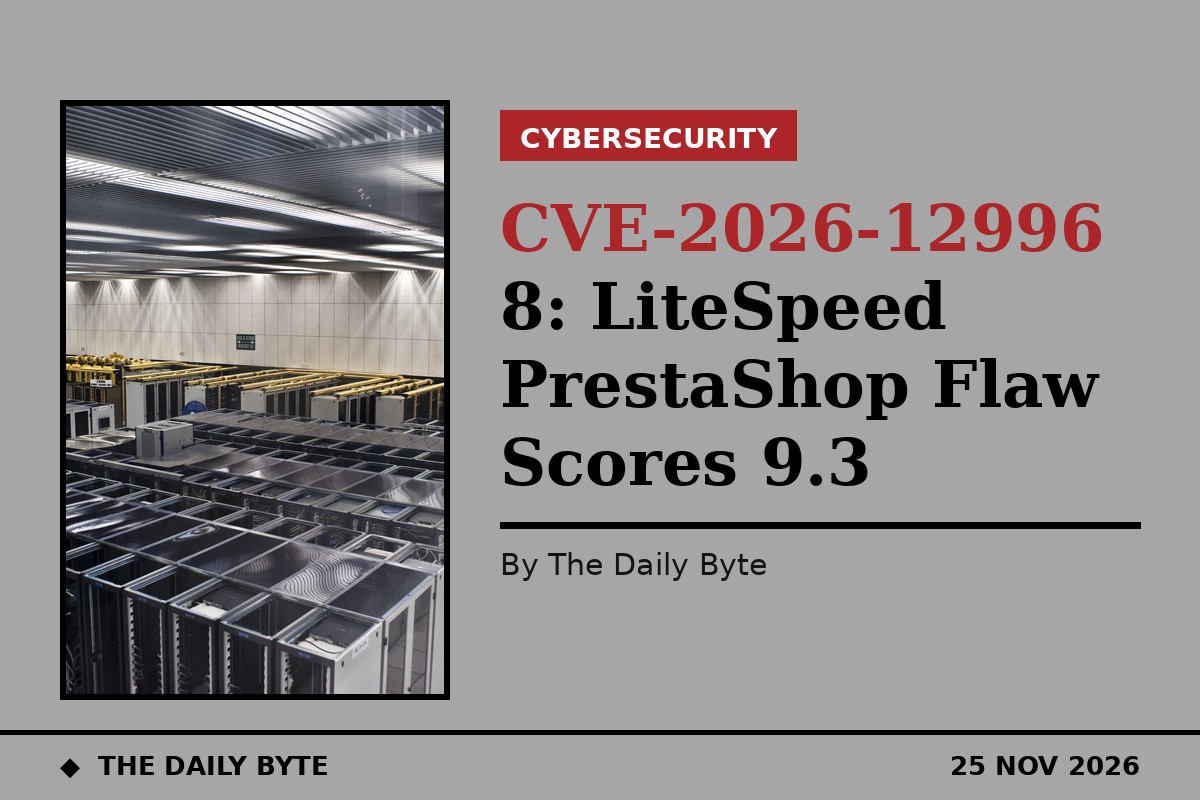
Longer term, the lesson is the same one this flaw demonstrates. A plugin should never pass a request parameter straight into a template engine, and any shop plugin that renders files should check both that the file is one of its own and that the caller is allowed to ask for it. (The image above is a generic file photo of a server hall, not the LiteSpeed plugin or any affected store.)
FAQ
What is CVE-2026-129968? It is a template injection flaw in LiteSpeed Cache Plugin for PrestaShop before version 1.6.2, scored 9.3 out of 10 under CVSS 4.0, that lets an unauthenticated attacker inject template content and take over a store.
Am I affected? If your PrestaShop store runs LiteSpeed Cache Plugin version 1.6.1 or earlier, yes.
Is there a fix? Yes. Update to version 1.6.2 or later, which LiteSpeed has already released.
Is it being exploited? No exploitation has been reported in the sources checked, and the flaw is not in CISA's exploited-vulnerabilities catalogue.
[Source: CERT Polska advisory for CVE-2026-129968](https://cert.pl/en/posts/2026/11/CVE-2026-129968) | [Source: NVD record for CVE-2026-129968 via OpenCVE](https://vulcheck.security.arvaninternal.ir/cve/CVE-2026-129968)