CVE-2026-130680: SiYuan Flaw Lets Notes Run Code
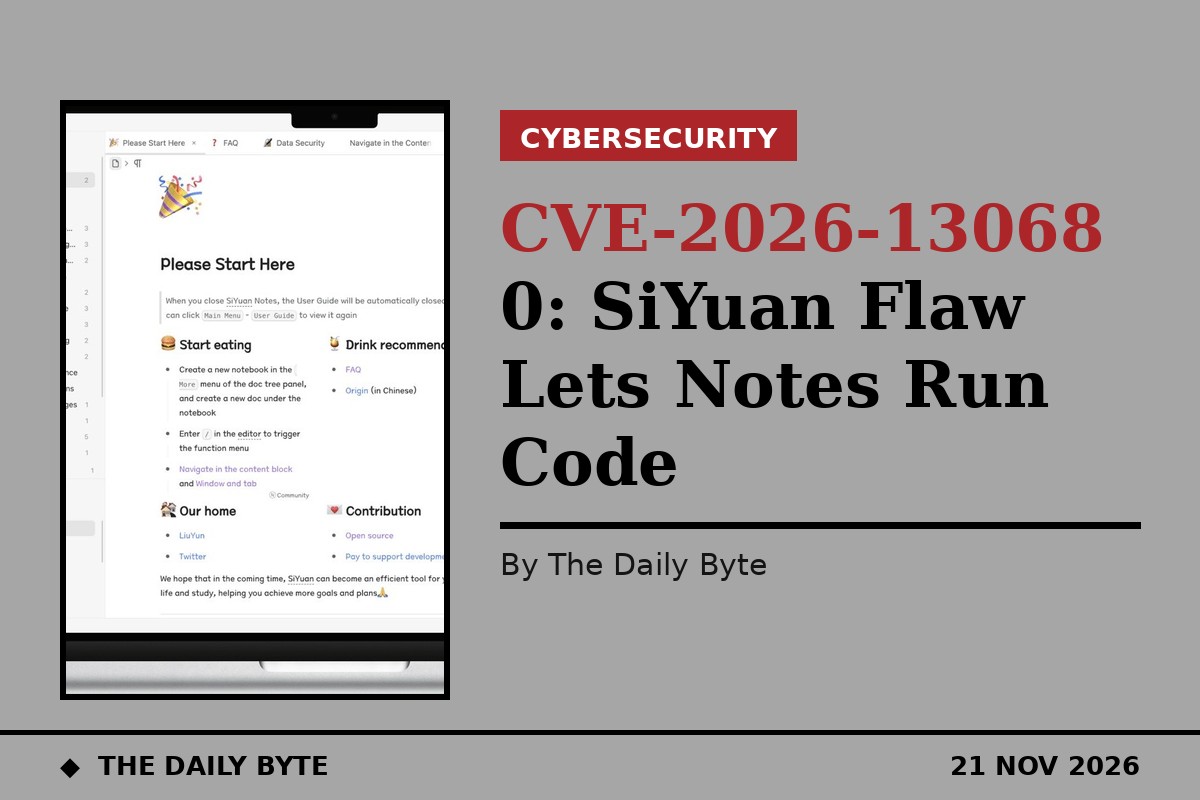
Three critical security flaws in the open-source note-taking app SiYuan can turn an ordinary shared note into a way to run commands on a victim's computer. The flaws, published in the National Vulnerability Database (NVD) on 18 November 2026, carry CVSS scores of up to 9.6, and all three are fixed in SiYuan version 3.8.10. Anyone running an earlier version should update now.
SiYuan is a personal knowledge-management application built on Electron, the framework that lets desktop apps run web technology. Its desktop client runs on Windows, macOS and Linux, and its documents are designed to be shared — users pass around notebooks and exported files, and teams keep shared knowledge bases. That sharing model is exactly what makes these flaws dangerous: the attack arrives as a document, not as a suspicious download or a phishing link.
What the three flaws do
The most severe flaw is CVE-2026-130680, rated 9.6. It sits in the Gallery and Kanban renderers of SiYuan's AttributeView feature, the database-style tables users build inside notes. Checkbox column names in those views are not escaped before they are drawn on screen, so an attacker can hide malicious HTML and JavaScript inside a column name. When the victim opens the crafted document or switches to the affected view, the hidden script runs.
The second flaw, CVE-2026-130679, rated 9.0, works the same way through a different function. SiYuan versions before 3.8.10 contain a stored cross-site scripting vulnerability in genAVValueHTML(), the function that builds the HTML for AttributeView values. An attacker who can store an AttributeView asset value can inject a script through an unescaped image source attribute, and the script runs when the victim opens the affected note or attribute panel.
The third flaw, CVE-2026-130681, also rated 9.0, is an incomplete fix for an earlier vulnerability. The patch for the earlier flaw did not cover every code path, leaving residual injection routes in the AttributeView rendering pipeline. All three flaws affect SiYuan versions before 3.8.10, with CVE-2026-130680 specifically affecting versions 3.3.0 to 3.8.9.
Why a note flaw can take over a computer
Stored cross-site scripting is usually a website problem: injected script runs in a visitor's browser. In SiYuan it is worse, because the desktop app runs with Node.js integration enabled. That means script running inside the app can reach Node.js features directly — spawning processes, reading and writing files, and opening network connections. A successful exploit can therefore run operating-system commands with the same privileges as the user who opened the note.
The attack chain is simple. An attacker builds a SiYuan document with a poisoned column name or asset value, saves it in the app's .sy.zip export format, and shares it as a plausible knowledge base, meeting notes or project document — by email, chat, cloud storage or a public repository. The victim only has to open it. No further clicks are needed once the malicious view renders.
What to do
Update SiYuan to version 3.8.10 or later. The version number is shown in the app's About dialog, and the release is available from the project's official repository. Until the update is installed, do not open .sy.zip files from people or places you do not trust, and be wary of shared workspaces and databases from unknown sources.
There is no confirmed in-the-wild exploitation of these flaws in public sources, and none of the three is listed in the US CISA Known Exploited Vulnerabilities catalogue. But the combination of a high score, a trivial trigger and a file format built for sharing makes weaponisation likely, and the disclosure of the flaws — including the exact functions involved — gives attackers a clear starting point. For an app that holds personal notes, research and work documents, that is a patch worth installing today, not next week.