CVE-2026-133951: Simple Membership Flaw Grants Editor Role
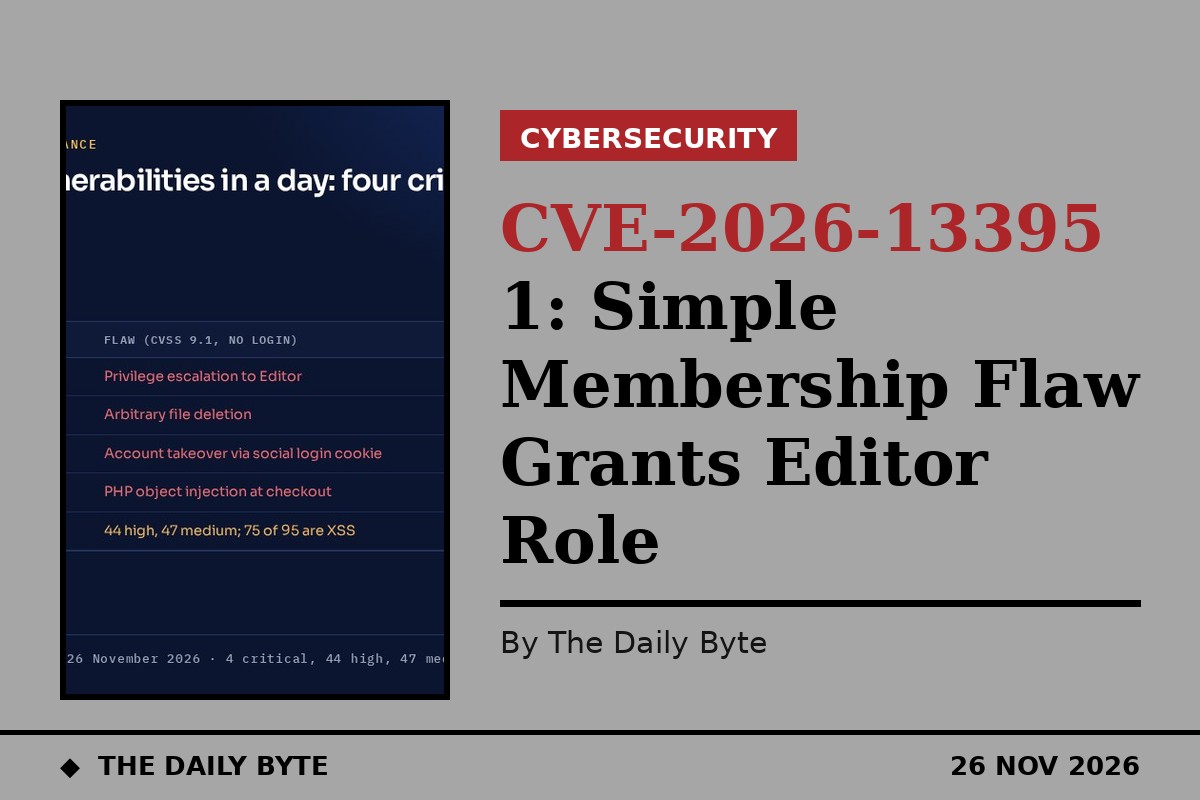
WordPress site owners running the Simple Membership plugin should update now after researchers disclosed a critical flaw that lets a visitor with no account register at any membership level and pick up the WordPress role attached to it. The vulnerability, tracked as CVE-2026-133951, carries a CVSS score of 9.1 out of 10 and was published on 26 November 2026. Wordfence, which assigned the CVE identifier, rates the flaw critical. The plugin has more than 40,000 active installations, making it the largest of four critical WordPress flaws disclosed in the same batch.
The flaw is in the secret that ties a registration form to a membership level. When the plugin is installed, it generates a site-wide signing secret called swpm_private_key_one using PHP's uniqid function, which is not a cryptographic random generator. The resulting secret is derived from the time of installation, leaving a keyspace of roughly 10 to the power of 15 candidates, or about 50 bits. An attacker can narrow that keyspace further using the public WordPress REST API date of the registration page the plugin creates automatically when it is installed.
The public registration form then hands the attacker the last piece they need. It prints a single-MD5 oracle, md5(key|level), as a value called swpm_level_hash. With the secret recovered by offline brute force against that oracle, an attacker can forge a valid hash for any configured membership level. The only check standing in the way is a non-constant-time comparison in the plugin's front-end registration code, which acts as the sole authorization gate on which level a visitor may register into.
Once the forged hash is accepted, the attacker self-registers into the chosen level and receives the WordPress role assigned to it. Where a level is mapped to an elevated role, the new account inherits it. Wordfence's description states that successful exploitation causes the attacker's own account to receive the complete editor role. An editor account can create, edit and publish posts and pages and upload media, giving an attacker a foothold to deface a site or plant further malicious content.
The fix is already available. Versions up to and including 4.8.9 are affected. Version 4.9.0, released on 23 November, signs the level on registration forms with HMAC-SHA256 and a random secret key instead of the predictable install-time secret. Version 4.9.1 followed on 26 November, so site owners should update to the latest release. Owners should also review which WordPress roles their membership levels grant, and check for recently registered accounts with elevated roles that they did not expect.
CVE-2026-133951 is one of four critical WordPress flaws, all scoring 9.1 and all triggerable without a login, that Wordfence published between 25 and 26 November 2026 as part of 95 new WordPress vulnerabilities across 77 plugins and themes. Wordfence's records do not report any of the four as exploited. The other three affect WP Job Portal, Iptanus File Upload and PDF Invoice for WooCommerce.


