CVE-2026-134931: Uniview NVR Buffer Overflow Flaw Hits 4.9
Uniview has disclosed a buffer overflow vulnerability in some of its network video recorder products, tracked as CVE-2026-134931. An authenticated attacker could exploit the flaw by sending specially crafted packets to an affected device, and successful exploitation may result in a temporary denial of service for the web service. Uniview published the security notice on 25 November 2026 and rates the flaw 4.9 on the CVSS scale, a medium severity.
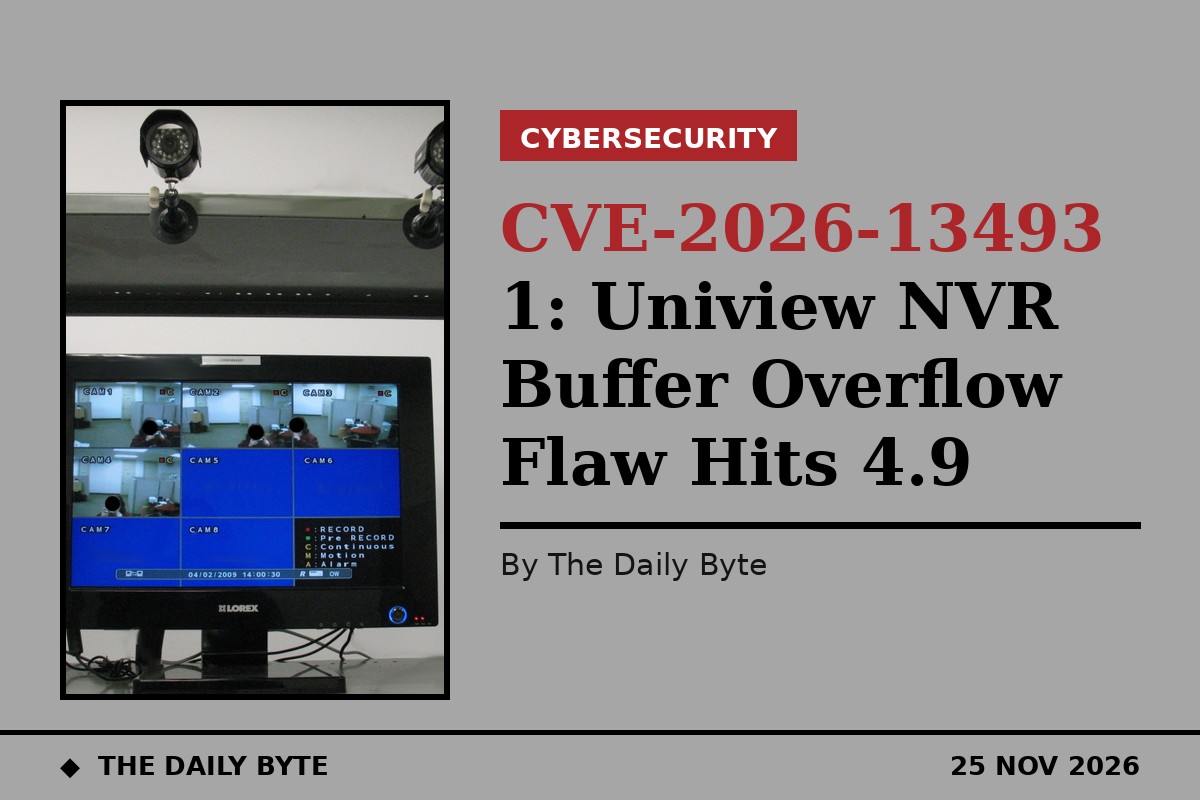
Network video recorders, known as NVRs, record video from IP security cameras over a network. They are used in offices, shops, warehouses and public buildings, so a flaw that can take their web interface offline matters even when it does not expose recorded footage. Uniview's notice, SA ID USRC-202611-01, credits Jincheng Wang, known as @winmt, from Nanjing University of Posts and Telecommunications with reporting the vulnerability.
What is affected
The flaw is a stack-based buffer overflow, classified as CWE-121. The CVSS vector is CVSS:3.1/AV:N/AC:L/PR:H/UI:N/S:U/C:N/I:N/A:H. In plain terms, the attack can be launched over the network, needs high privileges, and affects availability only: confidentiality and integrity are not rated as impacted. The attacker must already be authenticated, which limits who can attempt it, but anyone with valid high-privilege access to an exposed recorder could trigger the crash.
The affected models are the NVR301-xxS3, NVR301-xxS3-Px and NVR301-xxLS3-Px recorders running firmware earlier than NVR-B3610.36.16.260924. The fixed version is NVR-B3610.36.16.260924 and later. Uniview says the repair versions can be obtained through cloud upgrade, or by contacting the distribution channel, the service hotline or regional technical support.
What owners should do
Owners of the affected models should update to firmware NVR-B3610.36.16.260924 or later. Recorders that are reachable from the internet should be treated as the priority, since the attack is network-based, and access to the web service should be limited to trusted networks where possible.
The disclosure is a reminder that security cameras and their recorders are network devices like any other, and that their firmware needs the same attention as servers and routers. A temporary web service outage may sound minor, but on a recorder it can block live viewing and management at the moment it is needed most.
No exploitation has been reported, and the flaw is not listed in the US Cybersecurity and Infrastructure Security Agency's Known Exploited Vulnerabilities catalogue. The CVE record was published on 25 November 2026.
FAQ
What is CVE-2026-134931? It is a buffer overflow vulnerability in some Uniview NVR products. An authenticated attacker can send crafted packets that may cause a temporary web service denial of service. It is rated 4.9, medium severity.
Which models are affected? The NVR301-xxS3, NVR301-xxS3-Px and NVR301-xxLS3-Px recorders running firmware earlier than NVR-B3610.36.16.260924.
How do I fix it? Update to firmware NVR-B3610.36.16.260924 or later, via cloud upgrade or through Uniview support channels.
Source: Uniview security notice USRC-202611-01 | Source: NVD record for CVE-2026-134931