CVE-2026-136240: PDF Invoice Flaw Hits WooCommerce
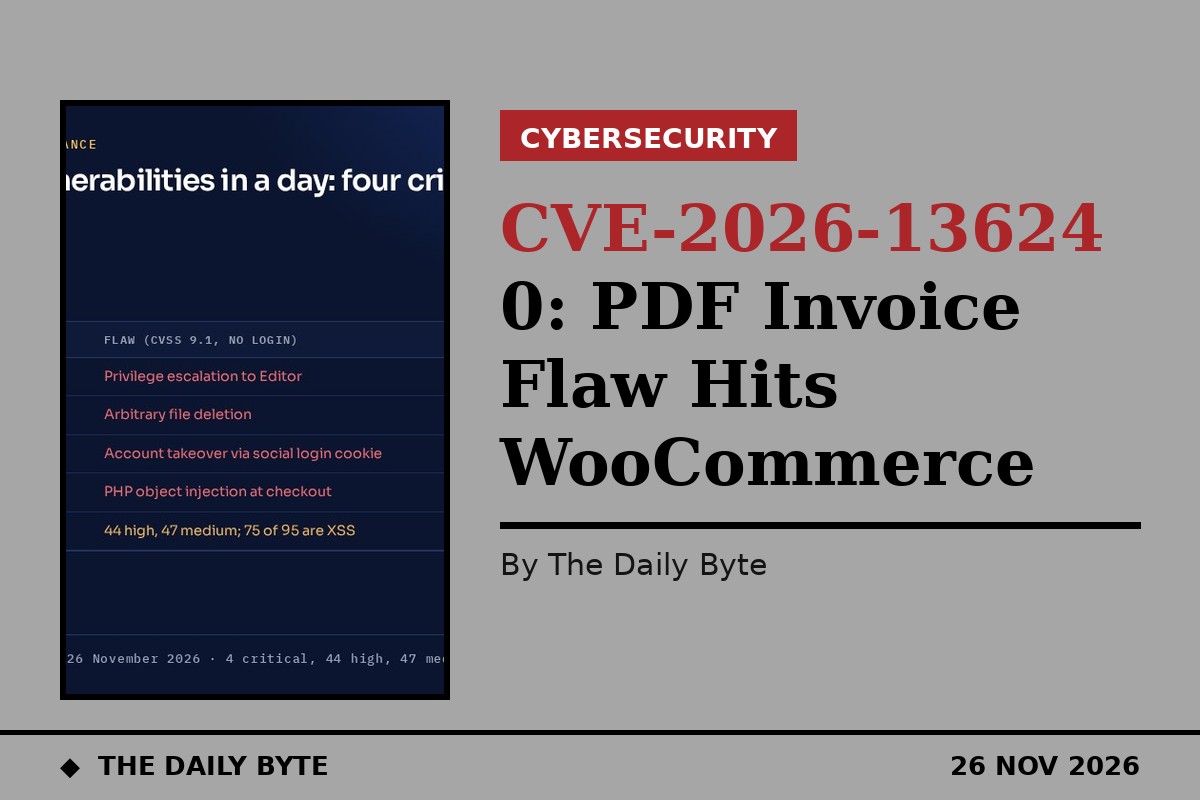
WooCommerce stores running the PDF Invoice for WooCommerce plugin should update to version 7.2.1 now, after researchers disclosed a critical flaw that lets a visitor with no account inject a malicious object through a checkout field and delete files from the site. The flaw, tracked as CVE-2026-136240, carries a severity score of 9.1 out of 10 and needs no login, no payment and no interaction from the store owner.
How the flaw works
The flaw is a PHP object injection, a weakness where untrusted data is turned back into a live PHP object inside the application. It is reached through the billing first name field in a WooCommerce Store API checkout, so any store that accepts guest orders is exposed. An attacker places an order as a guest, puts a crafted value in the first-name field, and the plugin passes it into code that rebuilds it as an object. From there, the injected object can be used to delete arbitrary files on the server.
File deletion is rated critical because deleting the site's main configuration file can return WordPress to its installation screen, where an attacker can connect the site to a database they control. The same release also fixes a second problem: any order's PDF invoice could be downloaded using a security token shared by all guests, exposing the customer's name, address, phone number and email address.
An incomplete fix for an earlier flaw
Version 7.2.1, released on 25 November, describes the new flaw as an incomplete fix of CVE-2026-109220, an earlier object-injection flaw in the same plugin that scored 9.8 and was fixed in version 7.2.0. That earlier flaw was reached through the customer note field at checkout. The new flaw uses a different field, the billing first name, which is why sites that updated to 7.2.0 are still exposed and need the 7.2.1 update.
Which versions are affected
All versions up to and including 7.2.0 are affected, and 7.2.1 is the fixed version. The plugin has more than 500 active installations, a small number compared with the other critical flaws disclosed in the same batch, but every one of them is a store holding customer and payment data. Wordfence's records do not report the flaw as exploited, but those records are only a day old and reports of exploitation usually arrive later.
What store owners should do
Update the plugin to 7.2.1 or later, and do not stop at 7.2.0. Stores should also look for signs of an attempt: a billing first name containing serialised PHP data is a sign someone tried the attack. If anything unexpected turns up, treat the site as compromised and check it before doing anything else. Updating closes the flaw, but it does not remove an account or a file added before the update.
Frequently asked questions
Do I need to update if my store does not take guest orders? The flaw is reached through the Store API checkout, so stores that require an account before checkout are less exposed, but the shared-token invoice download fixed in the same release affects guest orders too, so updating to 7.2.1 is still the safe step.
Has the flaw been used in attacks? No exploitation has been reported in the Wordfence records so far, but the flaw was only disclosed on 25 November, and exploitation reports usually come later.
Sources: WP Server Guard and VulnCrest.


