CVE-2026-136411: BusyBox flaw can read /etc/shadow
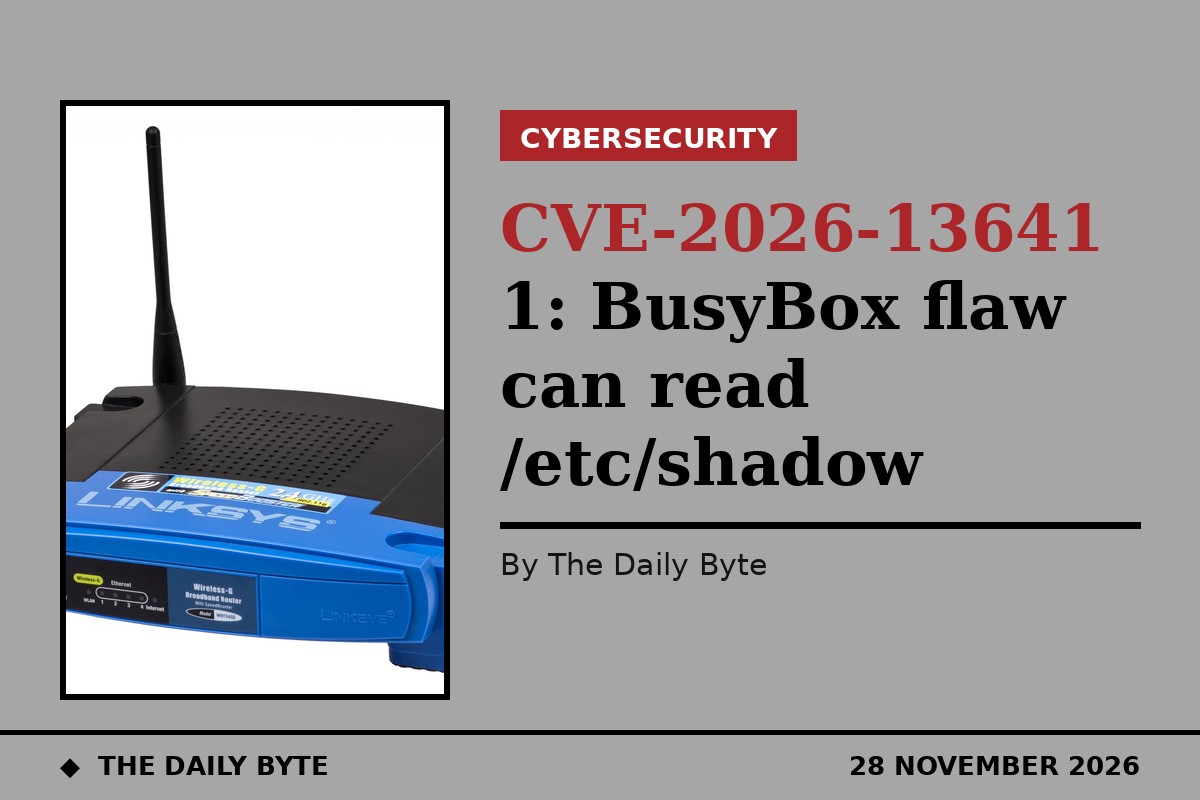
A flaw in one of the most widely used pieces of software on the planet lets anyone on the network read a device's most sensitive files, including its password database, without logging in. CVE-2026-136411 is an absolute path traversal vulnerability in the TFTP server shipped with BusyBox through version 1.38.0, and it scores 9.8 out of 10 under version 3.1 of the Common Vulnerability Scoring System, and 9.3 under version 4.0. There is no fixed release yet.
BusyBox is a single small program that bundles dozens of common Unix tools into one package, and it is baked into the firmware of routers, cameras, network storage boxes, set-top boxes and industrial equipment. When a device needs a tiny file transfer server, it often uses the one BusyBox provides, known as tftpd.
How the flaw works
The problem appears when tftpd is started without a directory argument. The directory argument tells the server which folder it is allowed to serve files from, and without it there is no fence at all. The National Vulnerability Database, quoting the numbering authority VulnCheck, describes it plainly: BusyBox through 1.38.0 contains an absolute path traversal vulnerability in tftpd that allows unauthenticated remote attackers to access files outside any intended directory when started without a DIR argument.
An attacker only needs to send a TFTP read or write request naming a file that begins with a slash, such as /etc/shadow, the file holding hashed Linux passwords. The server hands it over. Uploads work the same way, so an attacker can also overwrite files the server can write to, and because tftpd usually runs as root, that can reach root-owned scripts or scheduled tasks. TFTP has no authentication at all, so unauthenticated here simply means anyone able to send a packet to UDP port 69.
The flaw was found by Ali Ahmet Memis, who posted the bug and a patch to the BusyBox mailing list on 17 August 2026. His demonstration was two lines long: start tftpd from a folder with no directory argument, then ask it for /etc/shadow, which it serves. Uploads are enabled unless the server is started read-only, so a client can overwrite any existing file the daemon can write to and create new ones.
No fixed release yet
The maintainer, Denys Vlasenko, committed a fix on 6 November 2026. The patch strips leading slashes from requested file names and makes the directory argument work for non-root users as well. His comment in the code makes the point dryly: if someone really wants to expose their entire filesystem, starting tftpd on the root directory is the way to do it, but most people do not want that.
The catch is that the fix exists only as a commit on the master branch. The newest BusyBox release is 1.38.0, dated 13 May 2026, and the fix was committed six months later, so no released version contains it. Most BusyBox in the world is not installed by its owner: it arrives inside a device's firmware, and the owner gets a fix only when the vendor ships new firmware built from the patched source.
Why it is hard to fix
A flaw in a desktop program can be patched by its user in minutes, but a flaw in BusyBox sits underneath the vendor's firmware and the distributor's image. Each layer has to move before the device is safe, and many cheap devices never receive another firmware update at all. Until vendors rebuild, the only defence is to stop the vulnerable service from being reachable.
There is no public report of the flaw being exploited as of 24 November, and it is not listed in CISA's Known Exploited Vulnerabilities catalogue. But the working demonstration is already in the public record on the BusyBox mailing list, so that should be treated as a matter of time rather than a comfort.
What to do
First, find out whether anything you run answers TFTP on UDP port 69 using BusyBox, and whether its tftpd was started with a directory. A safe startup line ends with a directory, for example tftpd -r /srv/tftp; a vulnerable one ends at tftpd with nothing after it. Block port 69 at the boundary of any segment that does not need it: nothing on the internet should ever reach a TFTP server.
If you control the startup line, add a directory argument and the read-only flag if clients never need to upload. If it is a vendor appliance, ask the vendor in writing whether its firmware runs BusyBox tftpd without a directory, and when a build containing the November fix will ship. Anyone building their own BusyBox should apply the November commit now.


