CVE-2026-138227: D-Link R95 Flaw Lets Attackers Run Commands
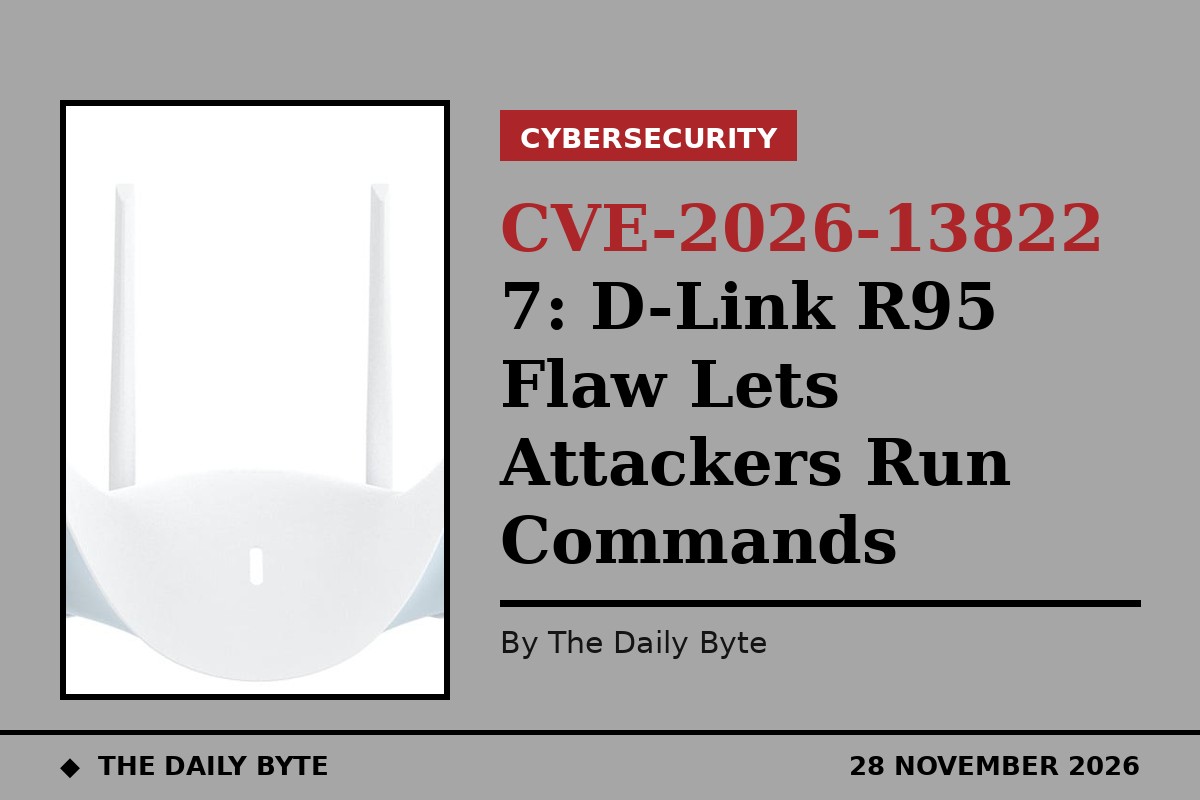
Three newly disclosed security flaws in D-Link's R95 Wi-Fi 7 router let a remote attacker run operating system commands on the device without logging in. The flaws, tracked as CVE-2026-138227, CVE-2026-138226 and CVE-2026-138225, were published on 28 November 2026, and public proof-of-concept exploit code is already available for them. No fix has been published.
All three flaws sit in the same place: the DHMAPI component of the router, in the system binary at /bin/ssi, which handles the router's SOAP interface. Each one takes a different input that is passed to the operating system shell without proper checks. CVE-2026-138227 abuses the TZLocation argument of the SetTimeSettings function, CVE-2026-138226 abuses the URI argument of SetSecureDNSSettings, and CVE-2026-138225 abuses the Hostname argument of SetQoSHostInfo. Because the injected input reaches the shell, an attacker can run arbitrary commands with the privileges of the router's system.
The affected version is the R95 running firmware 1.04B04Beta. The R95, sold as the D-Link BE9500, is a tri-band Wi-Fi 7 smart router with a combined speed of up to 9.5 gigabits per second, priced at about 254.99 US dollars or 180 pounds. The most severe of the three flaws, CVE-2026-138227, carries a VulDB meta base score of 10.0, the maximum, with a temporal score of 9.1, and it is classed as an OS command injection weakness, CWE-78. No authentication is needed to exploit it, and the attack can be launched remotely.
No fix published yet
There is no published fix or workaround for any of the three flaws. The vulnerability records state that no countermeasures are known and suggest replacing the affected device with an alternative product if no patch appears. That is a stark position for owners of a current, on-sale router, and it puts the onus on D-Link to respond.
This is not the first time the R95's DHMAPI component has been found wanting. D-Link published a support announcement in September 2026 for a similar OS command injection flaw in the same component, CVE-2026-93958, affecting the R95 running firmware BE9500_1.00.16, and that case was still listed as under investigation in October. The three new flaws show the same component is still yielding serious issues.
What R95 owners should do
Owners should first check which firmware their router is running and watch for a security advisory or patched firmware from D-Link. Until a fix is available, the router's management interface should not be reachable from the internet, and access to it should be limited to trusted devices on the home network. Remote administration, if it is switched on, should be switched off.
There is no confirmed report of these three flaws being exploited in real attacks so far. The public proof-of-concept code changes that calculation, though: once working exploit code is public, the barrier to attacking unpatched routers falls sharply. Owners who cannot patch should treat an internet-facing R95 as exposed.


