CVE-2026-97180: ASSA ABLOY Seawing Flaw Gives Root
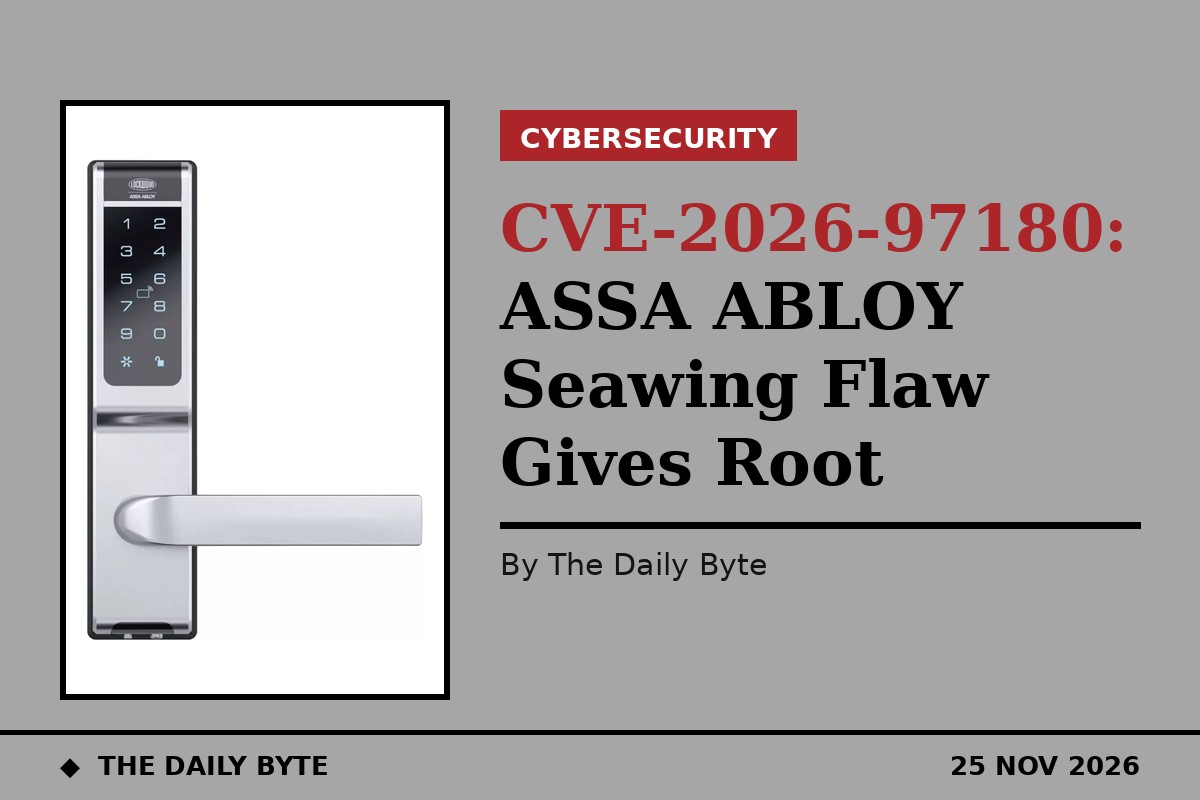
A critical flaw in an ASSA ABLOY access-control product lets an attacker run commands as the root user on the device, Poland's national computer emergency response team disclosed on 25 November 2026. The vulnerability, tracked as CVE-2026-97180, affects the WebConfig interface of the Seawing SC-1000, a controller used to manage building access. CERT Polska, which coordinated the disclosure, rates the flaw 9.4 out of 10 under the CVSS 4.0 scoring system.
A privileged attacker, one parameter, root access
The flaw is an operating-system command injection, classified as CWE-78. According to the CERT Polska advisory, the SC-1000 WebConfig interface does not properly clean user input in the server parameter of an HTTP request. A privileged attacker who can reach the device over the network can inject shell metacharacters into that parameter, and the underlying operating system then executes the injected commands as root.
Root access is the highest privilege on the device. An attacker who reaches it can run any command the system allows, which in practice means full control of the access-control controller. The advisory stresses that the attacker must already hold privileged access to the WebConfig interface: this is not a flaw that an anonymous visitor to a website can trigger. But once that bar is cleared, there is no further check standing between the attacker and complete control of the unit.
Fixed in version 1.5.14
All versions of SC-1000 WebConfig before 1.5.14 are affected, and the issue is fixed in version 1.5.14, the advisory states. The US National Vulnerability Database record for the flaw, published the same day, lists the same affected range and the same fix version, and points to the vendor's product-security advisory page for further detail.
The disclosure credits Maciej Kucab and Michal Lipinski for the responsible report. CERT Polska says it received the report and took part in coordinating the disclosure with the vendor, ASSA ABLOY Seawing.
What administrators should do
Operators running the SC-1000 should update WebConfig to version 1.5.14 or later. As with any management interface, the WebConfig service should also be kept off the open internet and restricted to trusted administrative networks, so that even a privileged account cannot be reached by an outsider. The disclosure carries no report of exploitation in the wild, and the flaw does not appear in the US Cybersecurity and Infrastructure Security Agency's catalogue of known exploited vulnerabilities. The National Vulnerability Database has not yet published its own severity assessment, so the 9.4 score cited here is CERT Polska's, as the assigning authority for the CVE record.
Access-control hardware rarely makes headlines, but it guards the doors of offices, hospitals and industrial sites. A root flaw in the controller that manages those doors is worth patching promptly, even without evidence of active attacks.
Source: CERT Polska advisory for CVE-2026-97180. The National Vulnerability Database record is at NVD CVE-2026-97180.