Cyclone Xavier weakens as Cook Islands warnings lift
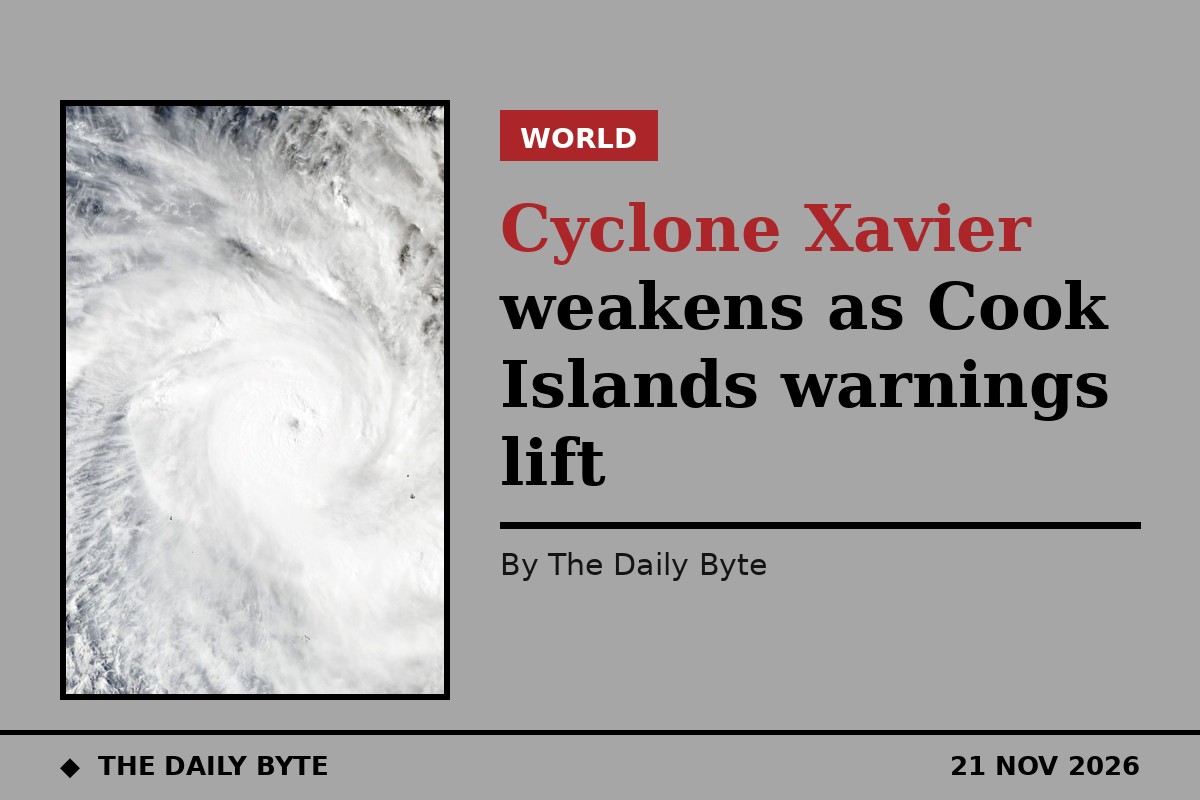
Cyclone Xavier has weakened sharply and the main warnings for the northern Cook Islands have been cancelled, bringing an end to the most intense phase of a storm that became the strongest November tropical cyclone on record east of the International Date Line.
The Fiji Meteorological Service, which runs the regional cyclone centre in Nadi, issued its final special bulletin on the storm on Friday evening. Bulletin 46 said the gale warning for Suwarrow, Pukapuka and Nassau had been cancelled, along with the tropical cyclone warning for land areas in the northern Cook Islands. A strong wind warning remained in force for Suwarrow, Pukapuka, Nassau, Manihiki and Rakahanga.
By that point Xavier was a Category 1 system, with a central pressure of 994 hectopascals, located near 11.4 degrees south and 162.9 degrees west, moving west-southwest at about 9 kilometres per hour. Forecasters said it would keep weakening and posed no risk of coastal flooding during high tides on its forecast track, although strong winds of up to 45 kilometres per hour, with gusts to 80, were still expected over Manihiki and Rakahanga.
From Category 2 to Category 5 in two days
Xavier began as a slow-moving tropical disturbance northeast of Samoa and the Cook Islands on 15 November. Within about two days it had strengthened from a Category 2 storm to a Category 5 system, the highest level on the regional scale, with sustained winds of about 220 kilometres per hour and gusts reaching 315 kilometres per hour.
NASA's Earth Observatory, which published a satellite image of the storm as its image of the day on 20 November, said Xavier was one of the most intense November tropical cyclones the region has seen in decades. Colorado State University hurricane expert Phil Klotzbach noted it was the strongest November tropical cyclone on record east of the International Date Line.
The storm thrived in warm seas of about 29 degrees Celsius with very little wind shear, and it developed on the southwestern edge of a vast tongue of warm water linked to an El Nino pattern that has been present in the region since June. Research shows that storm activity in the region typically shifts northeast during El Nino years, and that El Nino tends to fuel storms that strengthen unusually fast.
Damage on Manihiki, emergency on Nassau
Although Xavier's centre stayed offshore and never made a direct landfall, it still caused disruption across the remote northern Cook Islands. On Manihiki, waves damaged the wharf and coastal areas, and some homes suffered damage to walls and roofing. Residents said the worst had passed by 19 November, but the danger from the sea remained.
Power was the main concern on Manihiki. The island's diesel generator has been out of service for more than a year, leaving households dependent on limited solar power and private generators, with some homes getting electricity for only four or five hours at a time. Food supplies also ran low as imported goods were used up.
On Pukapuka, more than 300 people moved into shelters as the storm passed nearby, and schools were closed while residents prepared to take cover. Nassau, a small and isolated island with limited emergency capacity, was placed under a state of emergency by Cook Islands Prime Minister Mark Brown so that authorities could coordinate preparations and arrange evacuations if conditions worsened. No casualties or damage had been reported on Nassau by late Thursday, and no casualties were reported anywhere in the northern group.
A long season ahead
Emergency Management Cook Islands had urged residents across the northern group to stay in safe shelter and keep away from coastal areas while the storm passed. The low-lying atolls of the northern Cook Islands are spread far apart across the ocean, making warnings, communications and relief supplies difficult to deliver at the best of times.
Xavier was only the second named storm of the South Pacific season, after the short-lived Wati in October. A seasonal outlook from the Fiji Meteorological Service projects between 11 and 15 named tropical cyclones this season, with the greatest risk east of the International Date Line. Activity in the basin typically peaks in February.
For the northern Cook Islands, the immediate danger has now passed, but the clean-up and the repair of damaged wharves and coastal infrastructure are only beginning, and islanders will be watching the next disturbance in the Pacific with the fresh memory of how quickly Xavier grew.


