Two critical flaws hit D-Link DIR-600L routers
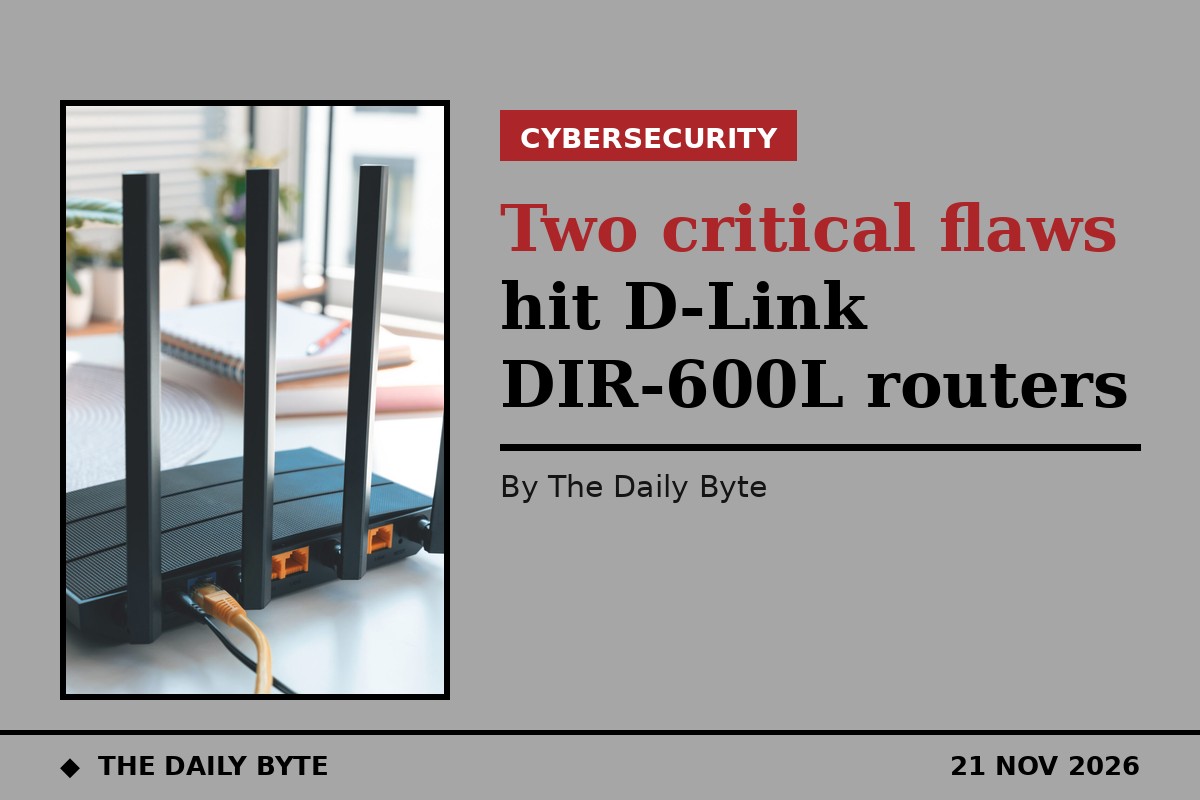
Two separate critical flaws have been found in the same home router, and both carry the maximum severity score. The D-Link DIR-600L, running firmware version 2.17b02, is affected by an operating-system command injection flaw and a stack-based buffer overflow, tracked as CVE-2026-133493 and CVE-2026-133993. Both score 10.0, and a public exploit is available for the first of the two.
The command injection flaw, CVE-2026-133493, sits in the router's GENA handler, the part of the web interface that processes event notifications. A flaw in the genacgi_main function of the gena.cgi script lets a remote attacker run operating-system commands on the router without logging in. The attack needs no user interaction and no privileges, and the CVE record was published on 20 November 2026.
A second flaw in the same component
The second flaw, CVE-2026-133993, was published in the US National Vulnerability Database on 21 November. It affects the same file, gena.cgi, in the GENA subscription handler, where the function FUN_0040efb0 fails to handle the service argument safely. Manipulating that argument can trigger a stack-based buffer overflow, which can crash the device or, in the worst case, let an attacker take control of it. It also carries a score of 10.0.
The two flaws share the same root problem: a small piece of the router's web interface that was never built to treat outside input as hostile. GENA is a protocol for event notifications on home networks, and the router's implementation of it exposes functions that outside traffic can reach. Because the flaws are in the web interface rather than behind a login screen, any attacker who can reach the router over the network can try them.
Why this matters
A router is the gateway for every device in a home or small office, so taking it over is a powerful position. An attacker with command execution on the router can change its settings, redirect traffic, watch unencrypted connections and use the device as a stepping stone to other machines on the network. The DIR-600L is an older model, and many of these routers are still in service long after their owners stopped thinking about them.
Neither flaw has been listed in the CISA catalogue of vulnerabilities known to be exploited, so there is no confirmed evidence of attacks in the wild. That is little comfort: the public exploit for CVE-2026-133493 lowers the skill needed to try it, and the second flaw arrived a day later in the same component, which suggests the code has not been closely reviewed.
What to do
No fixed firmware version is listed in the CVE record for either flaw, so owners should check D-Link's support pages for their model and apply any update that appears. Until a fix is available, the safest step is to take the router off the network, or put it behind a firewall that blocks outside access to its web interface, and consider replacing it with a currently supported model. Owners who keep using the device should watch for unexplained setting changes, new admin accounts, or traffic they cannot explain.
Sources
TheHackerWire: CVE-2026-133493, command injection in D-Link DIR-600L
StackFlag: CVE-2026-133493, D-Link DIR-600L allows remote command execution
Blacknote Intelligence: live threat feed, NVD entry for CVE-2026-133993, 21 November 2026