DA Holds Coalition Talks With MK Party in South Africa
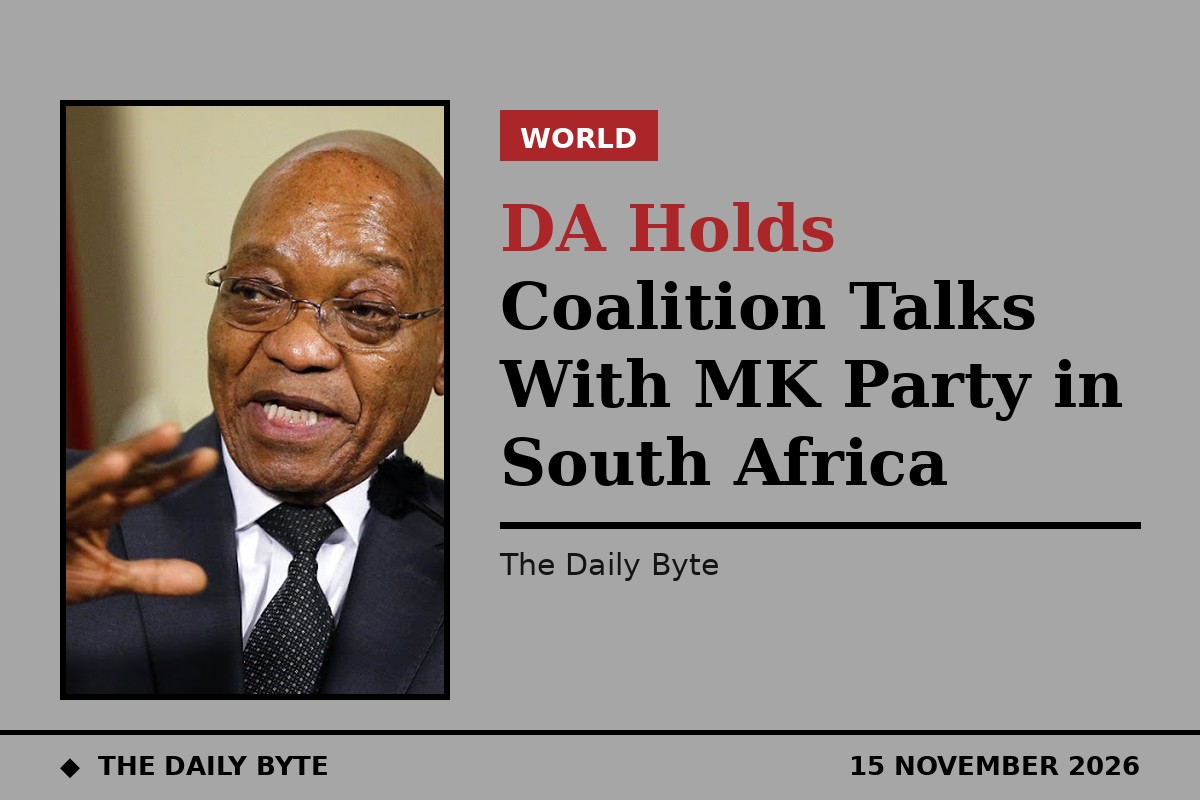
South Africa's Democratic Alliance (DA) has opened coalition talks with former president Jacob Zuma's uMkhonto weSizwe (MK) Party, in a striking break with its long-standing refusal to work with the party.
The two parties met in Midrand, north of Johannesburg, on Saturday 14 November to discuss possible cooperation in municipalities left without a clear winner by the local government elections held on 4 November. No agreement has been announced, and both sides have stressed that the discussions are at an early stage.
How the talks began
DA leader Geordin Hill-Lewis wrote to Zuma inviting discussions on coalitions, and the MK Party accepted. Advocate Dali Mpofu, the MK Party's national negotiator, confirmed the approach in an interview with SABC News earlier in the week, saying: "I can confirm that the DA has reached out. Their leader, Geordin Hill-Lewis, wrote a letter to President Zuma inviting discussions on coalitions."
After Saturday's talks in Waterfall, Johannesburg, MK first deputy president Duduzane Zuma said the party was willing to work with any political formation. The MK Party has said it has no preconditions and will speak to any party willing to talk to it.
A sharp change of position
The talks mark a significant shift for the DA, which had repeatedly said it would not form coalitions with the MK Party or the Economic Freedom Fighters (EFF), including in Johannesburg and KwaZulu-Natal. The DA has said one reason it joined the government of national unity was to keep the EFF and MK Party out of national government.
The DA has also approached the EFF about possible cooperation, and the EFF confirmed it had received a letter from the party. The MK Party is holding separate discussions with the African National Congress (ANC) and the EFF as well.
Why the talks matter now
The 4 November local elections left more than 130 municipalities without a party holding an outright majority. Councils have a 14-day window to elect mayors, speakers and executive committees, a deadline expected to fall around 25 November, so the bargaining is moving fast.
On the current seat counts, a DA and MK deal would hold a majority in eThekwini, where the MK Party won 86 seats and the DA 57, giving them 143 of the council's 223 seats, and in Msunduzi. In Johannesburg, Tshwane and Ekurhuleni, however, the two parties together would still fall about 30 seats short of a majority, so any deal there would need further partners.
ANC sets its own course
The ANC's National Executive Committee has centralised its coalition strategy and said it will treat a partnership with the DA only as a last resort, while seeking partners aligned to its manifesto. The ANC has said it will announce its position on coalition talks on Tuesday 17 November.
For now, the negotiations remain fluid. Meetings, invitations and exploratory talks do not amount to signed coalition agreements, and no party has yet shown it can assemble a stable governing majority in the hung metros. What happens in the coming days will decide who runs some of South Africa's biggest cities and whether basic services improve for the residents who depend on them.


