Darya Khan Cannibal Brothers Set for Release in 2026: Why the Case Still Exposes Gaps in Pakistan's Law
Introduction
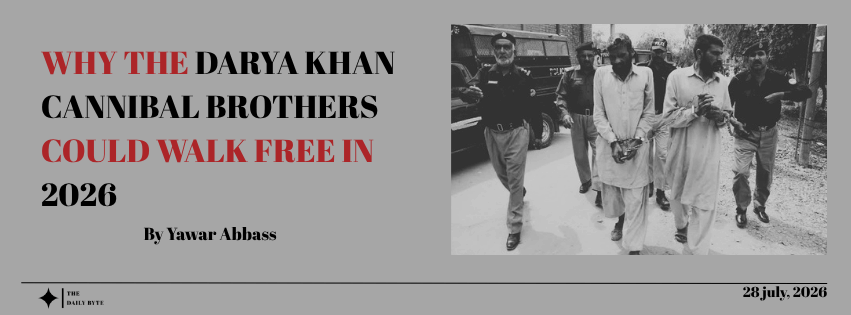
The expected release of the Darya Khan cannibal brothers, Mohammad Arif Ali and Mohammad Farman Ali, in mid-2026 has once again brought one of Pakistan's most disturbing criminal cases back into public discussion. After serving more than 12 years in prison, the brothers are due to complete their sentence, raising concerns about public safety, legal loopholes, and Pakistan's ability to manage high-risk offenders.
The case also highlights a long-standing gap in Pakistan's criminal justice system: there is still no specific law that criminalizes cannibalism.
Who Are the Darya Khan Cannibal Brothers?
The brothers, from Khwawar Kalan village near Darya Khan in Bhakkar district, were first arrested in 2011 after police found the body of a recently buried woman inside their home. Investigators said they had dug up the grave, removed part of the body, and cooked it.
During questioning, the brothers reportedly admitted to exhuming and consuming parts of several bodies from a nearby graveyard.
Since the Pakistan Penal Code had no specific provision covering cannibalism, they were charged under laws related to grave desecration and public order, receiving only two years in prison.
Second Arrest After Release
The brothers were released in 2013, but within months they were arrested again.
In April 2014, police raided their house after neighbors reported the smell of decomposing flesh. Officers recovered the remains of an infant, leading to another arrest.
This time, prosecutors used the Anti-Terrorism Act, arguing that the crimes had created widespread fear and panic in the community. An Anti-Terrorism Court sentenced the brothers to 11 years and four months of rigorous imprisonment, along with a fine.
Why the Case Changed Pakistan's Legal Debate
The Darya Khan case exposed a major weakness in Pakistan's criminal laws.
Because cannibalism is not specifically listed as an offence in the Pakistan Penal Code, prosecutors had to rely on laws intended for grave desecration and terrorism instead.
Several lawmakers later proposed amendments to criminalize cannibalism and increase punishments for grave desecration. However, despite committee approval, none of the proposed reforms became law.
Concerns Ahead of Their Release
With their sentence ending in 2026, authorities cannot legally keep the brothers in prison unless another lawful basis exists.
Legal experts and policymakers have suggested measures such as:
Restricting where they can live.
Mandatory police monitoring.
Regular psychiatric evaluations.
Ongoing mental health treatment.
Officials are also concerned about possible public backlash if the brothers return to their hometown, where memories of the case remain strong.
Why This Story Matters
Beyond its shocking nature, the Darya Khan case continues to raise important questions about Pakistan's criminal justice system.
The debate is no longer only about punishment. It is also about whether the country needs stronger laws, better forensic psychiatric facilities, and effective post-release monitoring for offenders who may continue to pose a serious risk to society.