DAX tops 27,000 for first time on Siemens earnings
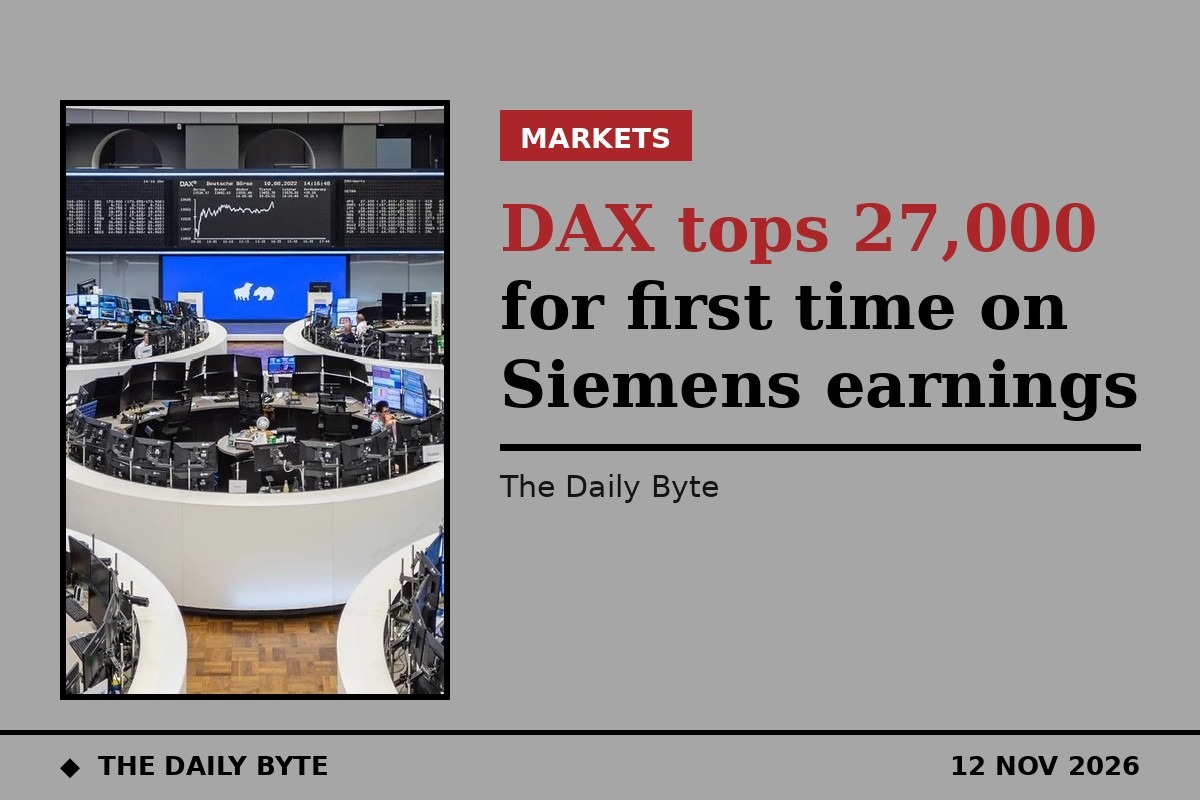
Germany's DAX index climbed above 27,000 points for the first time on Thursday, 12 November 2026, reaching an intraday high of 27,001.67 points in morning trading. The milestone capped a run of record sessions for Europe's largest economy, driven by strong corporate results and easing oil prices.
The index did not hold the round-number level into the close, but still finished the day higher. Germany's DAX climbed 0.41% on Thursday, according to dpa-AFX, after closing at a record 26,662.77 points on Wednesday, when it had gained 1.2%. France's CAC 40 gained 0.34% and Switzerland's SMI closed up 0.63%, while the pan-European STOXX 600 edged up 0.14% to 664.01.
Siemens powers the rally
Siemens was the main engine of the DAX's rise. The German industrial group reported record fourth-quarter orders of 34.8 billion euros, up 58% on a year earlier, with revenue up 11% to 23.7 billion euros. Profit in its Industrial Business rose 22% to a record 3.9 billion euros, and net income climbed 32% to 2.4 billion euros.
Siemens shares traded at 286.03 euros at 11:51 CET on Thursday, up 3.26% on Wednesday's Xetra close of 277.00 euros. For the full 2026 fiscal year, Siemens reported record orders of 108.2 billion euros and revenue of 83.4 billion euros, with free cash flow of a record 12.1 billion euros. The board proposed raising the dividend to 5.50 euros per share, from 5.35 euros a year earlier.
The company also set out an upbeat outlook for fiscal 2027, guiding to comparable revenue growth of 9% to 11%. That combination of a record order book and rising guidance gave investors confidence that the industrial recovery has further to run.
A broad European advance
The gains were not confined to Siemens. Online retailer Zalando gained about 2.5%, insurer Munich Re climbed 3.2% on stronger than expected third-quarter results, and Allianz advanced almost 2% after lifting its full-year earnings outlook. In London, the FTSE 100 ended 0.26% higher.
Not every German stock joined the rally. Carmakers and some industrial names ended lower, and GEA Group tumbled 4.7% after announcing a change in leadership. But the weight of positive earnings news was enough to carry the index to its landmark level.
What drove the mood
Three forces came together on Thursday. First, the earnings season has been stronger than expected, with companies in the STOXX 600 on track for quarterly profit growth of about 25%, the strongest in four years, according to LSEG data. Second, falling oil prices eased cost and inflation worries for European businesses and households. Third, investors continued to rotate towards European shares after a strong run for US technology stocks showed signs of strain.
The DAX has now set a series of records in November, and the 27,000 mark gives traders a new reference point. Whether the index can hold above it will depend on the next round of company results and on whether energy prices stay under control. This article reports market data and is not financial advice.