De Wever faces king's deadline in Belgium budget row
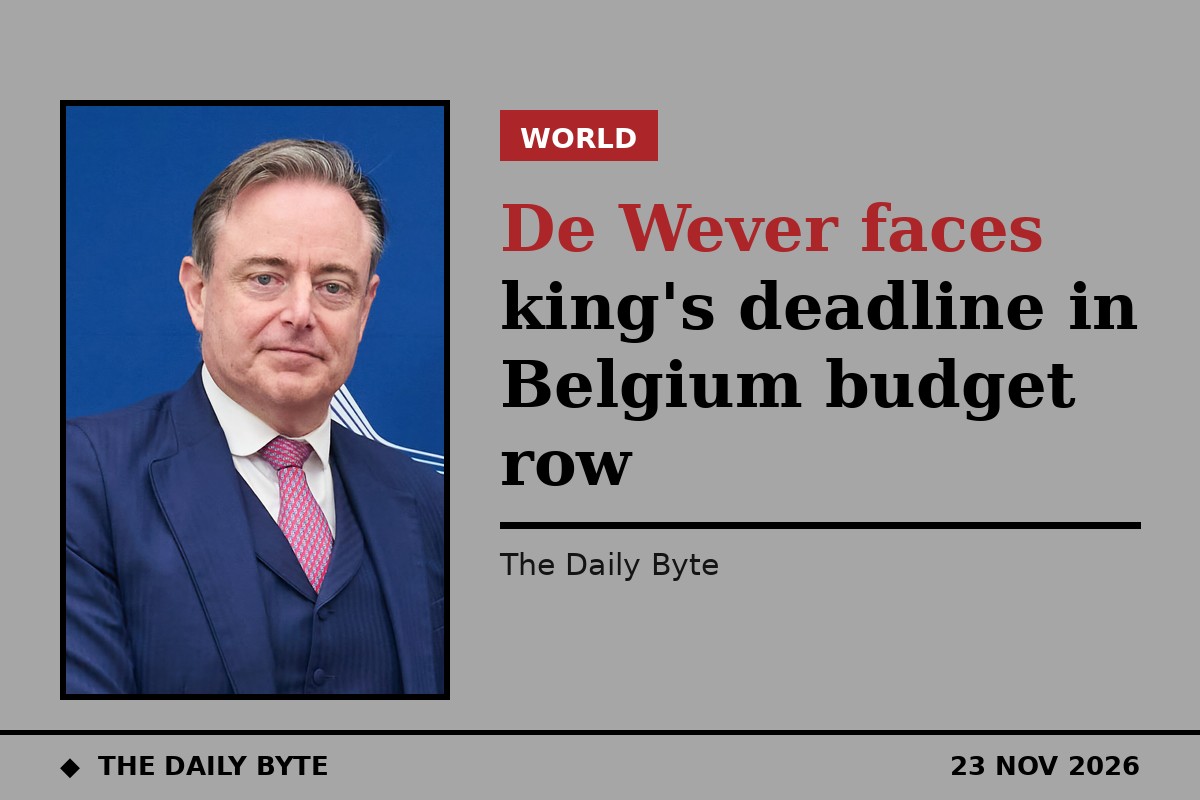
Belgian Prime Minister Bart De Wever said on Sunday 22 November 2026 that he will keep leading the government despite stalled budget talks, hours before he is due to report to King Philippe on Monday 23 November 2026 on whether his five-party coalition can agree a budget.
De Wever’s report to the palace is the deadline the king set a week ago, when he gave the prime minister until 23 November to reach a deal and avoid what the palace described as a damaging political and budgetary crisis for the country.
A deadline set by the king
De Wever offered his resignation on 2 November 2026 after an earlier round of budget negotiations collapsed. King Philippe refused to accept it four days later and told him to resume talks, setting an initial deadline of 16 November. When De Wever arrived at the Royal Palace on 16 November without an agreement, the king granted him one more week.
Talks broke down again late on Sunday 15 November. Four of the five coalition parties backed the broad outline of De Wever’s draft plan as a basis for further discussion, but the Flemish social democratic party Vooruit withheld its support. On Friday 20 November, De Wever and Vooruit leader Conner Rousseau held a bilateral meeting lasting about three hours, according to the Belga news agency. Details of their discussion were not disclosed, and no new meeting of the core cabinet had been convened as of Saturday 21 November.
If the coalition fails to produce an agreement by Monday’s deadline, the decision rests with King Philippe, who may either grant the prime minister a further extension or accept his resignation.
Where the talks stand
The coalition has been negotiating for months over a multi-year fiscal adjustment package aimed at saving about €10 billion by 2029, in order to reduce Belgium’s high budget deficit and comply with European Union fiscal rules. The main point of contention is taxation. Vooruit has argued that the burden of the adjustment is unfairly distributed and has called for a broader tax on millionaires’ financial wealth, including registered shares and cryptocurrency assets, seeking €1.1 billion in revenue from the wealthiest households, down from an earlier demand of €1.5 billion.
De Wever had earlier withdrawn a proposal for an across-the-board increase in the VAT rate, which would have raised about €4 billion, after a coalition party ruled it out altogether.
Why the budget matters
The European Commission’s spring economic forecast projected a budget deficit equivalent to 5.2 per cent of gross domestic product in 2026, rising to 5.4 per cent in 2027. Public debt, which stood at 107.9 per cent of GDP at the end of 2025, was forecast to reach 112.8 per cent in 2027. Belgium is already subject to the EU’s excessive deficit procedure, and forecasts compiled by the Federal Planning Bureau generally anticipate economic growth of less than one per cent in 2026.
Belgium has considerable experience of prolonged political negotiations: the country went 541 days without a fully functioning elected federal government after its 2010 election. It also began 2026 under a three-month emergency provisional budget after the preceding budget agreement was only finalised in late November 2025.
The deadline falls on the same day as a nationwide union demonstration in Brussels against the government’s austerity measures, which has also halted regular flights in Belgium between 07:00 and 21:00 as air traffic controllers join the protest.
Frequently asked questions
What happens if De Wever reports no deal on 23 November? King Philippe may grant him a further extension to keep negotiating, or accept his resignation, which De Wever first offered on 2 November 2026.
What is the €10 billion figure? It is the amount of recurring savings and extra revenue the coalition is trying to agree by 2029 to bring Belgium’s budget deficit down in line with EU fiscal rules.
Who is in the coalition? Five parties: De Wever’s Flemish nationalist N-VA, the French-speaking liberal Reformist Movement (MR), the Flemish Christian Democrats (CD&V), the centrist Les Engagés and the Flemish socialist party Vooruit.
Sources: Brussels Morning, EU Today and Pollar.


