FDA clears DeepHealth AI to predict breast cancer risk
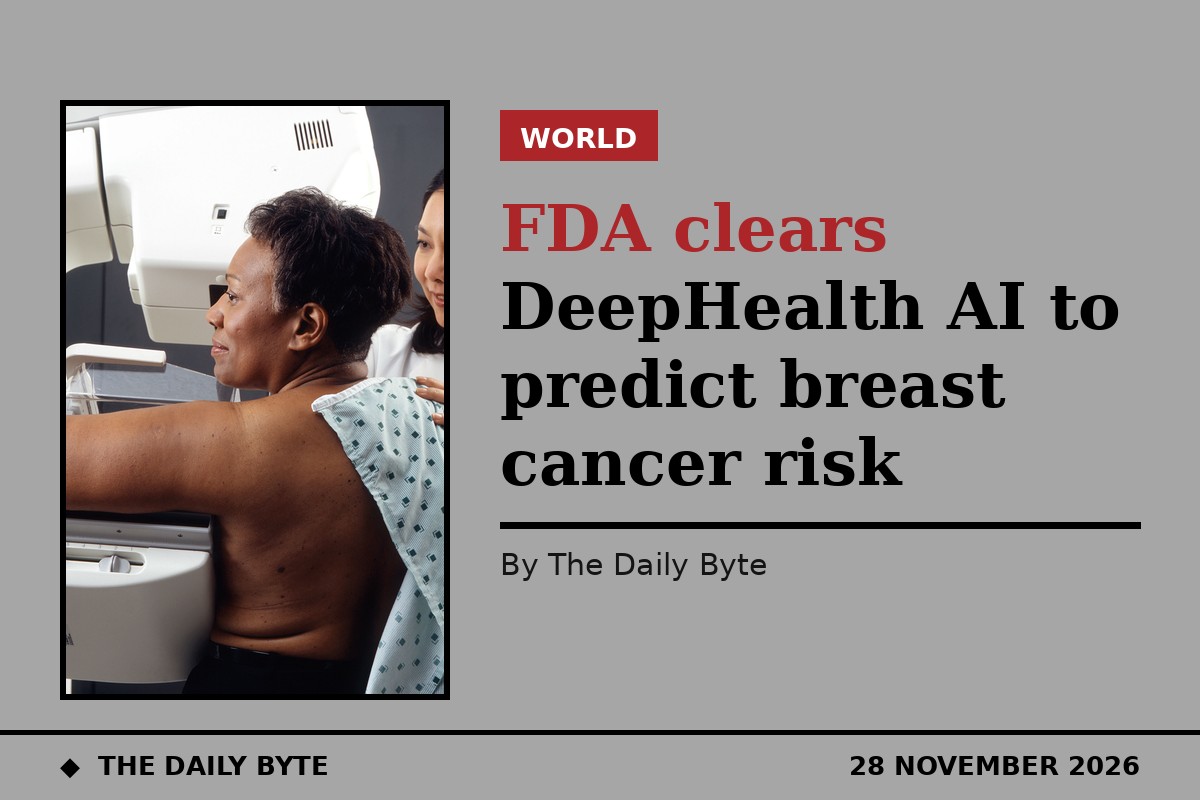
DeepHealth has received clearance from the US Food and Drug Administration for Mammo Risk, software that estimates a woman's future breast cancer risk from a routine 3D mammogram. The company, a subsidiary of the imaging operator RadNet, announced the clearance on 24 November 2026 and says it is the first FDA-cleared image-based breast cancer risk prediction tool for 3D mammography, including combined 3D and 2D imaging workflows.
Mammo Risk assesses the risk of developing breast cancer over three, four and five years. It works from mammogram images that have already been taken, so patients need no additional scan and no extensive clinical questionnaire. The software uses AI trained on 220,000 imaging studies to derive risk insights directly from routine mammograms, rather than relying on family history and other questionnaire answers as traditional risk models do.
How the tool was tested
The clearance rests on an independent multicentre study of more than 65,000 screening mammograms across 10 clinical sites in the United States. DeepHealth says the tool showed strong predictive performance in that study, with consistent results across subgroups including Black women and women with dense breasts, groups for whom traditional models have been less accurate and outcomes have historically been poorer. The FDA clearance is recorded as 510(k) K262709, decided on 23 November 2026.
The company says 3D mammography is now the predominant screening method in the United States, available at more than 90% of mammography facilities. An estimated 321,910 women in the US will be diagnosed with invasive breast cancer in 2026, according to the American Cancer Society, and five-year relative survival approaches 100% when cancer is found early, compared with 34% once it has spread to distant parts of the body, according to the National Cancer Institute. The aim is to identify patients who show no apparent signs of cancer but carry an elevated risk, so screening can be personalised, including consideration of supplemental imaging.
What happens next
Mammo Risk builds on earlier DeepHealth technology that predicted risk up to two years ahead and is CE-marked in Europe. A peer-reviewed study led by researchers at the Karolinska Institute and published in Science Translational Medicine, covering more than 154,000 women undergoing 3D mammography, found the earlier technology had an estimated 2.4-fold sensitivity compared with the Tyrer-Cuzick risk model when considering supplemental screening for the 12% of women at highest risk. The newly cleared version extends the prediction horizon to five years.
The software is now commercially available to healthcare providers in the US as part of DeepHealth's Radiology AI Suite, and the American Medical Association has established a Category III CPT code, effective 1 January 2027, to track use of image-based breast cancer risk assessment. DeepHealth will showcase Mammo Risk at RSNA 2026, the radiology meeting in Chicago, from 29 November to 3 December.


