Delhi Air Stays Very Poor as 17 Stations Turn Severe
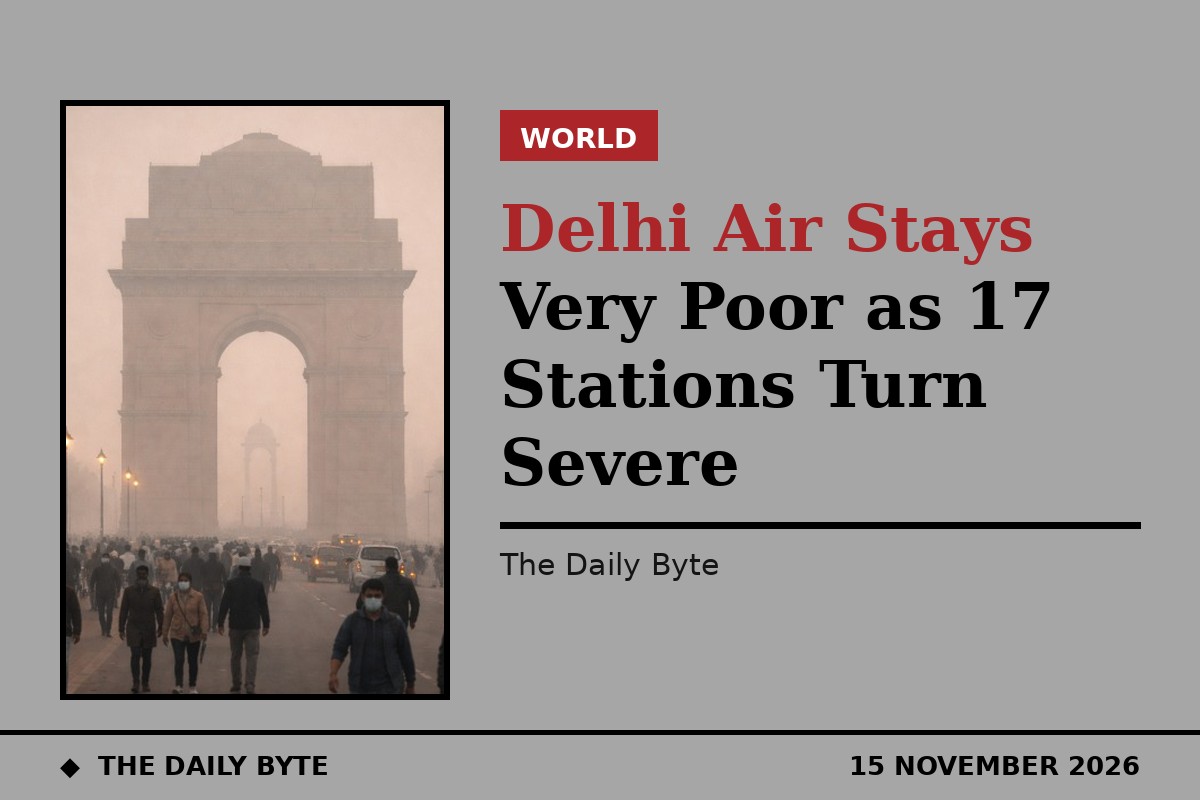
Delhi’s air quality stayed in the “very poor” range on Sunday, with smog covering large parts of the national capital and 17 of the city’s monitoring stations recording severe pollution.
Data from the Central Pollution Control Board (CPCB) put Delhi’s air quality index (AQI) at 352 on Sunday morning, in the very poor category. Several stations recorded far worse readings: IIT Delhi stood at 425, ITO at 415, the Commonwealth Sports Complex at 403, Delhi University’s North Campus at 402, Pusa at 402 and Burari Crossing at 400. Under the CPCB’s classification, readings between 301 and 400 are very poor and readings between 401 and 500 are severe.
The 24-hour average AQI for Saturday was 367, marginally lower than Friday’s 373, but 17 of the city’s 59 monitoring stations were in the severe category on Saturday. The slight improvement did little to ease concern, with a grey haze hanging over the city through the weekend.
Restrictions remain in force
The Commission for Air Quality Management (CAQM) invoked Stage III of the Graded Response Action Plan (GRAP) across Delhi-NCR on 6 November as pollution levels worsened, and the restrictions remain in force. GRAP Stage III is the set of emergency measures triggered when air quality deteriorates into the severe range.
The India Meteorological Department has forecast the possibility of very light rain at isolated places on Sunday, but experts say it is unlikely to bring real relief. The Air Quality Early Warning System forecasts that air quality will remain in the very poor range until at least Tuesday.
So far in November, Delhi has recorded 12 very poor days and two poor days, underlining how persistent the current pollution episode has become. Vehicles, stubble burning and firecracker emissions are among the main contributors, alongside unfavourable weather that traps pollutants close to the ground.
Health advice
At very poor and severe AQI levels, health authorities advise people to reduce prolonged outdoor exertion, and those with respiratory or heart conditions to take particular care. Masks were visible across the capital on Sunday as residents went about their day under the smog.
Delhi faces severe air pollution almost every winter, when falling temperatures, calm winds and crop burning in neighbouring states combine with the city’s own emissions. The current episode follows the same pattern, and with no significant rain expected, residents face several more days of poor air before conditions improve.
Sources: New Kerala and The Times of India via 7Globe, both reporting CPCB data.


