Delhi AQI stays 'very poor' at 365 as rain nears
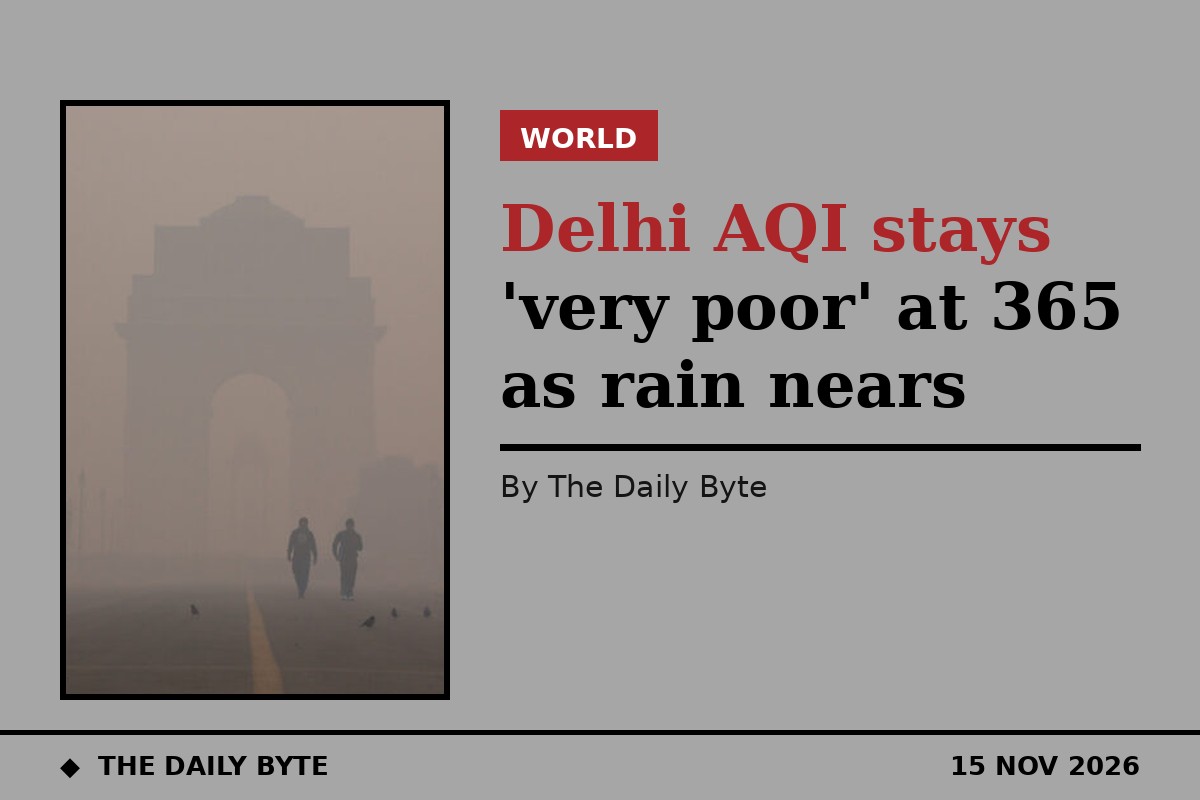
Delhi's air quality remained in the 'very poor' category on Sunday morning, with the Central Pollution Control Board (CPCB) recording an overall air quality index (AQI) of 365, as the capital marked the first day of Arghya during the Chhath Puja festival.
The reading followed a 24-hour average AQI of 383 on Saturday. Of the 59 monitoring stations that reported data on Saturday, 17 registered readings in the 'severe' category and a further 38 recorded 'very poor' air, leaving only a handful of stations outside the two worst bands.
Delhi's air has stayed stubbornly poor for more than a week. The city's AQI stood at 373 on Friday, up from 350 the day before, and had climbed back to 319 on Thursday after a brief dip to 299, inside the 'poor' band, on Tuesday. The India Meteorological Department (IMD) has forecast very light rain or drizzle at isolated places in Delhi on Sunday, raising hopes of at least temporary relief.
Rain may bring a slight improvement
A fresh western disturbance is expected to affect northwest India from Sunday, 15 November, according to the IMD. The department's forecast for Delhi points to very light rain or drizzle towards the morning and forenoon at isolated places, followed by mainly clear skies.
The Air Quality Early Warning System has also predicted lower concentrations of PM2.5 and PM10, the fine particulate pollutants, over the next 48 hours. Forecasters caution, however, that any improvement will depend on how much rain actually falls, and the Indian Institute of Tropical Meteorology expects Delhi's air quality to remain in the 'very poor' category over the coming days.
On Saturday, PM10 was the dominant pollutant in the capital, and transport accounted for the largest share of Delhi's pollution at 20.5%, according to the Decision Support System. Night temperatures are forecast to fall by 3 to 5 degrees Celsius between 16 and 19 November, which can trap pollutants closer to the ground when winds are calm.
Stage-III curbs remain in force
The Commission for Air Quality Management (CAQM) invoked Stage-III measures under the Graded Response Action Plan (GRAP) across Delhi and the National Capital Region on 6 November, after the city's AQI reached 382. The measures include restrictions on construction and demolition activities and additional curbs on specified older vehicles, alongside the Stage-I and Stage-II actions already in force.
Under India's national AQI scale, readings of 301 to 400 are classed as 'very poor' and 401 to 450 as 'severe'. At 'very poor' levels, health guidance warns that prolonged exposure can cause respiratory illness, with children, older people, pregnant women and people with existing breathing conditions most at risk.
Residents are advised to follow official advisories, limit outdoor exertion when pollution peaks, and watch for updated forecasts from the IMD and the CPCB.
Sources: The Daily Jagran, reporting CPCB and IMD figures; News eSamay, reporting the IMD forecast.


